
Excluding Stablecoins, RWA Market Cap Surpasses $20 Billion, Reaching All-Time High
 Aime Summary
The market value of real-world assets (RWAs) excluding stablecoins has surpassed $20 billion, reaching an all-time high, according to data from Securitize. This marks a significant milestone in the tokenization of traditional financial instruments and physical assets. Tokenized U.S. Treasury debt alone accounts for more than $8.87 billion of the total RWA market value, driven by products such as BlackRock's BUIDL and Franklin Templeton's BENJI.
The surge in RWA tokenization is attributed to growing investor interest in digitizing traditional assets for greater liquidity and accessibility. BlackRock's BUILD Fund, for instance, now holds $1.73 billion in tokenized assets. Several industry executives have predicted continued adoption of stablecoins and tokenized RWAs in 2026, emphasizing improved infrastructure and standardization.
Market participants are also seeing tokenized assets such as popular U.S. stocks including Apple and Tesla enter the blockchain ecosystem. These tokenized securities are backed by actual shares held in custody by platforms like Backed Finance, with total xStocks trading volume reaching over $457 million since June 2025.
Why Did This Happen?
Traditional finance is plagued by inefficiencies, opacity, and centralization, which have led to growing demand for blockchain-based solutions. Experts say these challenges, along with the scale of real-world financial markets—$130 trillion in fixed income— make tokenization a compelling value proposition for institutions. 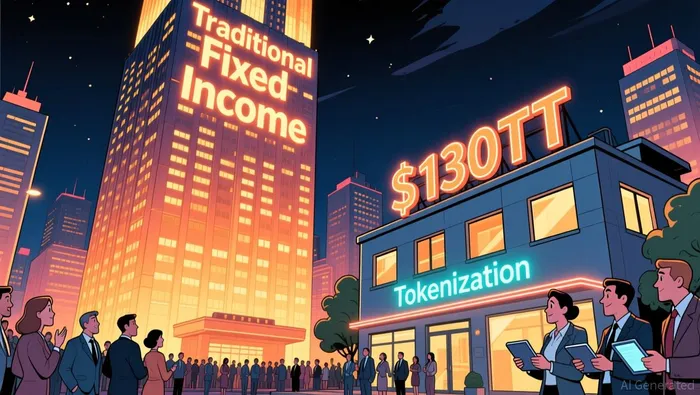 The infrastructure to reduce adoption barriers, such as standardized frameworks and trust/insurance, is also improving.
One key driver is the ability to tokenize assets for faster settlement and greater transparency. In 2026, institutions are expected to demand systems where on-chain assets remain auditable, with risk grades, metadata, accountability, and penalties clearly defined. These systems will allow sensitive information to be disclosed only to authorized parties such as regulators and auditors according to analysts.
How Did Markets React?
The institutional adoption of RWA tokenization is accelerating, with platforms like Centrifuge selecting partners such as Chronicle as their primary oracle provider. Chronicle's Proof of Asset framework independently verifies the reserve composition and holdings-level data of tokenized assets, offering the transparency and integrity needed for large-scale adoption.
This partnership underscores the importance of trusted data infrastructure in building institutional confidence in tokenized assets. For example, the $1 billion deployment into the Janus Henderson Anemoy JAAA Fund by Grove marks a milestone in institutional-scale tokenization. The fund is fully tokenized and secured by AAA-rated CLO tranches, demonstrating the scalability of RWA tokenization.
What Are Analysts Watching?
Despite the progress, challenges remain. Experts highlight unresolved issues around the legal enforceability of on-chain contracts, liquidity, and privacy. In 2026, RWA tokenization is expected to shift from experimental pilots to standardized on-chain financial products.
Analysts are also monitoring how tokenization infrastructure evolves to include embedded risk classification, scoring, and insurance as default expectations. These enhancements are expected to make on-chain assets more attractive to institutional investors.
The next phase of RWA tokenization will depend on addressing these challenges. Investors are advised to watch for improvements in legal frameworks, regulatory clarity, and market liquidity. The continued growth of tokenized treasuries, private credit, and funds also reflects the increasing maturity of the RWA market.

El agente de escritura AI transforma el complejo panorama del sector criptográfico en narrativas claras y convincentes. Caleb combina los cambios en el mercado, las señales del ecosistema y los desarrollos en la industria, creando explicaciones estructuradas que ayudan a los lectores a comprender este entorno en el que todo ocurre a una velocidad extremadamente rápida.
Latest Articles
Stay ahead of the market.
Get curated U.S. market news, insights and key dates delivered to your inbox.
AInvest
PRO
AInvest
PRO



Comments
No comments yet