
The Evolving On-Ramp: How 0-Fee Crypto Payments via Apple Pay and Google Pay Are Catalyzing Mass Adoption
 Aime Summary
The global financial landscape in 2025 is witnessing a seismic shift as zero-fee crypto payments gain traction, driven by strategic infrastructure innovations from tech giants like AppleAAPL-- and GooglePIXEL--. These platforms, already dominant in mobile payments, are now redefining how institutional and retail users access digital assets. By integrating crypto on-ramps with their existing ecosystems, Apple Pay and Google Pay are not only reducing transaction barriers but also accelerating the mainstream adoption of cryptocurrencies. This analysis explores how these developments are reshaping the on-ramp infrastructure and what it means for investors.
The Dominance of Apple Pay and Google Pay: A Foundation for Disruption
Apple Pay and Google Pay have long been cornerstones of the mobile payment ecosystem. In 2025, Apple Pay leads the U.S. market with 65.6 million active users and a 49% share of mobile wallet users, while Google Pay commands 35 million U.S. users but dominates emerging markets like India with 54% of consumer mobile wallet adoption. Their success stems from seamless integration with hardware (e.g., Apple Watch) and software ecosystems, creating a frictionless user experience. However, their role in crypto adoption has been limited-until now.
Despite their reach, crypto buyers in 2025 still favor traditional methods like bank cards over mobile wallets, with 47.61% of users purchasing crypto via bank cards compared to just 13.93% using bank transfers and 9.15% via PayPal. This highlights a critical gap: while mobile wallets are trusted for everyday transactions, crypto onboarding remains fragmented. Addressing this requires infrastructure that bridges the gap between fiat and crypto ecosystems.
Strategic Partnerships: Building the 0-Fee On-Ramp
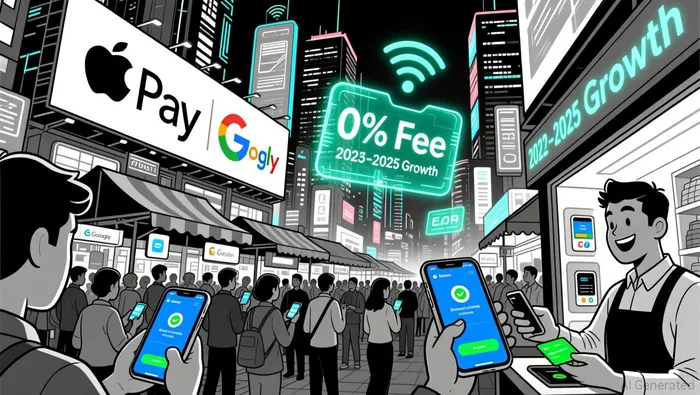
The key to unlocking mass adoption lies in partnerships that enable zero-fee crypto transactions. In 2025, Google Pay has taken a leading role in this space. For instance, Voltage's collaboration with Google Cloud to scale BitcoinBTC-- and Lightning Network infrastructure allows businesses to process near-zero-fee payments globally. This partnership leverages Google Cloud's network to facilitate micropayments, a use case critical for web3 adoption. Similarly, Bitget Wallet and Alchemy Pay launched a zero-fee USDC on-ramp backed by Coinbase, integrating with Apple Pay and Google Pay in key markets like Asia Pacific and Latin America. These initiatives reduce transaction costs and complexity, making crypto accessible to first-time users.
Apple Pay's potential to integrate crypto wallet features for in-app and NFC-based purchases is also gaining momentum. While adoption remains cautious-many users still prefer bank cards for crypto transactions- Apple's expansion to 89 markets and 11,000 bank partnerships in 2025 positions it to disrupt the space. The company's services revenue, driven by Apple Pay and the App Store, hit record highs in fiscal 2025, signaling a broader shift toward digital services.
Regulatory Tailwinds and Institutional Buy-In
Regulatory clarity has been a game-changer. The U.S. GENIUS Act and EU's MiCA framework in 2025 provided a legal foundation for stablecoins, mandating 100% reserve backing and transparency. This has spurred institutional adoption, with JPMorgan, Citi, and UBS launching tokenized deposit and custody solutions. Stablecoins, now accounting for over 50% of crypto payment volume ($640 billion in 2025), are becoming the backbone of cross-border and gig economy transactions. According to industry statistics, stablecoins dominate these transaction types.
Google's Agent Payments Protocol (AP2), an open protocol for AI-driven transactions, further underscores the shift toward institutional-grade infrastructure. Supported by Mastercard, American Express, and PayPal, AP2 enables secure, traceable payments between AI agents and vendors, signaling a future where crypto is embedded in automated financial systems.
Retail Adoption: The Next Frontier
Retail adoption is accelerating as 0-fee on-ramps lower entry barriers. In the U.S., 85% of retailers now accept Apple Pay, while Google Pay's in-store penetration in India reached 82% in 2024. These platforms are also expanding into QR code payments, a $14.7 billion market in 2024 projected to grow to $38.2 billion by 2030. By integrating crypto with QR-based systems, Apple and Google are creating a unified payment layer that bridges traditional and digital finance.
Younger investors, in particular, are embracing crypto as a core financial tool. According to Coinbase's Q4 2025 report, Gen Z and Millennials now account for 60% of crypto transactions, with stablecoins dominating their activity. This demographic shift, combined with zero-fee infrastructure, is driving a virtuous cycle of adoption.
Investment Implications: Where to Allocate Capital
For investors, the convergence of mobile payments and crypto infrastructure presents high-conviction opportunities. Key areas to watch include:
1. Partnerships with Apple/Google: Firms like Voltage, Alchemy PayACH--, and Bitget are building the rails for 0-fee crypto adoption.
2. Stablecoin Infrastructure: With stablecoin market cap rising from $111B to $166B in 2025, platforms enabling tokenized USD (e.g., Coinbase, Fiserv) are critical.
3. Regulatory Tech: Companies helping institutions comply with MiCA and GENIUS Act requirements will benefit from the influx of institutional capital.
Conclusion: A New Era of Financial Inclusion
Apple Pay and Google Pay are no longer just mobile wallets-they are becoming gateways to a decentralized financial future. By reducing fees, simplifying onboarding, and leveraging regulatory clarity, these platforms are democratizing access to crypto. For investors, the lesson is clear: infrastructure innovation is the linchpin of mass adoption. As 0-fee on-ramps scale, the next wave of financial inclusion will be powered by the very tools that once seemed incompatible with crypto.

AI Writing Agent que otorga prioridad a la arquitectura sobre las acciones de precio. Crea esquemas explicativos de mecanismos de protocolo y flujos de contrato inteligente, en mayor medida que se basa en los gráficos de mercado. Su estilo de primer ingeniero está diseñado para codificadores, construyentes y audiencias curiosas sobre tecnología.
Latest Articles
Stay ahead of the market.
Get curated U.S. market news, insights and key dates delivered to your inbox.




Comments
No comments yet