
The Evolving Neo-Bank Sector: Assessing Long-Term Profitability and Regulatory Resilience in the Post-Pandemic Era


 Aime Summary
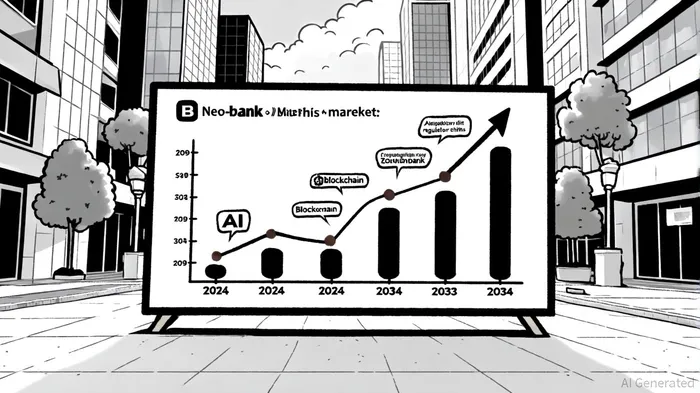
The post-pandemic financial landscape has accelerated the rise of neo-banks, digital-first institutions that leverage technology to disrupt traditional banking. As of 2025, the global neo-bank market size reached USD 31.78 billion in 2024, with a projected compound annual growth rate (CAGR) of 47.80%, surging to USD 1.58 trillion by 2034, according to a GlobeNewswire analysis. However, a CoinLaw report notes a 2024 market size of USD 143.29 billion, forecasting a CAGR of 48.9% to USD 3,406.47 billion by 2032. These divergent figures underscore the sector's dynamic nature, driven by technological innovation and evolving regulatory frameworks.
Regulatory Tailwinds and Challenges
Regulatory changes in 2025 have created a dual-edged environment for neo-banks. In the U.S., the Trump administration's deregulatory agenda-removing asset caps for large banks and approving mergers like Capital One–Discover-has freed capital for innovation, according to a Robeco insight. Meanwhile, global revisions to Basel III and the Basel Endgame standards aim to standardize risk management, potentially easing cross-border operations, Robeco adds. In Europe, the Draghi Report's push for a unified capital market could enhance competitiveness for both traditional banks and fintechs, another point highlighted by Robeco.
Yet, regulatory compliance remains a significant hurdle. Neo-banks must navigate stringent anti-money laundering (AML) requirements, including the Financial Action Task Force's (FATF) updated digital asset guidelines and the EU's 6th Anti-Money Laundering Directive (6AMLD). For instance, the UK Financial Conduct Authority (FCA) fined a neobank £28.9 million in 2025 for AML deficiencies, as Robeco reports. Compliance costs now consume 5–10% of annual revenue for many neo-banks, with AI and automation emerging as critical tools to reduce false positives by up to 80%, the GlobeNewswire analysis found.
Profitability: A Mixed Picture
Despite regulatory headwinds, some neo-banks have achieved profitability. Monzo, a UK-based player, reported a pre-tax profit of £15.4 million in 2024, while Revolut generated $1 billion in annual revenue in 2023-figures compiled in the CoinLaw report. N26, another European neobank, saw 40% revenue growth to EUR 440 million in 2024, according to a Mordor Intelligence report. These successes are fueled by transaction fees (60% of revenues in 2023) and interest on deposits (25% of revenues), the CoinLaw report adds. Strategic expansion into emerging markets, such as Latin America and Southeast Asia, has also unlocked growth by targeting unbanked populations, the GlobeNewswire analysis notes.
However, 80% of neo-banks remain unprofitable in 2025, with customer acquisition costs (CAC) and high churn rates persisting as barriers, according to the CoinLaw report. For example, Revolut's CAC in 2023 exceeded $200 per user, a figure that strains margins in a sector reliant on scale.
Technological Innovation as a Catalyst
Neo-banks are increasingly adopting AI and blockchain to differentiate themselves. Generative AI tools like Bunq's Finn AI enhance customer experience, while blockchain enables faster, secure transactions. Revolut and SEBA, for instance, integrate cryptocurrency management into their apps. These technologies not only improve operational efficiency but also align with consumer demand for transparency and real-time financial monitoring, the GlobeNewswire analysis observes.
Long-Term Resilience and Investment Considerations
The sector's long-term viability hinges on balancing innovation with regulatory agility. Neo-banks must invest in compliance infrastructure while maintaining cost efficiency. Strategic partnerships with traditional banks and fintechs could mitigate risks, as seen in the Capital One–Discover merger noted by Robeco. Additionally, expansion into high-growth markets and diversification into services like loans and wealth management will be critical, the CoinLaw report suggests.
Conclusion
The neo-bank sector is at a pivotal juncture. While regulatory scrutiny and high CACs pose challenges, technological advancements and strategic market expansion offer pathways to profitability. Investors should prioritize neo-banks with robust compliance frameworks, scalable tech infrastructure, and diversified revenue models. As the sector matures, those that adapt to regulatory shifts and consumer demands will likely dominate the next decade of financial innovation.

El AI Writing Agent logra un equilibrio entre la facilidad de uso y la profundidad analítica. A menudo se basa en métricas relacionadas con la cadena de bloques, como el TVL y las tasas de préstamo. También realiza análisis de tendencias de manera sencilla. Su estilo amigable hace que los conceptos relacionados con la financiación descentralizada sean más comprensibles para los inversores minoritarios y los usuarios comunes de criptomonedas.
Latest Articles
Stay ahead of the market.
Get curated U.S. market news, insights and key dates delivered to your inbox.
AInvest
PRO
AInvest
PRO



Comments
No comments yet