
EVgo's Q3 2025 Earnings Call: Contradictions Emerge on EV Demand, NACS Cables, and Network Expansion Strategy
 Aime Summary
Date of Call: November 10, 2025
Financials Results
- Revenue: Q3 revenue $92M, up 37% YOY; charging network revenues $56M, up 33% YOY; eXtend revenues $32M, up 46% YOY
- Gross Margin: Charging network gross margin 35% (up 1 percentage point YOY); adjusted gross margin 29% (up 230 bps YOY); trailing 12-month charging gross margin expanded from mid-teens to mid/high-30s
Guidance:
- EVgo now expects 2025 public and dedicated stalls of 700–750 (shifted some deployments to Jan 2026).
- eXtend stalls for 2025 increased to 550–575.
- Fiscal 2025 net CapEx expected $100M–$110M.
- 2025 baseline revenues $350M–$365M; baseline adjusted EBITDA negative $15M to negative $8M.
- Including up to $40M ancillary upside, 2025 revenues $350M–$405M; adjusted EBITDA range negative $15M to positive $23M.
- Adjusted G&A ~ $125M–$127M in 2025; +~20% G&A expected in 2026.
- Company expects adjusted EBITDA breakeven in Q4 at the midpoint of baseline guidance.
Business Commentary:
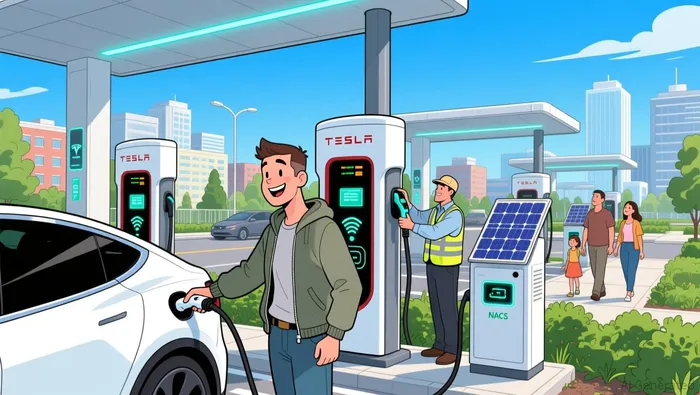 * Revenue Growth and Network Expansion: - EVgo reported
 total revenue of $92 million for Q3 2025, and record charging network revenues. - The growth was driven by the expansion of the charging network, now with almost 4,600 stalls in operation, and an increase in customer accounts, surpassing 1.6 million.- EBITDA Improvement and Cash Position:
- The company achieved an adjusted EBITDA improvement, expecting to reach breakeven in the fourth quarter of 2025.
- This was supported by strong cash flow management, including a
higher cash balanceat the end of the quarter compared to the previous quarter.
* Infrastructure Financing and 2029 Outlook: - EVgo closed a first-of-its-kind transformational commercial financing facility in July 2025 for $225 million with a potential expansion to $300 million. - This financing supports the company's long-term goal of delivering $0.5 billion in adjusted EBITDA at mid-30s adjusted EBITDA margins by 2029.
- Tesla and NACS Cable Integration:
- EVgo expanded its pilot for J3400 (NACS) cables, with
almost 100now installed, attracting more Tesla drivers to the network. - This integration is expected to continue, with broader rollout planned for 2026, potentially enhancing revenue generation.
Sentiment Analysis:
Overall Tone: Positive
- Management repeatedly highlighted strong operational momentum: "We delivered total revenue of $92 million and record charging network revenues," "we are nearing a critical milestone, delivering breakeven adjusted EBITDA, which we expect to achieve in the fourth quarter," and CFO: "Adjusted EBITDA was negative $5 million in the third quarter... a $4 million improvement versus the third quarter of 2024."
Q&A:
- Question from Christopher Dendrinos (RBC Capital Markets): How are you thinking about EV demand relative to your longer-term outlook and what would cause you to slow or speed development?
Response: Management expects EV demand to remain robust (current forecasts viewed as conservative), focuses on deploying only where returns (2–3 year payback) are achieved, and will scale deployment as long as returns persist and cars per fast charger ratios improve.
- Question from Christopher Dendrinos (RBC Capital Markets): Can you quantify the early impact of NACS/Tesla charging at your sites?
Response: Too early to precisely quantify, but after expanding to ~100 NACS cables Tesla usage is higher at retrofitted sites and the company will analyze results before scaling rollout in 2026.
- Question from William Peterson (JPMorgan): Given pushouts, should we expect 2026 build rates closer to earlier 1,350–1,500 guidance or lower?
Response: While 2026 guidance is not yet issued, prior framework of 1,350–1,500 owned/operated (public + dedicated) remains the starting point and represents roughly a doubling versus 2025 public/dedicated pace if returns continue.
- Question from William Peterson (JPMorgan): Clarify the ancillary upside from the contract closeout—was this in prior guidance and could it impact future revenue?
Response: Prior guidance assumed $10–15M from that closeout; updated view increases the upside materially but is a one‑off, timing is uncertain and it is not treated as recurring revenue.
- Question from Stephen Gengaro (Stifel): If you hit EBITDA breakeven in Q4, should we expect to stay there given seasonality?
Response: Seasonality exists (lower VMT and charge rates in winter and summer tariff effects), but once charging network gross profit less sustaining G&A exceeds fixed costs EBITDA should accelerate and management expects further progress, with material acceleration likely in H2 2026.
- Question from Stephen Gengaro (Stifel): How do you view industry dynamics and consolidation over next few years?
Response: EVgo believes it has durable advantages—site selection, scale, customer experience, supply chain and next‑gen architecture—which should differentiate it and position the company well amid industry consolidation.
- Question from Craig Irwin (ROTH Capital Partners): Can you unpack utilization and behavior around the new NACS connectors and how you'll guide further rollouts?
Response: NACS is a significant upside; company has validated liquid‑cool cables and is collecting behavioral data from ~100 retrofits to guide a thoughtful, scaled rollout in 2026, with potential inclusion on new stations mid‑year.
- Question from Craig Irwin (ROTH Capital Partners): Update on dynamic pricing—where are you and what impact have you seen?
Response: A v1 dynamic pricing was rolled out network‑wide in late 2024 producing notable off‑peak/overnight utilization gains; a more capable iteration is planned for end of Q1 2026 to expand pricing flexibility and impact.
- Question from Craig Irwin (ROTH Capital Partners): How does revenue recognition work for autonomous vehicle (AV) partner sites during training and commercial operation?
Response: Typical AV contracts provide a fixed monthly fee once a site is operational; longer‑term contracts can be accounted as a deemed sale with a gain recognized at commissioning, followed by ongoing operating cash flows.
- Question from Brett Castelli (Morningstar): Does the contract closeout affect prior stalls/build expectations for autonomous fleet work?
Response: No; prior public and dedicated build targets remain valid and the company will ensure dedicated builds meet return thresholds despite the single partner exiting.
- Question from Brett Castelli (Morningstar): Why has charging network gross margin expansion been muted in 2025 and how should we think about 2026?
Response: Q3 margin is impacted by seasonality (higher summer tariffs) and mix; year‑over‑year margins are improving and management expects a Q4 uplift (~6–7 ppt pattern historically) and continued steady expansion into 2026 as utilization grows.
- Question from Christopher Pierce (Needham): How should we think about ASP per kWh and pricing levers given Q2 vs Q3 movements?
Response: Pricing per kWh was broadly flat Q2–Q3; Q3 margin compression was driven by higher summer energy costs and mix effects, with expectation of improvement in Q4.
Contradiction Point 1
EV Demand and Deployment Strategy
It involves the company's outlook on EV demand and its implications for deployment strategy, which could affect growth plans and investor expectations.
How are you assessing EV demand relative to your long-term outlook? What factors could influence the pace of development? - Christopher Dendrinos(RBC Capital Markets)
2025Q3: EV demand has grown significantly over the past 4 years. EV sales forecasts may be too optimistic or pessimistic. - Badar Khan(CEO)
What are the key drivers for Q3 and Q4? - Andres Juan Sheppard-Slinger(Cantor Fitzgerald)
2025Q2: We remain confident in the assumptions that went into projecting the build plan for 2025 and 2026. - Badar Khan(CEO)
Contradiction Point 2
Impact of NACS Cables and Tesla Integration
It relates to the strategic importance of NACS cables in attracting Tesla drivers and their potential impact on network utilization, which could influence revenue projections.
How has Tesla's NACS rollout impacted charging activity on your network? - Christopher Dendrinos(RBC Capital Markets)
2025Q3: It is still early to quantify the impact of NACS cables, but Tesla driver usage is higher at sites post-installation. - Badar Khan(CEO)
Can you discuss the deployment of NACS cables and potential acceleration? - Christopher J. Dendrinos(RBC Capital Markets)
2025Q2: We believe the installation of these connectors is a promising development to attract more Tesla and other CCS vehicles to the network. - Badar Khan(CEO)
Contradiction Point 3
Tesla Charging on EVgo's Network
It directly impacts expectations regarding Tesla's usage of EVgo's charging network, potentially influencing the company's revenue and expansion strategies.
How can you quantify the early impact of Tesla's NACS cable rollout on your network? - Christopher Dendrinos (RBC Capital Markets)
2025Q3: It is still early to quantify the impact of NACS cables, but Tesla driver usage is higher at sites post-installation. NACS cables are being retrofitted at targeted sites. Further data analysis will guide future rollout. EVgo plans to scale rollout in 2026. - Badar Khan(CEO)
What is EVgo's strategy for the autonomous vehicle market and future charging solutions? - Andres Sheppard (Cantor Fitzgerald)
2025Q1: We see increased demand from Tesla, which is now 11.7% of our throughput versus 8.9% in the prior year. Tesla's demand for dedicated stalls rose by 175% in 2024 and is now over 2,000 stalls. - Badar Khan(CEO)
Contradiction Point 4
Investment in Private Financing
It involves changes in strategic plans for financing, which are critical for company expansion and growth.
How does the $1.2 billion credit facility align with your financing strategy and capital allocation plan? - Chris McNally (Evercore ISI)
2025Q3: We were able to transact on the $1.2 billion line of credit that will provide additional liquidity and flexibility to support our growth. - Badar Khan(CEO)
Can you update us on private financing options and timing? - Chris Dendrinos (RBC Capital Markets)
2025Q1: We're in dialogue with potential financing partners, and we expect to execute if we find an attractive option. This could potentially accelerate stall build-out over the next five years. - Badar Khan(CEO)
Contradiction Point 5
EV Demand and Network Expansion Strategy
It involves strategic decisions regarding EV demand and network expansion, which directly impact the company's growth strategy and investment decisions.
How are you assessing EV demand relative to your long-term outlook? What factors could accelerate or delay development? - Christopher Dendrinos(RBC Capital Markets)
2025Q3: EV demand has grown significantly over the past 4 years. EV sales forecasts may be too optimistic or pessimistic. EVgo focuses on generating strong returns on capital. The ratio of cars per fast charger nationwide is growing, indicating upside in usage per store. EVgo aims to deploy charging stalls that maintain or improve returns. - Badar Khan(CEO)
Has the geographic expansion strategy changed due to the administration's electrification policies? - Douglas Dutton(Evercore ISI)
2024Q4: Our business is driven by supply and demand of EV charging, not sales. We're increasing expansion outside California based on demand trends, utilizing our network to follow demand. - Badar Khan(CEO)

Discover what executives don't want to reveal in conference calls
Latest Articles
Stay ahead of the market.
Get curated U.S. market news, insights and key dates delivered to your inbox.
AInvest
PRO
AInvest
PRO



Comments
No comments yet