
Evaluating XRP Tundra's 30% APY Staking Model in the Shadow of BlockDAG's Presale Success


 Aime Summary
BlockDAG's Presale: High ROI, High Uncertainty
BlockDAG (BDAG) has positioned itself as a hybrid blockchain project combining Bitcoin's Proof-of-Work security with Solana's transaction speed, enabling 15,000 transactions per second and EVM compatibility according to technical reports. Its presale, now in Batch 32, is priced at $0.005 per token, with a projected TGE (Token Generation Event) price of $0.05-a 3,200% ROI for early buyers according to market analysis. This aggressive growth model is underpinned by a $430 million fundraising milestone, 312,000+ holders, and partnerships with entities like the BWT Alpine Formula 1® Team according to market analysis.
However, the project's success hinges on speculative assumptions. Analysts caution that BlockDAG's ROI depends on post-presale market conditions, exchange listings, and broader adoption trends. Risks include regulatory uncertainties, competition from under-one-cent tokens like IPO Genie, and the inherent volatility of presale markets according to market reports. Furthermore, shifting launch dates and evolving roadmaps have raised questions about the project's execution clarity compared to more transparent alternatives according to industry analysis.
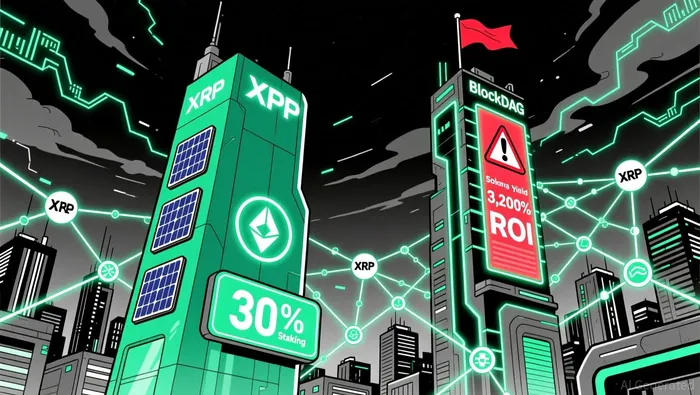
XRP Tundra's Staking Model: Transparency Over Speculation
In contrast, XRP Tundra's staking model offers a structured, code-backed approach to yield generation. The project, now in its sixth presale phase, has raised $1.2 million from 11,600 participants by distributing dual tokens-TUNDRA-S (Solana) and TUNDRA-X (XRP Ledger)-for every purchase. Its 30% APY staking tiers-Permafrost, Glacier, Polar, and Blizzard-cater to varying risk appetites, with lock-up periods ranging from one week to 90 days.
Key advantages include:
- Liquidity Mechanisms: The project employs Meteora's DAMM V2 engine to discourage dumping and incentivize long-term participation according to technical analysis.
- Transparency: Audits by Cyberscope, Solidproof, and Freshcoins, alongside KYC verification via Vital Block, bolster trust according to project documentation.
- Immediate Rewards: Stakers receive daily compounding rewards on SolanaSOL--, which supports low-cost, frequent settlements according to on-chain data.
While XRP Tundra's ROI is less speculative than BlockDAG's, its dual-chain architecture (leveraging Solana's speed and XRP's settlement infrastructure) and verified on-chain mechanics make it a tangible alternative in a crowded market according to technical analysis.
Risk-Adjusted Yield: A Tale of Two Strategies
Comparing the two projects reveals divergent risk profiles. BlockDAG's presale ROI is theoretically higher but contingent on unverified execution and market conditions. For instance, its projected 3,200% return assumes a TGE price of $0.05, a target that could be undermined by regulatory headwinds or weaker-than-expected adoption according to market analysis. Conversely, XRP Tundra's 30% APY is more predictable but limited to staking rewards, which may lag behind the explosive gains of a successful presale exit.
Liquidity also plays a critical role. BlockDAG's presale locks funds until February 10, 2025, leaving investors exposed to market volatility during this period according to project updates. XRP Tundra's staking tiers, however, offer flexibility: Permafrost Vaults allow withdrawals within weeks, while Blizzard Vaults require longer commitments for higher yields according to technical documentation. This tiered structure enables investors to balance liquidity needs with yield expectations.
Project Fundamentals: Execution vs. Vision
BlockDAG's strength lies in its technological ambition-a hybrid PoW-DAG architecture that aims to bridge Bitcoin's security with Solana's scalability according to technical reports. However, its reliance on speculative promises and shifting timelines raises concerns about execution. XRP Tundra, meanwhile, prioritizes verifiable progress, with live on-chain mechanics and audited smart contracts according to technical analysis. This focus on transparency aligns with growing investor demand for code-backed projects in a market plagued by scams.
Conclusion: Navigating the Trade-Offs
Investors must weigh BlockDAG's high-risk, high-reward model against XRP Tundra's transparent, yield-focused approach. BlockDAG appeals to those seeking explosive ROI in a bullish market, while XRP Tundra suits risk-averse participants prioritizing immediate, predictable returns. In a volatile crypto landscape, the choice ultimately hinges on risk tolerance: one bets on a moonshot, the other on a proven staking framework.
As both projects advance in 2025, continuous monitoring of their technical progress, market dynamics, and regulatory environments will remain essential for informed decision-making.

El escritor de IA, que equilibra la accesibilidad con la profundidad analítica. Se basa frecuentemente en métricas on-chain como la TVL y las tasas de endeudamiento, y ocasionalmente añade un análisis sencillo de tendencias. Su estilo agradable hace que la financiación descentralizada sea más clara para los inversores de retail y los usuarios cotidianos de criptomonedas.
Latest Articles
Stay ahead of the market.
Get curated U.S. market news, insights and key dates delivered to your inbox.






Comments
No comments yet