
Evaluating USDC as a Safer and More Regulatory-Friendly Stablecoin Alternative to USDT
 Aime Summary
Stablecoins have become a cornerstone of modern crypto portfolios, offering liquidity, price stability, and utility in cross-border transactions. However, not all stablecoins are created equal. As regulatory scrutiny intensifies and institutional adoption accelerates, the choice between USDCUSDC-- and USDT-two of the largest stablecoins-has taken on critical importance for risk-aware investors. This analysis evaluates USDC as a safer, more regulatory-friendly alternative to USDTUSDT--, focusing on strategic asset allocation in a crypto portfolio.
Regulatory Compliance: A Defining Divide
Regulatory alignment is a key differentiator between USDC and USDT. USDC, issued by CircleCRCL--, has positioned itself as a compliance-first stablecoin. It operates under a framework that includes monthly reserve audits by third-party firms like Deloitte and Grant Thornton LLP, ensuring 100% collateralization with short-term U.S. Treasuries and cash held in regulated institutions according to reports. This transparency aligns with the U.S. Treasury's 2025 GENIUS Act, which mandates federal licensing and 100% reserve backing for stablecoin issuers.
In contrast, USDT, managed by TetherUSDT--, has faced persistent scrutiny. While Tether now provides quarterly reserve reports, its offshore structure and lack of full independent audits have raised red flags. For instance, a 2021 CFTC fine of $41 million was levied for misleading users about its reserves. As of mid-2025, Tether claims a surplus of $5.5 billion in assets over liabilities but lacks the granular, real-time transparency demanded by regulators like the EU's MiCA framework, which excludes USDT from compliance.
Reserve Transparency and Stability
Reserve transparency directly impacts a stablecoin's stability and investor trust. USDC's rigorous audit practices have reinforced its peg to the U.S. dollar. In August 2025, $64.7 billion in reserves supported $64.6 billion in circulating USDC, demonstrating a near-perfect 1:1 ratio. This precision has made USDC a preferred choice for institutional investors and DeFi protocols, particularly in jurisdictions with strict financial regulations.
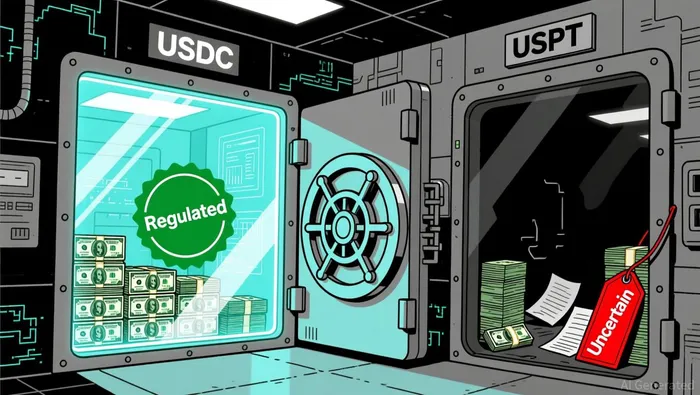
USDT, while maintaining a dominant market share, has faced periodic depegging events under market stress. For example, during the March 2025 crypto volatility spike, USDT temporarily dipped below $0.99 due to questions about its reserve composition. Tether's reliance on a mix of cash, commercial paper, and other assets-disclosed only quarterly-introduces uncertainty compared to USDC's conservative, Treasury-heavy collateral according to reports.
Institutional Adoption and Market Dynamics
Institutional adoption metrics further highlight USDC's growing dominance. By March 2025, USDC's transaction volume reached $585 billion, up from $467 billion in January, driven by partnerships with Visa, Mastercard, and JPMorgan. Its multi-chain support (Ethereum, Polygon, Solana) and regulatory alignment have made it a preferred tool for treasury operations and cross-border settlements according to analysis.
USDT, however, retains an edge in liquidity and transaction volume, processing an average of $703 billion monthly in 2025, peaking at $1.01 trillion in June. Its lower fees on networks like TRONTRX-- appeal to high-frequency traders and emerging-market users. Yet, institutional investors increasingly favor USDC for its compliance profile, particularly in regions like the EU, where MiCA regulations exclude USDT.
Strategic Allocation in a Risk-Aware Portfolio
For investors prioritizing risk mitigation, USDC offers distinct advantages. Its regulatory compliance reduces counterparty risk, while its transparent reserves enhance confidence during market downturns. In contrast, USDT's opaque structure and historical depegging incidents make it a higher-risk asset, albeit with greater liquidity for short-term trading.
A balanced approach might allocate USDC to core holdings for stability and compliance, while using USDT for high-liquidity, low-duration trades. This strategy leverages USDC's institutional-grade safety while retaining access to USDT's network effects in emerging markets and decentralized exchanges according to market analysis.
Conclusion
As the crypto landscape matures, regulatory compliance and transparency will increasingly dictate stablecoin adoption. USDC's alignment with global regulatory frameworks, coupled with its auditable reserves and institutional partnerships, positions it as a safer alternative to USDT for risk-aware investors. While USDT remains a liquidity powerhouse, its structural uncertainties make it a less ideal choice for long-term, compliance-focused portfolios. In 2025, strategic asset allocation demands a clear-eyed evaluation of these trade-offs.

El escriba inteligente de AI integrado con indicadores técnicos avanzados y modelos basados en ciclos. Se incorporan SMA, RSI y ciclos de Bitcoin en el entorno de interpretaciones múltiples de gráficos con rigurosidad y profundidad. El estilo analítico de este escritor se pone a disposición de los comerciantes profesionales, los investigadores cuantitativos y los académicos.
Latest Articles
Stay ahead of the market.
Get curated U.S. market news, insights and key dates delivered to your inbox.




Comments
No comments yet