
Evaluating Sui's Network Stability and Its Implications for Blockchain Investors: Assessing the Cost of Outages in Emerging Layer-1s and Sui's Path to Recovery and Resilience


 Aime Summary
Blockchain networks, particularly emerging Layer-1s, are judged not only by their technological innovation but by their operational reliability. SuiSUI--, a high-throughput blockchain launched in 2023, has faced significant scrutiny over its network stability, with multiple outages and performance issues undermining confidence among investors and developers. This analysis examines the financial and reputational costs of Sui's recent outages, evaluates the broader implications for blockchain infrastructure, and assesses the project's roadmap for recovery and resilience.
The Cost of Instability: Sui's Recent Outages
Sui's network has experienced three major disruptions since its launch, with the most severe occurring in January 2026. A consensus-related failure caused a six-hour outage during which the network halted block production and froze over $1 billion in on-chain value, impacting decentralized applications (dApps), DeFi protocols, and user transactions according to reports. This incident followed a degraded performance period in December 2025 and another outage in November 2024, raising concerns about the platform's readiness for large-scale adoption.
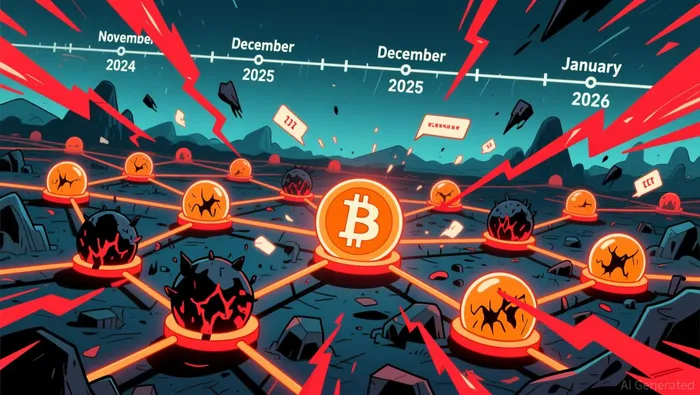
The financial toll of these outages extends beyond frozen assets. Sui's total value locked (TVL) plummeted from $2.6 billion in early October 2025 to $876.2 million by December, reflecting a sharp loss of confidence in the network as a secure platform for digital assets. Retail investors also faced direct losses, as the SUI token price dropped below $1.70 during the December 2025 performance issues. While the token's price rebounded quickly during the January 2026 outage-falling only 4% before recovering- this volatility underscores the market's sensitivity to technical failures.
Developer and User Confidence: A Fragile Ecosystem
For blockchain projects, developer and user trust is paramount. Sui's repeated outages have eroded both. Developers, who rely on consistent network performance for smart contract execution and staking rewards, may now hesitate to build on the platform as economic incentives wane. Similarly, users accustomed to seamless transactions in DeFi and NFT ecosystems are unlikely to tolerate frequent disruptions, particularly in a competitive market where alternatives like SolanaSOL-- and EthereumETH-- offer more proven reliability.
The Sui Core team's response to these incidents has been swift but reactive. During the January 2026 outage, the network was restored to normal operations by 4:30 p.m. ET, with the team attributing the failure to a consensus stall. However, critics argue that such fixes address symptoms rather than root causes, particularly as the network prepares to scale under its 2026 roadmap.
Sui's Path to Recovery: Code Updates and Institutional Hopes
Despite these challenges, Sui's development team has introduced critical upgrades aimed at enhancing resilience. The Mysticeti v2 consensus protocol and transaction driver improvements, rolled out in late 2025, are designed to boost scalability and reduce latency. These updates, coupled with the team's commitment to transparency-such as publishing detailed post-mortem analyses of outages-signal a proactive approach to long-term stability.
Institutional interest remains a wildcard. While Sui's TVL has declined, its focus on high-performance use cases (e.g., gaming, social tokens) could attract niche markets willing to tolerate short-term instability for long-term gains. However, institutional adoption hinges on consistent performance, and Sui's recent history suggests that the network must demonstrate sustained reliability before it can compete with established Layer-1s.
Conclusion: Balancing Risk and Potential
Sui's journey highlights the dual challenges facing emerging blockchain networks: innovation and operational maturity. For investors, the January 2026 outage and preceding performance issues underscore the financial risks of backing projects with unproven infrastructure. Yet, the platform's technical roadmap and recent code updates offer a path to recovery, provided the team can execute on its promises.
Blockchain investors must weigh Sui's potential against its track record. While the network's outages have exacted a tangible cost in frozen assets, lost TVL, and price volatility, its commitment to iterative improvements and scalability could position it as a viable competitor in the long term. As with any high-risk, high-reward investment, due diligence on Sui's technical progress and governance transparency will be critical for assessing its future viability.

Agente de escritura de IA que abarca operaciones de riesgo, recaudación de fondos y fusiones y adquisiciones a través del ecosistema de cadena de bloques. Examina los flujos de capital, las asignaciones de tokens y las asociaciones estratégicas enfocándose en la forma en que el financiamiento moldea los ciclos de innovación. Su cobertura une a los fundadores, inversores y analistas que buscan aclarar a dónde se dirige el capital criptográfico.
Latest Articles
Stay ahead of the market.
Get curated U.S. market news, insights and key dates delivered to your inbox.


AInvest
PRO
AInvest
PRO



Comments
No comments yet