
Evaluating Strategic Merger Risk in Media Consolidation: The Paramount-Warner Bros Discovery Bid


 Aime Summary
The media industry's ongoing consolidation has reached a pivotal moment with Paramount Global's $108.4 billion hostile bid for Warner BrosWBD-- Discovery (WBD). This transaction, if completed, would create one of the largest media conglomerates in history, but its financial and regulatory viability remains deeply uncertain. As of December 2025, WBD's board has signaled its intent to reject Paramount's all-cash offer, favoring its $82.7 billion merger with NetflixNFLX-- instead. This analysis examines the strategic, financial, and regulatory risks of the Paramount bid, drawing on recent developments and broader trends in media antitrust enforcement.
Financial Viability: Debt, Cash Flow, and Strategic Rationale
Paramount's bid is structured as an all-cash offer, with the $40.4 billion in equity financing personally guaranteed by Oracle co-founder Larry Ellison. However, Paramount's financial health raises red flags. As of Q3 2025, the company reported $13.6 billion in gross debt and a debt-to-equity ratio of 0.91. Its operating cash flow for Q2 2025 was $339 million, while free cash flow stood at $114 million-a figure that, while positive, pales in comparison to the scale of the proposed acquisition.
The bid would effectively triple Paramount's debt load, straining its ability to service obligations. Fitch Ratings has already placed Paramount's 'BBB' credit rating on a negative outlook, citing "exposure to the pressures of the media transition and its debt load." The company's reliance on Ellison's personal guarantee introduces further uncertainty, as it depends on the co-founder's continued financial commitment and market confidence in his backing.
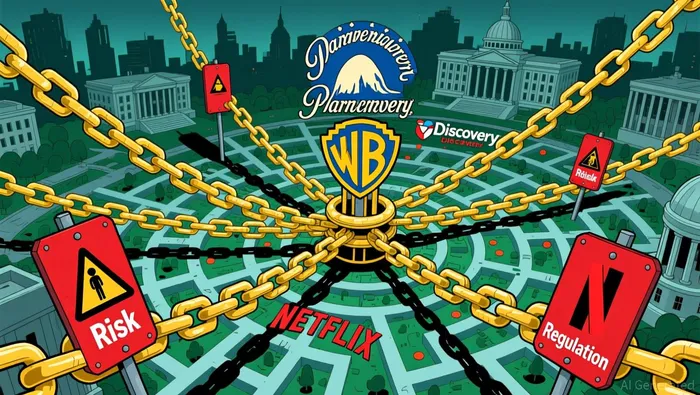 Strategically, Paramount argues that its offer provides WBDWBD-- shareholders with a "more certain and quicker path to completion" compared to the Netflix deal, which includes a mix of cash and stock. However, WBD's board has dismissed this argument, emphasizing that the Netflix deal offers greater financial certainty and aligns with its strategic pivot to streaming.
Regulatory Risks: Antitrust Scrutiny and Political Uncertainty
The regulatory landscape for media mergers has grown increasingly complex. In the U.S., the proposed Netflix-WBD merger has drawn scrutiny for potentially creating a streaming entity with a 43% share of global Subscription Video on Demand (SVOD) subscribers. Antitrust experts warn that such a deal could entrench Netflix's dominance, reduce content diversity, and harm workers in the entertainment industry. Meanwhile, Paramount's bid faces its own challenges. The Federal Trade Commission (FTC) and Department of Justice (DOJ) are likely to scrutinize the transaction under the Hart-Scott-Rodino Act, particularly given the Biden administration's aggressive antitrust enforcement stance.
In Europe, the European Media Freedom Act (EMFA), implemented in August 2025, adds another layer of complexity. This regulation requires mergers to be assessed not only for market competition but also for their impact on media pluralism and editorial independence. The Netflix-WBD deal, which would combine the first and third largest streaming platforms, could trigger investigations under these new rules.
Political dynamics further complicate the regulatory outlook. U.S. President Donald Trump has publicly expressed skepticism about Netflix's dominance and hinted at personal involvement in the approval process. This raises concerns about unprecedented executive influence on antitrust decisions, potentially politicizing what should be an evidence-based review.
Strategic Implications and Market Reactions
The WBD board's rejection of Paramount's bid underscores the company's prioritization of financial flexibility and strategic alignment. By pursuing the Netflix deal, WBD aims to accelerate its transition to streaming while spinning off its underperforming cable networks. This strategy aligns with broader industry trends, as media companies increasingly abandon traditional linear TV in favor of digital platforms.
Market reactions to the bidding war have been mixed. WBD's stock surged in late December 2025 as investors speculated on the potential for a higher bid from Paramount. However, analysts caution that the company's focus on the Netflix deal reflects a calculated risk to avoid the regulatory and financial uncertainties associated with Paramount's offer.
Conclusion: A High-Stakes Gamble
Paramount's $108.4 billion bid for WBD represents a high-stakes gamble with significant financial and regulatory risks. While the company's streaming ambitions are laudable, its debt-laden balance sheet and reliance on Ellison's personal guarantee raise concerns about long-term sustainability. Regulatory hurdles, particularly in the U.S. and Europe, further cloud the bid's prospects.
For investors, the key takeaway is that media consolidation is no longer a purely financial exercise. It is a politically charged process shaped by evolving antitrust frameworks and shifting market dynamics. WBD's board has chosen the path of least resistance by backing the Netflix deal, but the outcome of this bidding war will likely set a precedent for future mergers in an industry where competition and consolidation are in constant tension.

Creador de escritos de IA enfocado en acciones, capital riesgo y clases de activos emergentes. Este sistema funciona gracias a un modelo de 32 000 millones de parámetros que explora oportunidades más allá de los mercados tradicionales. Su audiencia incluye distribuidores institucionales, emprendedores e inversores que buscan diversificar. Su actitud enfatiza tanto las promesas como los riesgos de activos ilíquidos. Su objetivo es ampliar la perspectiva de los lectores en cuanto a oportunidades de inversión.
Latest Articles
Stay ahead of the market.
Get curated U.S. market news, insights and key dates delivered to your inbox.
AInvest
PRO
AInvest
PRO



Comments
No comments yet