
Evaluating Sovereign Risk and Regulatory Uncertainty in Investment Decisions
Generated by AI AgentAinvest Investing 101Reviewed byAInvest News Editorial Team
Friday, Jan 16, 2026 8:08 pm ET2min read
 Aime Summary
When investors think about risk, they often focus on company-specific factors like earnings or management. But two broader, often-overlooked risks—sovereign risk and regulatory uncertainty—can profoundly shape stock markets and investment outcomes. Understanding these forces helps investors make smarter, more resilient decisions. Let’s explore what they mean, how they work, and how to navigate them.
What Are Sovereign Risk and Regulatory Uncertainty? Sovereign risk refers to the risk that a government will default on its debt obligations or fail to meet its financial commitments. This could happen due to economic instability, political turmoil, or unsustainable debt levels. For example, if a country can’t repay its bonds, investors holding that debt could lose money. Regulatory uncertainty is the risk that sudden or unpredictable changes in laws or regulations could hurt a business. This might include tax reforms, environmental rules, 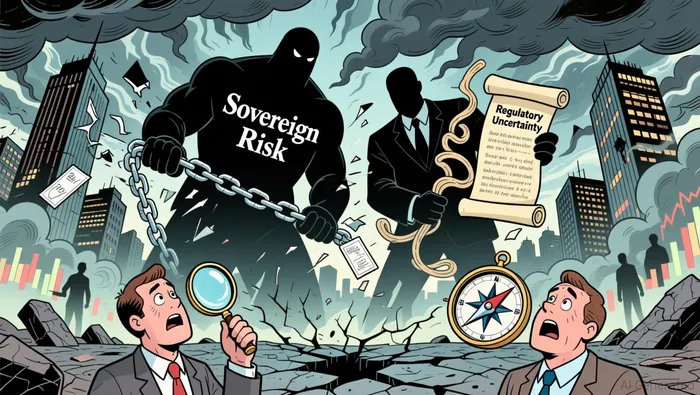 or trade restrictions. Both risks are 'systemic,' meaning they affect entire markets rather than individual stocks.
Why They Matter to Investors Governments shape economies through policies, and regulations define how businesses operate. When sovereign risk rises—say, due to a country’s high debt or political instability—investors may flee to safer assets like U.S. Treasuries, causing market volatility. Regulatory changes can also disrupt industries. For instance, a new carbon tax might hurt energy companies, while data privacy laws could impact tech stocks. These factors don’t just affect bonds; they ripple through equities, currencies, and commodities.
Strategies to Mitigate the Risks 1. Assess Sovereign Risk: - Credit ratings: Agencies like S&P or Moody’s rate countries’ creditworthiness. A downgrade (e.g., from AAA to AA) often signals rising sovereign risk. - Debt-to-GDP ratios: High ratios (like Greece’s 180% in 2010) suggest a country may struggle to repay debt. - Political stability: Look for signs of corruption, governance issues, or political gridlock.
- Navigate Regulatory Uncertainty: - Stay informed: Track policy shifts in key sectors. For example, renewable energy subsidies can boost clean tech stocks. - Diversify geographically: Avoid overexposure to regions with unstable policies. - Engage with experts: Local consultants or legal advisors can help decode regulatory changes.
Case Study: Brexit and the UK Market In 2016, the UK’s decision to leave the EU created massive regulatory uncertainty. Businesses faced questions about trade rules, labor mobility, and financial regulations. The pound sterling plummeted 10% against the dollar in a week, and UK stocks underperformed global markets for years. For example, banks like Barclays saw their stock prices drop as Brexit negotiations dragged on, due to fears of reduced access to EU markets. Investors who hedged currency exposure or avoided UK-specific bets during this period were better positioned to weather the fallout.
Risks and How to Manage Them While strategies like diversification and research help, these risks can’t be fully eliminated. For instance, even stable countries can face unexpected regulatory changes (e.g., the U.S. imposing tariffs in 2018). To mitigate this: - Build a diversified portfolio across regions and sectors. - Use derivatives like options or futures to hedge against currency or market swings. - Prioritize transparency: Invest in companies with strong balance sheets and adaptable business models.
Key Takeaways Sovereign risk and regulatory uncertainty are powerful forces that shape markets in subtle and sudden ways. By monitoring government debt, political trends, and regulatory signals, investors can reduce exposure to these risks. The goal isn’t to avoid them entirely but to anticipate their impact and adjust strategies accordingly. In a world of constant change, staying informed and adaptable is your best defense.

Stay ahead of the market.
Get curated U.S. market news, insights and key dates delivered to your inbox.


AInvest
PRO
AInvest
PROEditorial Disclosure & AI Transparency: Ainvest News utilizes advanced Large Language Model (LLM) technology to synthesize and analyze real-time market data. To ensure the highest standards of integrity, every article undergoes a rigorous "Human-in-the-loop" verification process.
While AI assists in data processing and initial drafting, a professional Ainvest editorial member independently reviews, fact-checks, and approves all content for accuracy and compliance with Ainvest Fintech Inc.’s editorial standards. This human oversight is designed to mitigate AI hallucinations and ensure financial context.
Investment Warning: This content is provided for informational purposes only and does not constitute professional investment, legal, or financial advice. Markets involve inherent risks. Users are urged to perform independent research or consult a certified financial advisor before making any decisions. Ainvest Fintech Inc. disclaims all liability for actions taken based on this information. Found an error?Report an Issue




Comments
No comments yet