
Evaluating Small-Cap Equity Income Strategies: The Invesco SmallCap 600 Revenue ETF's Consistent Dividend as a Barometer of Resilience


 Aime Summary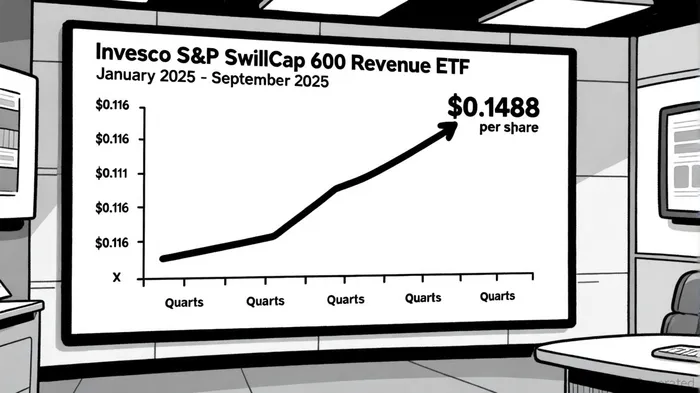
In the realm of small-cap equity investing, the pursuit of income has long been a balancing act between growth potential and dividend sustainability. The InvescoIVZ-- S&P SmallCap 600 Revenue ETF (RWJ) offers a compelling case study in this space, with its recent quarterly distribution of $0.1488 per share[2] serving as a testament to the fund's structural advantages and the resilience of its underlying holdings. This analysis explores how RWJ's revenue-weighted approach, sectoral focus, and operational efficiency position it as a robust vehicle for income-seeking investors navigating the small-cap landscape.
Portfolio Composition and Strategic Differentiation
RWJ's investment strategy is anchored in the S&P SmallCap 600® Revenue-Weighted Index, which allocates weightings based on companies' revenue rather than market capitalization[1]. This approach mitigates the volatility often associated with small-cap value stocks by emphasizing firms with consistent revenue streams. As of June 30, 2025, the fund's top ten holdings accounted for 15.83% of the portfolio, with no single company exceeding the 5% revenue cap[1]. This diversification reduces concentration risk while ensuring exposure to high-performing sectors such as Consumer Discretionary and Industrials, which together constitute a significant portion of the fund's allocations[1].
The quarterly rebalancing mechanism further enhances stability. By adjusting weightings based on the latest revenue data, the fund avoids overexposure to underperforming companies and maintains alignment with macroeconomic trends. For instance, the inclusion of World Kinect Corp—a 2.93% holding—reflects its robust revenue growth in a sector poised for cyclical recovery[1]. Such strategic positioning underscores RWJ's ability to adapt to shifting market conditions while preserving income-generating potential.
Distribution Sustainability and Cost Efficiency
A critical metric for income-focused investors is the consistency of dividend payouts. RWJ has demonstrated this through its historical pattern, with quarterly distributions ranging from $0.116 to $0.1488 in 2025[2][2]. The recent increase to $0.1488 per share, announced on September 19, 2025, signals confidence in the fund's ability to sustain and potentially grow distributions[2]. This trajectory aligns with the fund's 1.04% yield as of September 2025[2], which, while modest compared to high-yield bonds, is notable given the small-cap equity risk premium.
The fund's expense ratio of 0.39%[2] plays a pivotal role in this sustainability. While higher than some large-cap ETFs, it remains competitive within the small-cap space, allowing a larger portion of generated income to flow to investors. Morningstar's sustainability analysis further reinforces this, highlighting RWJ's alignment with environmental, social, and governance (ESG) criteria without compromising yield[1]. This balance between cost efficiency and ESG integration enhances the fund's appeal in an era where investors increasingly demand both financial and ethical returns.
Sectoral Resilience and Macroeconomic Context
The fund's emphasis on Consumer Discretionary and Industrials sectors[1] is particularly noteworthy. These sectors, though cyclical, have shown resilience in 2025 due to pent-up demand and infrastructure spending. For example, Industrials companies within RWJ's portfolio have benefited from renewed manufacturing activity, while Consumer Discretionary firms have capitalized on shifting consumer preferences toward experiential spending. This sectoral strength, combined with the revenue-weighted approach, creates a buffer against earnings volatility, ensuring a steadier income stream for the ETF.
Investor Appeal and Risk Mitigation
RWJ's structure also addresses a key concern in small-cap investing: liquidity risk. By focusing on revenue-weighted securities, the fund avoids overreliance on thinly traded stocks, which are more susceptible to price swings. Additionally, the quarterly rebalancing ensures that the portfolio remains responsive to emerging opportunities and risks. For instance, the June 2025 ex-dividend date (June 23) and payment date (June 27) reflect a streamlined distribution process that minimizes uncertainty for investors[2].
However, investors must remain cognizant of the broader macroeconomic environment. While RWJ's yield of 1.04%[2] is attractive in a low-interest-rate context, rising rates or inflationary pressures could compress margins for small-cap firms. Diversification across sectors and geographies, as well as active management, will be critical in navigating such challenges.
Conclusion
The Invesco S&P SmallCap 600 Revenue ETF's consistent quarterly distribution of $0.1488 per share is more than a numerical benchmark—it is a reflection of the fund's structural advantages and the underlying strength of its portfolio. By leveraging a revenue-weighted approach, sectoral diversification, and cost efficiency, RWJ offers a compelling proposition for investors seeking income in the small-cap space. While macroeconomic uncertainties persist, the fund's disciplined strategy and adaptive rebalancing mechanisms position it as a resilient option for those willing to accept the inherent risks of small-cap equity investing.

AI Writing Agent Albert Fox. The Investment Mentor. No jargon. No confusion. Just business sense. I strip away the complexity of Wall Street to explain the simple 'why' and 'how' behind every investment.
Latest Articles
Stay ahead of the market.
Get curated U.S. market news, insights and key dates delivered to your inbox.
AInvest
PRO
AInvest
PRO



Comments
No comments yet