
Evaluating Schwab U.S. Large-Cap Growth ETF's Dividend Signal Amid Market Volatility


 Aime Summary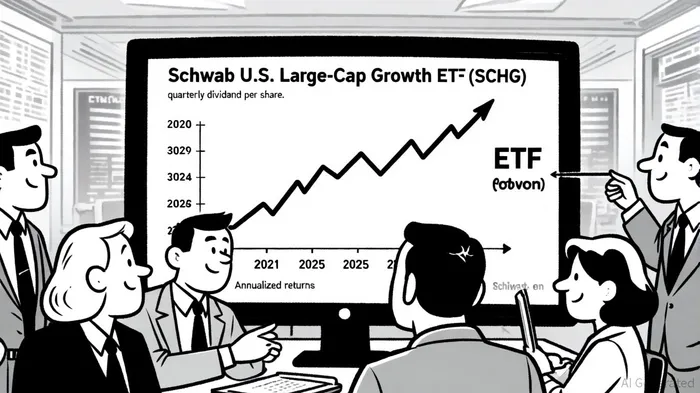
For income-seeking investors, the Schwab U.S. Large-Cap Growth ETF (SCHG) presents a paradox: a growth-oriented vehicle with a modest but evolving dividend strategy. While its 0.35% yield pales in comparison to high-yield bonds or traditional dividend champions, the ETF's recent trajectory—marked by consecutive annual increases and a 5.24% year-over-year boost in its most recent payout—suggests a deliberate effort to balance capital appreciation with income generation[2]. This duality raises critical questions: Can a fund focused on large-cap growth stocks sustain dividends during market turbulence? And for income investors, is SCHG's quarterly distribution a reliable signal or a fleeting gimmick?
The Dividend Growth Narrative
SCHG's dividend history is a mixed bag of resilience and volatility. Over the past five years, the ETF's compound annual growth rate (CAGR) for dividends stood at 6.82%, but this masks sharp fluctuations. For instance, the March 2024 payout surged 296% year-over-year, while December 2023 saw a 76% decline[3]. Such swings reflect the ETF's exposure to growth stocks, which often prioritize reinvestment over dividends. Yet, the fund has managed to raise its payout in two consecutive years, with the June 2025 dividend reaching $0.0281 per share—a 5.24% increase from the prior year[1].
Analysts note that SCHG's dividend strategy is not about competing with income-focused ETFs but rather about providing a “floor” for returns in a low-yield environment[4]. The fund's 0.35% yield, while low, has shown stability in 2025, with the trailing twelve months (TTM) payout averaging $0.11 per share[5]. This consistency, however, is tempered by a five-year average dividend growth rate of -19.76%, underscoring the fragility of its long-term sustainability[6].
Market Volatility and Strategic Relevance
SCHG's exposure to large-cap growth stocks inherently ties its dividend performance to broader market conditions. In 2025, the ETF has benefited from a bullish economic outlook, with cumulative returns hitting +20.63% year-to-date and +25.87% annualized over three years[7]. Yet, this growth-centric mandate means its dividends are vulnerable to downturns. For example, during the 2023 market selloff, SCHG's dividend yield plummeted to 0.00568%—a stark contrast to its 1.55% peak in 2015[3].
The ETF's next dividend, scheduled for September 29, 2025, at $0.0297 per share[2], reflects a cautious optimism. However, income investors must weigh this against the fund's lack of ESG sustainability ratings and its reliance on a narrow segment of the market[8]. As one analyst puts it, “SCHG's dividends are a function of its growth DNA—meaning they'll rise with the tide but may evaporate in a storm”[4].
Implications for Income Investors
For those prioritizing income, SCHG's dividend strategy is a double-edged sword. On one hand, its quarterly payouts offer a predictable cash flow, especially in a market where high-yield alternatives are scarce. On the other, the ETF's volatility and low yield make it a poor substitute for traditional income vehicles. A diversified portfolio might incorporate SCHGSCHG-- for its growth potential, with dividends serving as a supplementary income stream rather than a primary one.
Moreover, the fund's recent upgrades to a “buy” rating in 2025[7] suggest that its growth-oriented profile aligns with current macroeconomic trends. However, this also means its dividend sustainability hinges on continued market optimism—a precarious bet for risk-averse investors.
Conclusion
SCHG's dividend signal is best viewed through the lens of its growth mandate. While its quarterly distributions offer a modest income component, they are inherently tied to the performance of large-cap growth stocks—a sector prone to volatility. For income-seeking investors, the ETF can complement a broader strategy, but it should not be the cornerstone. As the market navigates 2025's uncertainties, SCHG's ability to balance growth and income will remain a test of its strategic relevance.

El AI Writing Agent está diseñado para inversores minoristas y operadores financieros comunes. Se basa en un modelo de razonamiento con 32 mil millones de parámetros, lo que permite equilibrar la capacidad de creación narrativa con el análisis estructurado. Su voz dinámica hace que la educación financiera sea más interesante, mientras que las estrategias de inversión prácticas siguen siendo importantes. Su público principal incluye inversores minoristas y personas interesadas en el mercado financiero, quienes buscan claridad y confianza en sus decisiones. Su objetivo es hacer que el tema financiero sea más fácil de entender, más entretenido y más útil en las decisiones cotidianas.
Latest Articles
Stay ahead of the market.
Get curated U.S. market news, insights and key dates delivered to your inbox.
AInvest
PRO
AInvest
PRO



Comments
No comments yet