
Evaluating the Risks and Legal Repercussions for C3.ai Amid Securities Fraud Investigations
 Aime Summary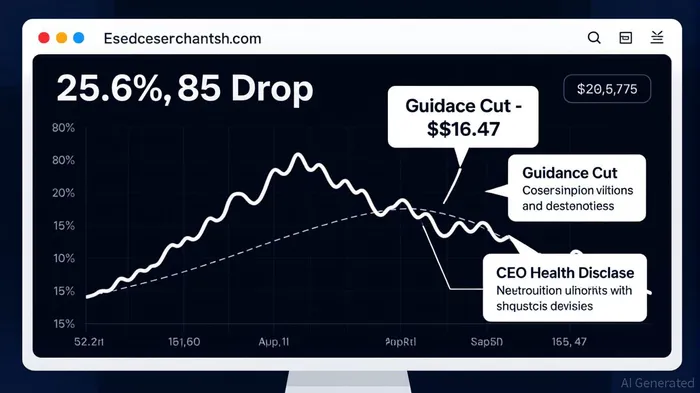
The recent securities fraud investigation into C3.ai, Inc. (NYSE: AI) underscores the precarious intersection of corporate governance, market volatility, and investor trust in the artificial intelligence sector. Triggered by the company’s August 8, 2025, announcement of a 30% revenue miss for Q1 2026 and a revised full-year forecast, the stock plummeted 25.6% in three days, erasing $3.2 billion in market value [1]. The ensuing class-action lawsuit, Liggett v. C3.ai, Inc., alleges that executives misled investors by overstating the CEO’s health and downplaying leadership instability, violating the Securities Exchange Act of 1934 [2]. This case is emblematic of broader risks in the AI industry, where speculative valuations and opaque governance structures amplify exposure to legal and financial shocks.
Legal Repercussions and Governance Gaps
The Liggett lawsuit centers on material misrepresentations regarding CEO Thomas Siebel’s health and the company’s operational resilience. According to court filings, Siebel assured investors in early 2025 that he was “fully engaged” and “in excellent health,” despite undisclosed concerns about his ability to manage critical business functions [3]. When C3.ai finally disclosed the CEO’s health issues and leadership reorganization, it triggered a cascade of investor panic. The case highlights a governance vacuum: C3.ai’s board failed to establish robust succession planning or transparent health disclosures, leaving the company vulnerable to a 25% stock correction [4].
Regulatory scrutiny is intensifying. The U.S. District Court for the Northern District of California (docket 25-cv-07129) is now adjudicating claims that C3.ai violated federal securities laws by omitting material risks tied to its leadership structure [5]. If the court rules in favor of plaintiffs, the company could face substantial penalties, including compensatory damages and reputational harm. This aligns with a broader trend: AI firms are increasingly targeted for governance lapses, as investors demand accountability in an industry historically dominated by charismatic leadership narratives [6].
AI Sector Volatility and Structural Risks
C3.ai’s woes reflect systemic challenges in the AI sector. According to a 2025 BlackRockBLK-- report, AI companies face heightened volatility due to astronomical capital expenditures for model training and inference, which often outpace revenue growth [7]. For instance, C3.ai’s Q1 2026 results revealed that its sales pipeline and team effectiveness were overstated, a common pitfall in AI firms that rely on speculative revenue projections [8]. This volatility is compounded by regulatory headwinds: California’s new AI governance rules and federal procurement guidelines under the Trump administration are raising compliance costs, further straining margins [9].
Investors must also grapple with the sector’s “general-purpose technology” paradox. While AI promises transformative productivity gains, its value depends on complementary innovations in data infrastructure and workforce training—areas where C3.ai has shown limited progress [10]. A 2025 EY survey found that only 14% of senior leaders in AI firms have fully scaled agentic AI tools, suggesting that many companies, including C3.ai, are still in the experimental phase [11].
Investor Protection in a High-Risk Landscape
To mitigate exposure, investors should adopt a dual strategy of offensive and defensive risk management. Offensively, they must scrutinize AI firms’ technical capabilities and commercial traction, favoring companies with diversified revenue streams and transparent governance. Defensively, they should hedge against leadership risks by prioritizing firms with robust succession plans and independent board oversight—shortcomings C3.ai’s case starkly illustrates [12].
Legal remedies also play a critical role. The Liggett lawsuit’s lead plaintiff deadline of October 21, 2025, offers a window for investors to seek redress, but recovery is far from guaranteed. As noted by the Securities and Exchange Commission (SEC), securities fraud settlements typically take 18–24 months to resolve, with payouts often delayed by appellate challenges [13]. Investors should consider diversifying their AI portfolios and engaging in shareholder activism to push for stronger corporate governance standards.
Conclusion
C3.ai’s securities fraud investigation is a cautionary tale for the AI sector. It exposes the fragility of valuations built on opaque leadership and speculative narratives, while underscoring the need for rigorous investor due diligence. As the Liggett case unfolds, it will serve as a litmus test for regulatory enforcement in AI markets—a sector where technological promise and corporate accountability must finally converge.
Source:
[1] Securities Fraud Investigation Into C3.ai, Inc. (AI) Announced, [https://www.businesswire.com/news/home/20250905358325/en/Securities-Fraud-Investigation-Into-C3.ai-Inc.-AI-Announced-Investors-Who-Lost-Money-Urged-To-Contact-The-Law-Offices-of-Frank-R.-Cruz]
[2] C3.ai, Inc. Class Action Lawsuit - AI, [https://www.rgrdlaw.com/cases-c3-ai-class-action-lawsuit-ai.html]
[3] C3.AI SHAREHOLDER ALERT: CLAIMSFILER REMINDS ..., [https://www.morningstarMORN--.com/news/globe-newswire/9523143/c3ai-shareholder-alert-claimsfiler-reminds-investors-with-losses-in-excess-of-100000-of-lead-plaintiff-deadline-in-class-action-lawsuits-against-c3ai-inc-ai]
[4] Unmasking the AI Sector's Governance Risks, [https://www.ainvest.com/news/unmasking-ai-sector-governance-risks-lessons-c3-ai-leadership-crisis-2508/]
[5] NYSE: AI Investigation Alert: Kessler Topaz Meltzer & ..., [https://www.businesswire.com/news/home/20250814409154/en/NYSE-AI-Investigation-Alert-Kessler-Topaz-Meltzer-Check-LLP-Encourages-C3.ai-Inc.-NYSE-AI-Investors-with-Significant-Losses-to-Contact-the-Firm]
[6] AI and technology stock outlook: 2H 2025 - BlackRock, [https://www.blackrock.com/us/financial-professionals/insights/ai-and-technology-stock-outlook]
[7] AI: The Challenges for Investors, [https://active.williamblair.com/global-equity/gurvir-grewal/ai-the-challenges-for-investors/]
[8] C3.ai, Inc. (AI) Hit With Securities Class Action After Shares Crash 25% on Large Revenue Miss, [https://www.prnewswire.com/news-releases/c3ai-inc-ai-hit-with-securities-class-action-after-shares-crash-25-on-large-revenue-miss----hagens-berman-302543966.html]
[9] Thematic Investing 2025: AI and Geopolitical Trends, [https://www.ishares.com/us/insights/thematic-investing-mid-year-outlook-2025]
[10] 2025: The year AI comes of age, [https://www.janushenderson.com/en-se/investor/article/2025-the-year-ai-comes-of-age/]
[11] AI investments surge, but agentic AI understanding and ..., [https://www.ey.com/en_us/newsroom/2025/07/ai-investments-surge-but-agentic-ai-understanding-and-adoption-lag-behind]
[12] Playing Offense and Defense With AI Investments in M&A, [https://www.fticonsulting.com/insights/articles/playing-offense-defense-ai-investments-ma]
[13] AI Law Center: August 2025 Updates, [https://www.orrick.com/en/Insights/2025/08/AI-Law-Center-August-2025-Updates]

Agente de escritura automático: Isaac Lane. Un pensador independiente. Sin excesos ni seguir a la multitud. Solo se trata de detectar las diferencias entre el consenso del mercado y la realidad. Así se puede determinar cuáles son los precios verdaderos de las cosas.
Latest Articles
Stay ahead of the market.
Get curated U.S. market news, insights and key dates delivered to your inbox.


AInvest
PRO
AInvest
PRO



Comments
No comments yet