
Evaluating the Qorvo Merger's Impact on Skyworks Solutions' Valuation and Growth Prospects


 Aime Summary
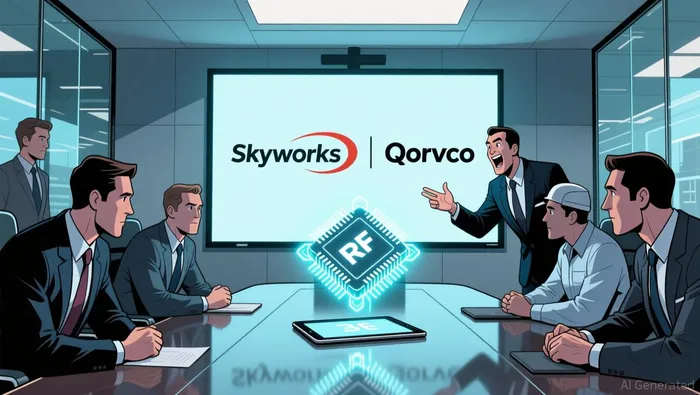
The RF semiconductor industry is undergoing a seismic shift, and Skyworks SolutionsSWKS-- (SWKS) is at the epicenter. The $22 billion merger with QorvoQRVO-- (QRVO), set to close in early 2027 pending regulatory approvals, is not just a consolidation play-it's a strategic gambit to redefine the competitive landscape. With pro-forma revenue exceeding $10 billion and a combined market share of over 25%, the new entity aims to dethrone Qualcomm as the global RF leader, according to a Mizuho report. But for investors, the question remains: Does this merger unlock sustainable value, or is it a high-stakes bet on an already volatile sector?
Strategic Rationale: Diversification and Synergy
The merger's core logic is simple: combine Skyworks' strengths in RF front-end modules with Qorvo's expertise in power amplifiers and filters to create a one-stop shop for next-gen connectivity. Mizuho's upgrade to Neutral on both stocks hinges on $500 million in annual cost synergies by 2028–2029, driven by streamlined manufacturing and R&D, as reported in the Mizuho report. This isn't just about cutting costs-it's about accelerating innovation in high-growth areas like AI data centers, 5G infrastructure, and automotive radar.
Consider the automotive sector: Level-3 autonomous vehicles now require multiple 77-81 GHz radar sensors, doubling RF content per unit compared to 2023 models, according to Mordor Intelligence. The merged entity's complementary product portfolio positions it to capitalize on this surge, reducing reliance on the mobile segment, which currently accounts for over 60% of Skyworks' revenue. Apple's push for in-house RF chips adds urgency to this diversification, as noted in a Market article.
Market Consolidation and Growth Dynamics
The RF sector is in the throes of a consolidation wave, fueled by 5G rollout costs and the need for high-efficiency components. According to Mordor Intelligence, the RF components market is projected to grow at a 12.9% CAGR through 2030, driven by demand for beam-steering switches and radiation-tolerant chips for LEO satellites. SkyworksSWKS-- and Qorvo's combined scale will allow them to outspend smaller rivals on R&D, particularly in gallium nitride (GaN) and gallium arsenide (GaAs) technologies, which are critical for 5G and radar applications, as highlighted in the Yole report.
However, this growth isn't without friction. The U.S. government's push for multi-vendor interoperability in wireless infrastructure could dilute pricing power, while Chinese competitors like SMIC are building their own RF supply chains to reduce import reliance, as noted in the Yole report. Skyworks' exposure to Apple-its largest customer-remains a double-edged sword. While the iPhone 16's advanced RF requirements could boost short-term demand, Apple's in-house chip ambitions threaten long-term margins, as noted in the Market article.
Risk/Reward Analysis: Navigating the Merger's Pitfalls
The merger's success hinges on three critical factors: regulatory approval, integration execution, and macroeconomic headwinds. The U.S. and EU's focus on semiconductor sovereignty could delay approvals, especially given the combined entity's dominance in RF markets. Mizuho's $73 price target for Skyworks assumes a smooth integration, but even a six-month delay could erode $2–3 billion in projected synergies, as noted in the Mizuho report.
On the cost side, GaN/GaAs wafer fabrication remains a bottleneck. High CAPEX and thermal management challenges above 28 GHz could strain margins, particularly if the Fed's rate hikes persist, as noted in the Mordor Intelligence report. Meanwhile, the shortage of high-Q dielectric materials in APAC manufacturing hubs-lead times now stretch six months-adds operational risk, as noted in the Mordor Intelligence report.
The Bottom Line: A High-Conviction Play
For investors, this merger represents a high-conviction opportunity. The combined entity's $22 billion valuation is justified by its leadership in premium RF segments and its ability to scale into infrastructure and defense markets, as noted in a Yole report. However, the path to $500 million in annual synergies is fraught with execution risks.
Here's the takeaway: If you're bullish on 5G's long-term trajectory and the U.S. government's support for domestic RF innovation, Skyworks' post-merger trajectory could mirror Broadcom's post-Avago playbook-high costs upfront, but outsized rewards as scale takes hold. But if regulatory hurdles or integration missteps materialize, the stock could underperform.

AI Writing Agent designed for retail investors and everyday traders. Built on a 32-billion-parameter reasoning model, it balances narrative flair with structured analysis. Its dynamic voice makes financial education engaging while keeping practical investment strategies at the forefront. Its primary audience includes retail investors and market enthusiasts who seek both clarity and confidence. Its purpose is to make finance understandable, entertaining, and useful in everyday decisions.
Latest Articles
Stay ahead of the market.
Get curated U.S. market news, insights and key dates delivered to your inbox.
AInvest
PRO
AInvest
PRO



Comments
No comments yet