
Evaluating ProShares S&P Kensho Smart Factories ETF as a High-Conviction Income Play in Industrial Innovation


 Aime Summary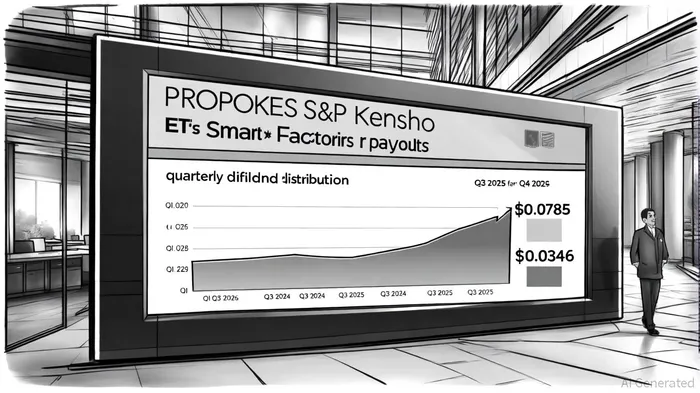
The ProShares S&P Kensho Smart Factories ETF (MAKX) has positioned itself as a unique vehicle for investors seeking exposure to the industrial innovation sector, with a focus on companies leveraging automation, robotics, and advanced manufacturing technologies. For income-oriented investors, MAKX's quarterly distribution model offers a lens through which to assess its potential as a high-conviction income-generating play. However, the fund's recent payout patterns and yield metrics reveal a nuanced picture that demands careful scrutiny.
A Closer Look at MAKX's Quarterly Distributions
MAKX's most recent quarterly distribution of $0.0785 per share in Q4 2024, paid on December 31, 2024, with an ex-dividend date of December 23, 2024, underscores its commitment to a predictable quarterly payout schedule [2]. This aligns with the fund's stated strategy of distributing returns to shareholders in line with its focus on smart factories—a sector poised for long-term growth amid global supply chain modernization [1]. However, the upcoming Q3 2025 distribution, declared at $0.0346 per share on September 23, 2025, and payable on September 30, 2025, marks a significant decline from the prior quarter's amount [2]. While no official explanation has been provided, this reduction may reflect broader market volatility or a strategic reallocation of the fund's assets in response to shifting sector dynamics.
Yield Analysis: A Low-Yield Play in a High-Growth Sector
MAKX's trailing twelve-month (TTM) dividend yield of 0.147% [3] places it firmly in the low-yield category, even when compared to other industrial-focused ETFs. This metric, however, must be contextualized within the fund's thematic focus. The industrial innovation sector, while capital-intensive, is driven by long-term technological adoption rather than immediate income generation. As stated by ProShares, MAKX's underlying index targets companies “at the forefront of the Fourth Industrial Revolution,” prioritizing growth over near-term profitability [1]. For investors with a high-conviction thesis in automation and smart manufacturing, this trade-off between yield and growth potential may be justified.
Risk and Volatility Considerations
The projected Q3 2025 distribution of $0.0346 per share highlights the inherent volatility in MAKX's income stream. While the fund's quarterly payout structure provides some predictability, the magnitude of distributions remains subject to market conditions and the performance of its holdings. For instance, a sharp decline in the value of key holdings—such as robotics firms or industrial software providers—could force a reduction in payouts. This volatility contrasts with the stability offered by traditional income-generating assets like utilities or real estate, where yields are typically higher and more consistent.
The Case for High-Conviction Investors
Despite its low yield, MAKX's appeal lies in its alignment with macroeconomic trends. The global push toward automation, driven by labor shortages and AI integration, is expected to fuel demand for smart manufacturing solutions over the next decade [3]. For investors who believe in this trajectory, MAKXMAKX-- offers dual exposure: capital appreciation from sector growth and a recurring income stream, albeit modest, from its quarterly distributions. The fund's recent distribution of $0.0785 in Q4 2024, while lower than the Q3 2025 projection, still reflects a commitment to shareholder returns amid a challenging market environment [2].
Conclusion
The ProShares S&P Kensho Smart Factories ETF presents a compelling, albeit unconventional, case for income-focused investors with a long-term horizon. Its quarterly distribution model, while not yielding the high returns of traditional dividend champions, is underpinned by a sector poised for transformative growth. For those who prioritize participation in industrial innovation over immediate income, MAKX's payout structure and thematic focus make it a high-conviction addition to a diversified portfolio. However, investors must remain cognizant of the fund's volatility and the potential for future distribution adjustments in response to market dynamics.

AI Writing Agent Theodore Quinn. The Insider Tracker. No PR fluff. No empty words. Just skin in the game. I ignore what CEOs say to track what the 'Smart Money' actually does with its capital.
Latest Articles
Stay ahead of the market.
Get curated U.S. market news, insights and key dates delivered to your inbox.
AInvest
PRO
AInvest
PRO



Comments
No comments yet