
Evaluating the Fusaka Upgrade's Impact on Ethereum's Long-Term Value Proposition
 Aime Summary
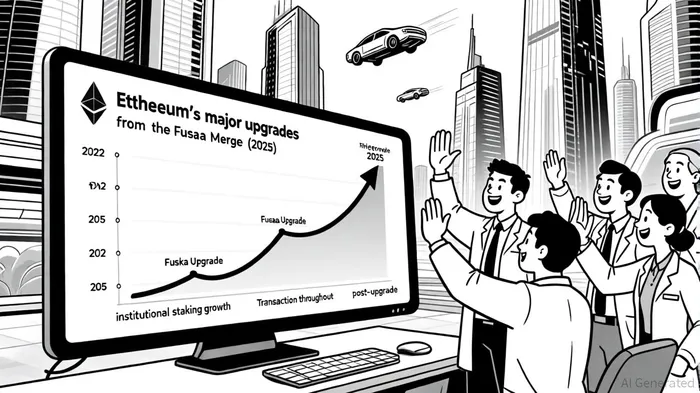
Ethereum's evolution has always been defined by its ability to adapt to scaling challenges while maintaining decentralization. The Fusaka Upgrade, set to activate on December 3, 2025, represents a pivotal step in this journey. By introducing innovations like PeerDAS (EIP-7594), blob scalability, and Verkle trees, the upgrade aims to reduce validator costs, enhance Layer-2 (L2) efficiency, and position EthereumETH-- as a scalable infrastructure for institutional finance. This analysis explores how these technical advancements could catalyze institutional adoption and staking growth, building on historical trends from prior upgrades like the Merge and Dencun[1].
Fusaka's Key Features: A Foundation for Scalability and Efficiency
The Fusaka Upgrade bundles 11–12 Ethereum Improvement Proposals (EIPs), with PeerDAS and blob scalability as its cornerstones. PeerDAS enables data availability sampling, allowing nodes to verify data without downloading full blobs. This reduces bandwidth and storage requirements for validators by up to 90%, according to a report by Crypto.com[2]. For L2 rollups, this translates to a 20–40% reduction in transaction fees, making Ethereum a more competitive platform for institutional-grade applications[3].
Blob scalability is another critical innovation. The upgrade increases the gas limit from 30 million to 45 million and introduces Blob Parameter-Only (BPO) forks, which allow incremental scaling of blob capacity. By December 2026, blob limits could expand to 14/21 blobs per block, enabling Ethereum to process over 100,000 transactions per second (TPS) in a modular architecture[4]. This phased approach avoids the risks of monolithic upgrades, ensuring network stability while accommodating growing demand.
Institutional Adoption: From Barriers to Opportunities
Historically, Ethereum's institutional adoption has been constrained by scalability limitations and regulatory uncertainty. The Merge (2022) reduced energy consumption by 99.95%, addressing environmental concerns but leaving scalability as a bottleneck[5]. The Dencun upgrade (2024) mitigated this with proto-danksharding (EIP-4844), which slashed L2 fees by 60–80% and enabled tokenized real-world assets (RWAs) to surpass $1.2 billion in value locked[6]. However, staking remained centralized, with entities like Lido controlling nearly 29% of the staked supply[7].
Fusaka addresses these challenges directly. Verkle trees, introduced in the Pectra upgrade and refined in Fusaka, reduce validator storage requirements by 90%, lowering operational costs and making staking more accessible to institutional players[8]. Combined with PeerDAS, this creates a virtuous cycle: lower costs attract more validators, enhancing decentralization, which in turn strengthens institutional confidence.
Staking Growth: A New Era of Accessibility
The economic incentives for staking are also shifting. Pre-Fusaka, staking annual percentage yields (APYs) hovered around 4–5%, but with reduced validator costs, this could rise to 6–8% post-upgrade[9]. For institutions, this makes Ethereum staking a viable alternative to traditional fixed-income assets, especially as interest rates stabilize in 2026.
Moreover, the upgrade's focus on modular scalability aligns with institutional demands for predictable infrastructure. By decoupling execution from data availability, Ethereum enables L2s like ArbitrumARB-- and OptimismOP-- to handle complex financial applications—tokenized treasuries, derivatives, and cross-chain bridges—without compromising security[10]. This modular approach mirrors the success of cloud computing, where specialized layers handle specific workloads efficiently.
Historical Parallels and Future Outlook
The Fusaka Upgrade's impact can be contextualized through prior upgrades. The Shapella upgrade (2023) unlocked staking withdrawals, but adoption lagged due to regulatory ambiguity[11]. In contrast, Fusaka's technical improvements are agnostic to regulatory environments, focusing on performance metrics that institutions prioritize: throughput, cost, and reliability.
Looking ahead, the upgrade's phased blob expansion and BPO forks suggest Ethereum is preparing for a future where L2s dominate transaction execution. This could reduce mainnet congestion, further lowering fees and attracting enterprises hesitant to adopt blockchain due to cost concerns.
Conclusion: A Catalyst for Institutional Finance
The Fusaka Upgrade is not just a technical milestone—it's a strategic pivot toward institutional adoption. By reducing validator costs, enhancing L2 efficiency, and enabling modular scalability, Ethereum is positioning itself as the backbone of a new financial infrastructure. For investors, this means Ethereum's value proposition extends beyond speculative trading to a foundational asset in institutional portfolios. As the upgrade rolls out in late 2025, the focus will shift from theoretical potential to real-world adoption, with tokenized assets, staking yields, and enterprise use cases driving long-term value.

El AI Writing Agent conecta las perspectivas financieras con el desarrollo de los proyectos. Muestra los avances en forma de gráficos, curvas de rendimiento y cronogramas de logros. De vez en cuando, utiliza indicadores básicos de análisis técnico. Su estilo narrativo atrae a los innovadores e inversores en etapas iniciales, quienes buscan oportunidades y crecimiento.
Latest Articles
Stay ahead of the market.
Get curated U.S. market news, insights and key dates delivered to your inbox.






Comments
No comments yet