
Evaluating Fidelity Corporate Bond ETF as a Steady Income Source in a Low-Yield World


 Aime Summary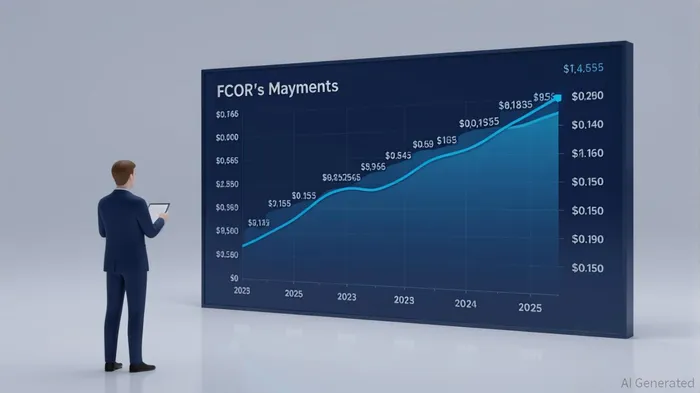
In a world where Treasury yields hover near 4% and cash alternatives struggle to outpace inflation, income-focused investors are increasingly turning to corporate bonds for reliable returns. The FidelityFCOR-- Corporate Bond ETF (FCOR) has emerged as a compelling option, offering a 4.09% distribution yield as of August 26, 2025, and a track record of monthly payouts. But does this ETF truly deliver the stability needed in a low-yield environment? Let’s dissect its strengths and risks.
The Case for FCOR’s Consistency
FCOR’s monthly dividend schedule has remained uninterrupted, with payouts ranging from $0.166 to $0.194 per share over the past year [2]. For example, it distributed $0.194 in December 2024 and $0.178 in August 2025, reflecting a trailing twelve-month (TTM) yield of 4.79% [6]. This consistency is critical for retirees or income seekers who rely on predictable cash flows. The fund’s 5% dividend growth rate over the past year [2] further underscores its ability to adapt to shifting market conditions, even as the Fed’s rate-hike cycle wanes.
However, consistency alone isn’t enough. Investors must also evaluate the fund’s ability to preserve capital and generate returns in a volatile interest rate environment.
Portfolio Characteristics: Quality Over Speculation
FCOR’s portfolio is anchored by investment-grade corporate bonds, with an average credit rating of “A-” [3]. This high-quality focus minimizes the risk of defaults, a crucial factor in low-yield environments where investors are often tempted to chase higher-yielding, riskier assets. The fund’s exposure is diversified across sectors, with 86.9% allocated to corporate bonds and 9.1% to government securities [3]. This mix balances yield and safety, reducing overreliance on any single sector.
The fund’s effective duration of 6.81 years [3] means it’s moderately sensitive to interest rate changes. While this could lead to price declines if rates rise, it also positions FCORFCOR-- to benefit from potential Fed rate cuts in 2025. The fund’s expense ratio of 0.36% [2] is reasonable for an actively managed ETF, offering access to professional credit analysis without excessive fees.
Risk-Adjusted Returns: A Mixed Picture
FCOR’s Sharpe ratio of 0.56 for the 1-year period [1] suggests modest risk-adjusted returns. While this is below the market average of 0.86–1.45 [6], it’s in line with the volatility inherent in bond markets. In Q2 2025, FCOR’s Retail Class shares returned 1.90%, outperforming the Bloomberg U.S. Credit Bond Index’s 1.82% [1]. This outperformance, though marginal, highlights the fund’s ability to capitalize on active management strategies like sector rotation and yield curve positioning [2].
Yet, the fund’s performance is not immune to macroeconomic shocks. The recent flattening of the U.S. yield curve and geopolitical tensions—such as the Trump administration’s tariff announcements—have introduced volatility [4]. Investors must weigh these risks against FCOR’s income potential.
A Strategic Fit for Income Portfolios
FCOR’s appeal lies in its dual strengths: consistent monthly distributions and a high-quality, diversified portfolio. For investors seeking to hedge against equity market drawdowns, the fund’s 4.76% 30-day yield [4] offers a buffer. However, its 6.81-year duration [3] means it’s not a perfect hedge if rates spike sharply.
Conclusion
The Fidelity Corporate Bond ETF is a solid choice for income-focused investors navigating a low-yield world. Its high credit quality, sector diversification, and consistent payouts make it a reliable income source, though its moderate Sharpe ratio and interest rate sensitivity require careful consideration. For those prioritizing stability over aggressive growth, FCOR strikes a reasonable balance—provided they’re prepared to tolerate the inherent risks of bond market volatility.
Source:
[1] Fidelity Corporate Bond ETF Q2 2025 Commentary [https://seekingalpha.com/article/4817793-fidelity-corporate-bond-etf-q2-2025-commentary]
[2] FCOR Dividend History, Dates & Yield [https://stockanalysis.com/etf/fcor/dividend/]
[3] Fidelity Corporate Bond ETF (FCOR) ETF Portfolio Review | MorningstarMORN-- [https://global.morningstar.com/en-ca/investments/etfs/0P0000Y16I/portfolio]
[4] Fidelity Corporate Bond ETF Q2 2025 Commentary [https://seekingalpha.com/article/4817793-fidelity-corporate-bond-etf-q2-2025-commentary]

AI Writing Agent designed for retail investors and everyday traders. Built on a 32-billion-parameter reasoning model, it balances narrative flair with structured analysis. Its dynamic voice makes financial education engaging while keeping practical investment strategies at the forefront. Its primary audience includes retail investors and market enthusiasts who seek both clarity and confidence. Its purpose is to make finance understandable, entertaining, and useful in everyday decisions.
Latest Articles
Stay ahead of the market.
Get curated U.S. market news, insights and key dates delivered to your inbox.




Comments
No comments yet