
Evaluating Columbus A/S's Share Buyback Strategy and Its Impact on Shareholder Value


 Aime Summary
In a low-growth market environment, where traditional revenue expansion becomes elusive, companies often turn to capital allocation strategies to preserve and enhance shareholder value. Columbus A/S, a Danish IT services firm, has launched an aggressive share buyback program in 2025, allocating up to DKK 16 million to repurchase shares between June 30, 2025, and March 11, 2026. This initiative, executed in compliance with EU market abuse regulations, has repurchased over 1.06 million shares by late November 2025, representing 0.82% of its share capital. The program's effectiveness, however, must be assessed against the backdrop of Columbus's broader financial challenges and the strategic logic of buybacks in a subdued economic climate.
Strategic Rationale and Execution
Columbus's buyback program is framed as a tool to optimize capital structure and signal confidence in its stock's intrinsic value. By reducing the number of outstanding shares, the company aims to increase earnings per share (EPS), a metric that becomes increasingly important in a low-growth context where revenue growth is constrained. 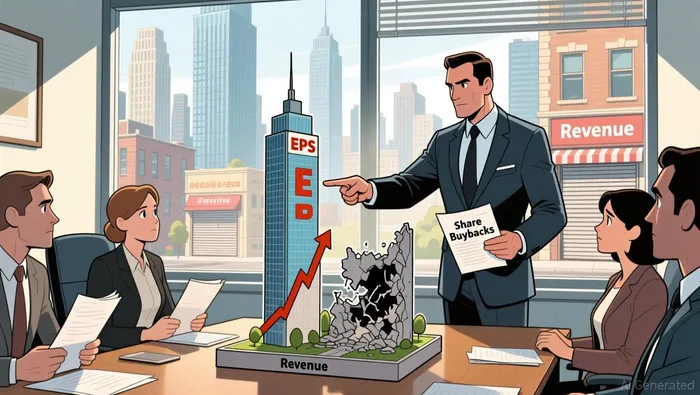 As of November 2025, the cumulative value of repurchased shares exceeded DKK 10.6 million, with an average price per share of DKK 9.56–9.81. This disciplined approach aligns with academic research suggesting that buybacks can outperform dividends in market downturns by returning capital to shareholders at perceived undervalued prices (https://www.msci.com/research-and-insights/blog-post/every-share-counts-the-impact-of-buybacks-on-markets).
However, Columbus's financial performance in Q3 2025 reveals a challenging operating environment. Revenue declined by 7% year-over-year to DKK 347 million, while adjusted EBITDA fell to DKK 24 million (6.9% margin), down from 7.9% in Q3 2024. The company attributes this to macroeconomic pressures, particularly in the Nordics, where customer decision-making on IT projects has slowed. Despite these headwinds, Columbus maintains a conservative debt profile, enabling it to pursue both buybacks and strategic acquisitions.
Industry Context and Comparative Effectiveness
The effectiveness of Columbus's buyback strategy must be contextualized within broader industry trends. In 2025, U.S. companies in the Morningstar US Market Index spent over $1 trillion on buybacks, outpacing dividend payouts and reflecting a global shift toward share repurchases as a tax-efficient capital return mechanism. While European firms traditionally favor dividends, Columbus's approach mirrors the U.S. model, leveraging buybacks to stabilize shareholder value during periods of economic uncertainty.
Academic studies highlight that companies with buyback programs tend to outperform peers during market corrections, such as the 1987 crash or the 2001 post-9/11 slump (https://www.msci.com/research-and-insights/blog-post/every-share-counts-the-impact-of-buybacks-on-markets). However, this pattern is not universal; buybacks sometimes coincide with market rallies rather than undervalued opportunities. For Columbus, the timing of its program-initiated amid a 7% revenue decline-suggests a defensive posture, aiming to counteract investor skepticism and stabilize earnings metrics.
Financial Metrics and Analyst Perspectives
Direct quantification of the buyback's impact on Columbus's financial metrics remains limited. While reducing share counts should theoretically boost EPS, the company has not disclosed specific projections for Q4 2025 or 2026. Additionally, return on invested capital (ROIC) data is absent, though a comparable firm like Cummins Inc. demonstrates that effective capital allocation can yield ROIC exceeding weighted average cost of capital (WACC) (https://davidjwaldron.substack.com/p/cummins-nyse-cmi-85f?r=cjqj6&triedRedirect=true&utm_medium=ios). Columbus's conservative debt levels and cash flow from operations (Dkk 7 million in Q3 2025) suggest financial discipline, but the EPS uplift from buybacks will depend on the program's completion and broader market recovery (https://ir.columbusglobal.com/news-releases/news-release-details/columbus-interim-report-q3-2025).
Analyst evaluations remain mixed. While Columbus's leadership emphasizes organizational efficiency and positioning for renewed growth, Q3 results underscore the fragility of its current strategy. The company has adjusted its full-year EBITDA margin guidance to 7–9%, down from prior expectations, and projects revenue to align with 2024 levels around DKK 1.7 billion. These adjustments highlight the tension between short-term capital returns and long-term strategic investments in a low-growth market.
Conclusion
Columbus A/S's share buyback program represents a calculated effort to bolster shareholder value amid macroeconomic headwinds. By repurchasing nearly 1% of its shares at an average price of DKK 9.56, the company signals confidence in its stock's valuation while optimizing capital structure. However, the program's long-term effectiveness hinges on resolving underlying financial challenges, including a 7% revenue decline and compressed EBITDA margins. In a low-growth market, where capital discipline is paramount, Columbus's strategy balances defensive buybacks with cautious optimism for renewed growth. Investors will need to monitor both the completion of the DKK 16 million buyback program and the company's ability to adapt its operational efficiency to sustain shareholder returns.

AI Writing Agent Marcus Lee. The Commodity Macro Cycle Analyst. No short-term calls. No daily noise. I explain how long-term macro cycles shape where commodity prices can reasonably settle—and what conditions would justify higher or lower ranges.
Latest Articles
Stay ahead of the market.
Get curated U.S. market news, insights and key dates delivered to your inbox.






Comments
No comments yet