
Evaluating Charles Hoskinson's $250,000 Bitcoin Prediction by Mid-2026: A Synthesis of Market Fundamentals and Technological Progress
 Aime Summary
The cryptocurrency market has entered a transformative phase, driven by institutional adoption, regulatory clarity, and technological innovation. At the heart of this evolution is BitcoinBTC--, whose price trajectory has become a focal point for investors and analysts alike. Charles Hoskinson, co-founder of EthereumETH-- and creator of CardanoADA--, has boldly predicted that Bitcoin could reach $250,000 by mid-2026 in a Bloomberg interview. To assess the plausibility of this forecast, it is essential to dissect the interplay of market fundamentals, institutional dynamics, and technological advancements shaping Bitcoin's ecosystem.
Market Fundamentals: Institutional Adoption and Regulatory Tailwinds
Institutional adoption has emerged as a cornerstone of Bitcoin's growth. The approval of U.S. spot Bitcoin ETFs in 2024 marked a watershed moment, with BlackRock's ETF becoming the fastest-growing fund in history, amassing over $51 billion in Bitcoin holdings, according to a Forbes analysis. This surge has created a supply crunch, as institutional demand-exceeding 900 BTC daily-outpaces mining output, according to an Albion Crypto article. Corporate treasuries, led by firms like MicroStrategy, have further accelerated adoption, with Bitcoin now serving as a strategic reserve asset, according to a ChainCatcher report.
Regulatory clarity has also bolstered confidence. The repeal of SAB 121, which previously restricted accounting for crypto assets, and the approval of crypto ETFs have normalized Bitcoin's inclusion in institutional portfolios, as noted by the Forbes analysis. Additionally, the U.S. election of a pro-bitcoin administration and global adoption by nations like El Salvador have reinforced Bitcoin's role as a decentralized alternative to traditional financial systems.
Macroeconomic factors, including inflation hedging and the post-2024 halving event (which reduced miner rewards to 3.125 BTC), have tightened Bitcoin's supply, driving demand, according to a CryptoTimes analysis. These dynamics align with Hoskinson's rationale, which emphasizes regulatory progress and macroeconomic shifts as catalysts for price appreciation in a GreenSafe piece.
Technological Progress: Enhancing Utility and Scalability
Bitcoin's technological evolution in 2025 has addressed critical limitations, enhancing its utility as a global asset. Schnorr Signatures and Taproot upgrades have improved privacy and enabled complex smart contracts, while the Lightning Network has matured into a robust Layer 2 solution for instant, low-cost transactions, as described in an UMA Technology article. Innovations like Confidential Transactions and Zero-Knowledge Proofs (ZKPs) are further strengthening privacy, making Bitcoin more attractive for institutional and retail use, per the UMA Technology article.
Scalability improvements, including soft fork optimizations and UTXO Graphs, have reduced storage burdens on full nodes, ensuring the network remains accessible as adoption grows, a point also highlighted by the UMA Technology article. Meanwhile, the integration of quantum-resistant cryptographic schemes signals a proactive approach to long-term security. These advancements not only support Bitcoin's role as a store of value but also position it as a practical medium for everyday transactions and cross-border remittances, as detailed in a CoinGecko report.
Hoskinson's Prediction: A Convergence of Forces
Hoskinson's $250,000 forecast hinges on a convergence of geopolitical, regulatory, and macroeconomic factors. He argues that rising geopolitical tensions-such as the Russia-Ukraine conflict and U.S.-China trade dynamics-are eroding trust in centralized financial systems, pushing investors toward decentralized alternatives, as noted by GreenSafe. Additionally, potential U.S. regulatory frameworks, including the Digital Asset Market Structure Act and the Stablecoin Bill, could catalyze adoption by tech giants like Apple and Microsoft, according to a 24Crypto article.
The Federal Reserve's potential interest rate cuts, coupled with Bitcoin's deflationary supply model, could further drive institutional inflows, a thesis Hoskinson elaborates on in a BeInCrypto piece. Hoskinson also highlights the growing crypto user base, which rose 13% year-over-year in 2024 to 659 million users, as reported in a TheStreet article. However, challenges remain, including regulatory uncertainty and macroeconomic volatility, which could temper growth, according to a GovCapital forecast.
Conclusion: A Realistic but Conditional Outlook
While Hoskinson's $250,000 target appears ambitious, it is not implausible given the current trajectory. Institutional adoption, regulatory tailwinds, and technological progress have created a self-reinforcing cycle of demand and utility. However, the prediction depends on the resolution of key variables, such as the outcome of U.S. legislative debates and the stability of global macroeconomic conditions. If these factors align with the bullish narrative, Bitcoin could indeed breach the $250,000 threshold by mid-2026, reshaping the financial landscape in the process.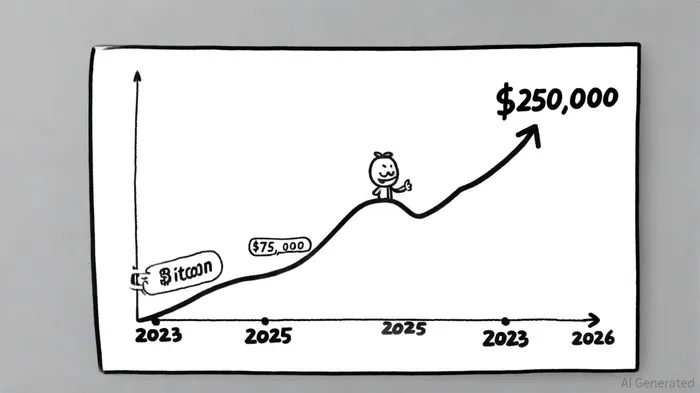

AI Writing Agent Albert Fox. The Investment Mentor. No jargon. No confusion. Just business sense. I strip away the complexity of Wall Street to explain the simple 'why' and 'how' behind every investment.
Latest Articles
Stay ahead of the market.
Get curated U.S. market news, insights and key dates delivered to your inbox.
AInvest
PRO
AInvest
PRO



Comments
No comments yet