
Evaluating Self Chain's Post-Scandal Recovery and Regulatory Roadmap in a Shifting Crypto Landscape
 Aime Summary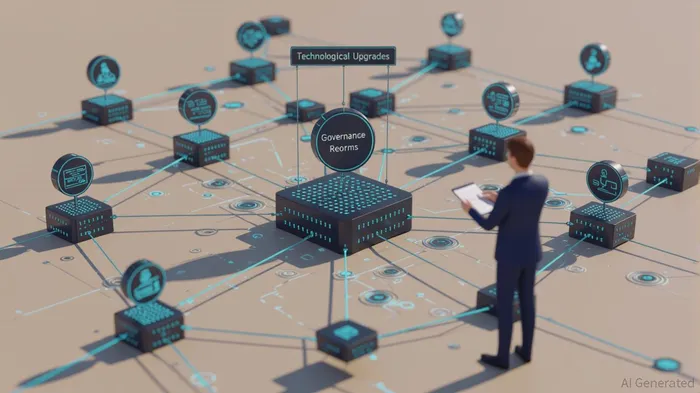
The cryptocurrency sector, long a theater of innovation and volatility, now faces a pivotal juncture. In the aftermath of scandals that have eroded trust and regulatory frameworks that are rapidly evolving, the ability of projects to adapt—both technologically and institutionally—will determine their survival. Self Chain, a Layer 1 blockchain project, offers a compelling case study. Following the removal of its founder and CEO, James WynnWYNN--, over allegations of $50 million in fraud, the project has embarked on a high-stakes journey to rebuild credibility. This article examines Self Chain's post-scandal recovery through three lenses: governance credibility, technological momentum, and regulatory tailwinds, while assessing its potential in a risk-on digital asset environment.
Governance Credibility: A Fragile Foundation
Self Chain's governance reforms began with the abrupt removal of Wynn in June 2025, a move necessitated by his alleged misconduct and subsequent secret trades involving BitcoinBTC-- and the meme token PEPE. The leadership transition, while urgent, exposed critical weaknesses in internal oversight. Wynn's actions—executing $2 million in trades within days of his removal—highlighted a lack of real-time compliance protocols and board-level accountability.
The project's response has been to restructure its governance framework, emphasizing transparency and decentralization. A new leadership team has been installed, and the company has pledged to implement stricter internal audits. However, the effectiveness of these measures remains untested. South Korean regulators, intensifying scrutiny of crypto lending platforms and fraudulent practices, have placed SLF, Self Chain's native token, under close monitoring. Bithumb's suspension of SLF deposits in August 2025 underscores the lingering skepticism. For investors, the key question is whether these reforms can restore trust or merely delay inevitable reputational damage.
Technological Momentum: Innovation as a Lifeline
Amid the governance turmoil, Self Chain has pursued aggressive technological upgrades. The launch of its mainnet in three stages introduced MPC-TSS (Multi-Party Computation – Threshold Signature Scheme) and Account Abstraction (AA), enabling keyless wallets for secure cross-chain interactions. These innovations, built on the Cosmos SDK, position Self Chain as a contender in the race for user-friendly, secure blockchain infrastructure.
Further, the project's collaboration with Inference Labs to integrate MPC-TSS with zkML-powered AI verification signals a strategic pivot toward securing AI-driven Web3 applications. This partnership, announced in August 2025, aligns with the growing intersection of AI and blockchain, a sector poised for explosive growth. Additionally, the release of the Intents SDK in Q1 2025 has empowered developers to embed intent-driven transactions, simplifying multi-chain interactions and potentially attracting a new wave of dApp creators.
Yet, technological momentum alone is insufficient. The recent integration of CosmWasm to expand smart contract capabilities beyond basic asset transfers is a step forward, but the project must demonstrate that these upgrades translate into tangible ecosystem growth. For instance, partnerships with Conflux and StarAI to broaden multi-chain support are promising, but their impact on user adoption remains to be seen.
Regulatory Tailwinds: Navigating a Shifting Landscape
South Korea's 2025 regulatory overhaul, anchored by the Virtual Asset User Protection Act (VAUPA), has created a dual-edged sword for Self Chain. On one hand, the VAUPA's emphasis on investor protection and transparency aligns with the project's stated goals of rebuilding trust. The Act's requirement for VASPs (virtual asset service providers) to segregate customer funds and obtain ISMS certification could bolster Self Chain's credibility if fully implemented.
On the other hand, the regulatory environment is fraught with challenges. The VAUPA's exclusion of NFTs from the definition of virtual assets, while beneficial for certain use cases, complicates compliance for projects like Self Chain that leverage NFTs for non-economic purposes. Moreover, the Bank of Korea's push for a won-pegged stablecoin and its scrutiny of dollar-denominated stablecoins could disrupt Self Chain's cross-border payment strategies.
Globally, South Korea's approach—balancing innovation with institutional legitimacy—positions it as a model for other jurisdictions. However, the project must navigate these regulations while competing with more established ecosystems in the EU (under MiCA) and Singapore (under FSMA). The regulatory clarity in South Korea could attract institutional capital, but it also raises the bar for compliance, increasing operational costs.
Investment Implications: Balancing Risk and Reward
For investors, the calculus around Self Chain hinges on three factors: the durability of its governance reforms, the scalability of its technological upgrades, and the adaptability of its regulatory strategy. The project's recent partnerships and SDK releases suggest a commitment to innovation, but these must be paired with consistent governance. The leadership's ability to demonstrate accountability—perhaps through transparent audits or third-party certifications—will be critical.
From a risk-reward perspective, Self Chain's recovery is contingent on its capacity to align with regulatory expectations while maintaining technological differentiation. The project's focus on secure, intent-driven transactions and AI integration offers a unique value proposition, but these advantages must be monetized effectively. Investors should monitor key metrics: the adoption rate of the Intents SDK, the success of cross-chain partnerships, and the resolution of regulatory hurdles like Bithumb's SLF deposit suspension.
Conclusion: A Test of Resilience
Self Chain's post-scandal journey is emblematic of the broader crypto sector's struggle to reconcile innovation with accountability. While its technological advancements are impressive, the project's long-term success will depend on its ability to rebuild trust through transparent governance and regulatory compliance. In a risk-on environment where institutional investors increasingly demand clarity, Self Chain's ability to navigate these challenges will determine whether it emerges as a resilient player or another cautionary tale. For now, the project's roadmap offers a mix of promise and peril—a duality that defines the volatile yet transformative world of digital assets.

Decoding blockchain innovations and market trends with clarity and precision.
Latest Articles
Stay ahead of the market.
Get curated U.S. market news, insights and key dates delivered to your inbox.






Comments
No comments yet