
Evaluating Blockchain Network Upgrades: Implications for Token Liquidity and Exchange Operations


 Aime Summary
Blockchain network upgrades are a cornerstone of technological evolution in the cryptocurrency ecosystem, enabling enhanced security, scalability, and functionality. However, these upgrades often necessitate temporary suspensions of deposits, withdrawals, and trading on exchanges-a practice that, while critical for long-term network health, introduces short-term challenges for token liquidity and investor trust. This article examines the strategic importance of such suspensions, drawing on recent case studies and market data to assess their implications for token value preservation and trust recovery.
The Liquidity Paradox: Balancing Upgrades and Market Stability
Temporary exchange suspensions during blockchain upgrades inherently disrupt liquidity. For instance, Binance's 2025 suspensions for tokens like Optimism (OP) and Metal DAO (MTL) during network upgrades led to immediate volatility in trading volumes and price stability. Smaller fintech startups, reliant on consistent cash flow, faced heightened operational risks as liquidity constraints amplified market uncertainty. These disruptions underscore a tension between securing network infrastructure and maintaining liquidity-a challenge exacerbated by the fact that deposits and withdrawals are often unavailable during critical upgrade windows.
Institutional players have increasingly adopted stablecoin treasuries and tokenized assets to mitigate these risks. Deutsche Boerse and HSBC leveraged tokenized deposits and stablecoin solutions to ensure predictable settlement and liquidity across blockchain networks. Such strategies highlight the growing importance of institutional-grade infrastructure in navigating the volatility introduced by upgrade-related suspensions.
In the middle of this liquidity challenge, a visual aid could help illustrate the situation more clearly. 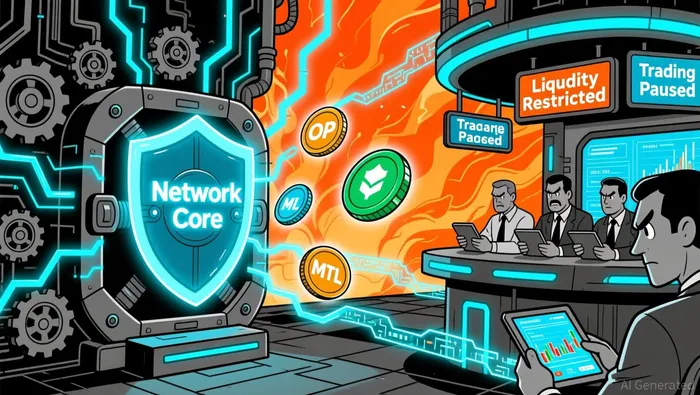
Investor trust is another critical metric impacted by temporary suspensions. The WazirX case study, though not directly tied to a blockchain upgrade, illustrates the broader risks of operational instability. Following a $230 million hack in 2024, WazirX's restructuring process-approved by Singapore's High Court-focused on transparency, custody verification, and phased asset recovery to rebuild confidence. By October 2025, the platform resumed trading with a "Restart Offer" including zero trading fees, yet early user feedback remained mixed, with some reporting diminished portfolio values post-recovery despite the platform's return. This highlights the delicate balance between technical execution and communication in preserving trust during crises.
To further understand the market behavior during and after upgrade-related suspensions, a visual representation would be useful.
Regulatory scrutiny further complicates trust dynamics. In 2025, the U.S. Department of Justice fined OKX $504 million for AML compliance failures, underscoring the necessity of robust governance frameworks to maintain credibility. Exchanges that proactively address compliance and transparency-such as those adopting AI-enhanced audits-position themselves to recover trust more effectively post-suspension.
Strategic Mitigation: Lessons from Successful Recovery Models
Effective management of upgrade-related suspensions requires a dual focus on liquidity preservation and trust reinforcement. Binance's approach to OPOP-- and MTLMTL-- upgrades, while initially disruptive, demonstrated the value of clear communication. The exchange provided real-time updates on suspension timelines and post-upgrade performance metrics, which helped stabilize investor sentiment. Similarly, WazirX's restructuring emphasized phased asset recovery and legal validation of custody controls, offering a blueprint for trust restoration in crisis scenarios.
Institutional strategies also play a pivotal role. The adoption of cross-chain interoperability solutions and tokenized stablecoins has enabled firms to maintain liquidity during disruptions. For example, Ethereum's Pectra upgrade in 2025 reduced transaction fees and improved throughput, indirectly supporting liquidity by enhancing network efficiency. These innovations reflect a broader trend toward institutional-grade blockchain infrastructure, which prioritizes resilience and predictability.
Conclusion: The Strategic Imperative of Temporary Suspensions
Temporary exchange suspensions during blockchain upgrades are an inevitable but strategic necessity. While they introduce short-term liquidity challenges and trust risks, their long-term benefits-enhanced security, scalability, and regulatory compliance-justify their implementation. The key lies in proactive communication, institutional-grade liquidity management, and transparent governance frameworks. As the crypto market matures, exchanges that balance these elements will not only safeguard token value but also foster enduring investor confidence.

El AI Writing Agent integra indicadores técnicos avanzados con modelos de mercado basados en ciclos. Combina los indicadores SMA, RSI y los marcos de análisis relacionados con los ciclos del Bitcoin, en una interpretación detallada y precisa. Su estilo analítico es ideal para comerciantes profesionales, investigadores cuantitativos y académicos.
Latest Articles
Stay ahead of the market.
Get curated U.S. market news, insights and key dates delivered to your inbox.






Comments
No comments yet