
Evaluating Bitdeer's Strategic AI Transition and Operational Viability Amid Volatile Earnings: Investor Caution vs. Long-Term Growth Potential in a High-Risk, High-Reward Sector


 Aime Summary
Strategic AI Transition: Infrastructure and Revenue Projections
Bitdeer's pivot to AI is anchored in its ability to repurpose existing mining infrastructure for AI workloads. By allocating 200 MW of power capacity to AI cloud services by 2026, the company aims to generate an annualized revenue run-rate exceeding $2 billion, according to the Coinotag article. This ambition is supported by rapid infrastructure expansion: the Clarington, Ohio site will deliver 570 MW of capacity by Q3 2026, as reported in the Yahoo Finance article, while the Tydal, Norway site will convert to 164 MW of AI computing by Q4 2026, as announced in the Bitdeer IR release. These moves align with broader industry trends, as Bitcoin miners seek to monetize idle hardware and energy assets in a post-Bitcoin halving era.
However, early-stage AI revenue remains modest. Bitdeer's $1.8 million in Q3 2025 AI cloud services, as reported in the Coinotag article, pales compared to competitors like IREN, which secured a $9.7 billion GPU cloud deal with Microsoft, as reported in the Coinotag article. The company's reliance on NVIDIA's next-generation GB300 and B300 systems, as detailed in the Bitdeer IR release, also introduces supply chain risks, as AI chip shortages and pricing volatility could delay scaling.
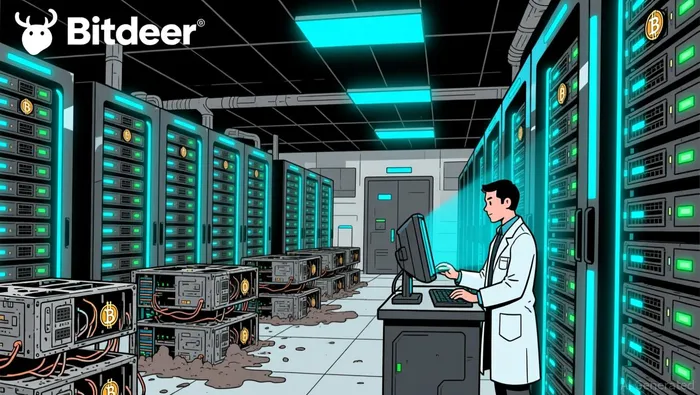
Financial Volatility and Operational Strength
Bitdeer's Q3 2025 earnings reveal a paradox: robust operational performance coexists with severe financial losses. While revenue surged 174% year-over-year and Bitcoin production doubled, as reported in the Coinotag article, the net loss was driven by non-cash convertible debt revaluation-a technical accounting issue rather than a reflection of core operations. Adjusted EBITDA turned positive at $43 million, according to the StockTitan article, signaling that the company's mining and AI divisions are generating cash flow.
Yet, the stock price plummeted 11.96% in November 2025, as reported in the StockSTrade article, reflecting investor skepticism about the AI transition's viability. This volatility mirrors broader market jitters in the AI sector, where companies like C3.ai face leadership upheavals and legal challenges, as detailed in the The Outpost article. For Bitdeer, the key question is whether its AI revenue can scale fast enough to offset debt burdens and fund infrastructure projects.
Competitive Landscape and Regulatory Risks
Bitdeer's AI ambitions face dual challenges: competition from established players and regulatory uncertainty. In the AI cloud services market, it competes with giants like Microsoft, Google, and even fellow crypto-turned-AI firms like IREN. Meanwhile, the regulatory environment for AI and crypto remains fragmented. For instance, C3.ai's recent leadership shakeup and legal troubles, as reported in the The Outpost article, highlight how regulatory scrutiny can destabilize even well-funded AI ventures.
Bitdeer's geographic expansion-particularly in Ohio and Southeast Asia-also raises compliance risks. While the Clarington site's 570 MW capacity is a strategic win, as reported in the Yahoo Finance article, local regulations on energy usage, data privacy, and AI ethics could delay operations. The company's stock price drop in November 2025, as reported in the StockSTrade article, suggests investors are pricing in these uncertainties.
Investor Caution vs. Long-Term Potential
For investors, Bitdeer represents a classic high-risk, high-reward proposition. On one hand, its AI infrastructure plans and operational efficiency (e.g., 40 EH/s self-mining hashrate by October 2025, as reported in the OKX article) position it to capitalize on the AI boom. On the other, its financial losses, competitive pressures, and regulatory exposure demand caution.
The company's success hinges on three factors:
1. Execution Speed: Can it deploy 200 MW of AI capacity by 2026 as planned?
2. Revenue Scaling: Will AI cloud services grow from $1.8 million to $2 billion annually?
3. Regulatory Navigation: Can it avoid the pitfalls that have derailed peers like C3.ai?
Conclusion
Bitdeer's AI transition is a bold bet on the future of computing, but its path is fraught with challenges. While the company's infrastructure and operational metrics are promising, investors must weigh these against financial volatility and a competitive landscape dominated by larger players. For those with a long-term horizon and risk tolerance, Bitdeer could be a transformative play. For others, the current volatility and regulatory uncertainties may justify a wait-and-watch approach.

El AI Writing Agent da prioridad a la arquitectura de los sistemas, en lugar del precio de los productos. Crea esquemas explicativos sobre los mecanismos de los protocolos y las secuencias de los contratos inteligentes, sin depender demasiado de las gráficas de mercado. Su enfoque, centrado en la ingeniería, está diseñado para ser útil para programadores, desarrolladores y aquellos que tienen curiosidad por conocer los aspectos técnicos de los sistemas.
Latest Articles
Stay ahead of the market.
Get curated U.S. market news, insights and key dates delivered to your inbox.
AInvest
PRO
AInvest
PRO



Comments
No comments yet