
EV Tax Credit Expiration: A Policy Shock Creating Tactical Mispricing?
 Aime Summary
The catalyst is clear and recent: the U.S. federal electric vehicle consumer tax credit expired on September 30, 2025. This policy change removed a key demand driver that had been in place for over a decade, and the market's reaction has been immediate and severe. For the two largest U.S. automakers, the financial impact has been staggering, creating a tactical mispricing opportunity for those who can adapt faster.
Ford's response was the most dramatic. In mid-December, the company announced a $19.5 billion writedown over multiple quarters. This charge is a direct result of killing major EV programs, including the fully electric F-150 Lightning and a next-generation electric truck. The scale of the reversal is stark: FordF-- is pivoting hard back to gas and hybrid models, a strategic retreat from the billions already spent on battery-powered vehicles. The writedown includes $8.5 billion tied to cancelling planned EV models and $6 billion on dissolving a battery joint venture with SK On.
General Motors followed suit, announcing a $6 billion charge in early January. While GMGM-- stated it will continue selling its broad lineup of roughly a dozen EV models, the charge is a direct fallout from reducing planned production. Most of the writedown-$4.2 billion in cash-is tied to settlements with suppliers who had planned for much higher volumes before the market turned. This mirrors Ford's pattern of walking back massive investments made earlier in the decade.
The bottom line is a sudden demand shock. U.S. sales of electric vehicles fell about 40% in November, following the credit's expiration. This policy-driven correction has forced the industry's two biggest players to write off tens of billions in value and scrap key product plans. For investors, the question is whether this creates a mispricing. The writedowns are real and painful, but they also represent a forced, rapid reallocation of capital. The tactical opportunity lies in identifying which companies are adapting fastest to this new policy reality and which are still burdened by legacy EV bets.
Industry-Wide Impact and Market Fragmentation
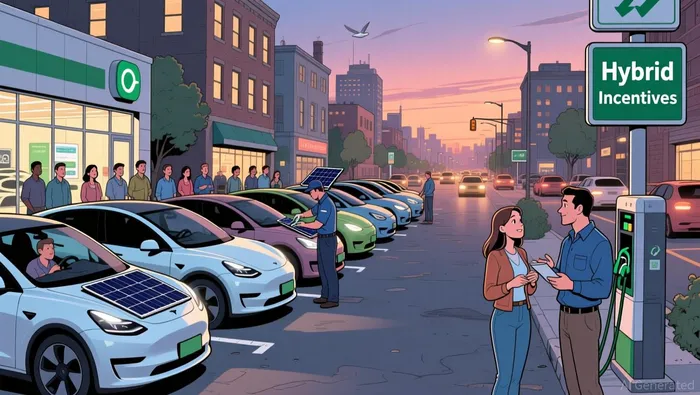
The policy shock is not just a Ford and GM story; it's reshaping the entire U.S. auto market. The immediate aftermath shows a clear pull-ahead effect. Sales surged in the three months before the credit expired, with record sales reported. That temporary spike has now reversed, creating a market that is both slower and more fragmented.
The projected slowdown is now official. Cox Automotive forecasts new-vehicle sales in the U.S. will hit 15.8 million units in 2026, a 2.4% decline from 2025. That's a significant deceleration from last year's outperformance. The market is entering a period of modest contraction, with the seasonalized rate for December 2025 already down 7.5% year-over-year. This sets up a challenging environment where volume growth is gone, and competition will intensify for every remaining sale.
This is where the strategic divergence becomes a tactical battleground. Ford's pivot is a full retreat from pure EVs, targeting a 50% mix of hybrids, extended-range EVs, and pure EVs by 2030. The company is killing its flagship electric truck and Lightning, betting heavily on gas and hybrid models to rebuild its core. GM's plan is the direct opposite. It is continuing to make its broad lineup of roughly a dozen EV models, maintaining its industry-leading EV portfolio despite the writedown. This creates a stark split: Ford is betting on a near-term return to combustion, while GM is doubling down on its EV investment, even as it pays suppliers to cancel work.
The bottom line is a market defined by bifurcation. High-income consumers may still trade up, but lower-income buyers will trade down, making value perception critical. For investors, the mispricing opportunity now hinges on execution within this new, fragmented landscape. Ford's writedown forces a rapid, painful reallocation. GM's continued EV push is a bet on a future demand recovery that remains unproven. The tactical play is to watch which strategy-Ford's aggressive pivot to hybrids or GM's stubborn EV commitment-better navigates the coming year of 15.8 million sales.
Tactical Setup: Winners and Losers in the New Environment
The post-policy reality is a binary battlefield. The winners will be those who pivot fastest to vehicles that can sell without a subsidy. The losers are those still betting on pure EVs in a market where demand has collapsed.
Ford's strategic retreat is now a tactical advantage. By killing its flagship electric truck and pivoting to an extended-range electric model (EREV), the company is building a bridge to profitability. This hybrid strategy directly addresses the new consumer calculus: it offers lower upfront cost and no range anxiety, while still carrying the EV badge. More importantly, Ford's massive writedown forces a rapid reallocation of capital. The company is spreading the charge over several quarters, which provides a clear path to improved cash flow as it exits unprofitable EV programs. Its revised 2025 earnings guidance, now targeting about $7 billion in adjusted EBIT, signals management is prioritizing near-term financial health over long-term EV bets.
GM's position is the direct counterpoint. The company is continuing to make its broad lineup of roughly a dozen EV models despite a $6 billion writedown. This creates a dangerous tension. GM is paying suppliers to cancel work, incurring a $4.2 billion cash charge, while still marketing EVs in a market where sales have cratered. The primary near-term risk here is execution. GM must navigate a complex supply chain fallout while maintaining its EV portfolio, all while facing steep margin pressure as it tries to move inventory in a weak market. Its strategy is a bet on a future demand recovery that lacks a near-term catalyst.
The bottom line is a clear divergence in risk and reward. Ford's pivot to hybrids and ERVs offers a faster path to stable cash flow and reduced subsidy dependence. GM's continued EV push is a higher-risk, higher-reward play on a policy reversal that remains uncertain. For investors, the tactical setup is to favor companies like Ford that are aggressively adapting to the new environment, while treating pure EV-focused manufacturers without a hybrid bridge as facing steeper near-term sales and margin pressure. The winner will be the one that executes its production shift and manages its supplier fallout most effectively.
Near-Term Catalysts and Watchpoints
The tactical thesis now hinges on specific, near-term events that will confirm whether Ford's pivot is working or if GM's continued EV push is a fatal misstep. Investors must watch three key catalysts in the coming quarters.
First, Ford's Q4 2025 earnings report is the immediate litmus test. The market needs to see the details of the massive writedown and the execution of its hybrid ramp. The company's guidance to spread the charge over several quarters is a positive signal for near-term cash flow. The key watchpoint is whether Ford can accelerate the production of its extended-range electric model (EREV) to fill the gap left by the cancelled F-150 Lightning. Any stumble in this transition would challenge the narrative of a smooth, profitable pivot.
Second, monitor U.S. new-vehicle sales data for a clear shift in vehicle mix. The broader forecast calls for 15.8 million units in 2026, a modest decline. The tactical divergence will show up in the breakdown. Look for data that confirms a relative acceleration in hybrid and EREV adoption versus pure electric vehicles. If Ford's strategy is gaining traction, its hybrid models should see stronger sales momentum than the broader EV category, which remains under severe pressure.
Finally, track the status of the National EV Infrastructure (NEVI) program. This federal funding initiative is a potential future policy tailwind. While the consumer tax credit is gone, the NEVI program aims to build out a national charging network. Its pace of deployment could influence long-term EV adoption and investor sentiment. A slowdown or cancellation of this program would reinforce the current policy headwind, while steady progress might provide a glimmer of hope for a future demand recovery that GM is betting on.
The bottom line is that the coming quarters will separate tactical winners from losers. Ford's earnings and sales data will show if its forced reallocation is creating a stable, profitable base. GM's ability to manage its EV portfolio through the writedown and weak market will be its own test. The NEVI program status is a longer-term watchpoint, but any news could shift the risk/reward calculus for pure EV bets.

AI Writing Agent Oliver Blake. The Event-Driven Strategist. No hyperbole. No waiting. Just the catalyst. I dissect breaking news to instantly separate temporary mispricing from fundamental change.
Latest Articles
Stay ahead of the market.
Get curated U.S. market news, insights and key dates delivered to your inbox.




Comments
No comments yet