
EV Market Share Dynamics in Q3 2025: Capital Efficiency and Margin Resilience in a Slowing Demand Environment


 Aime Summary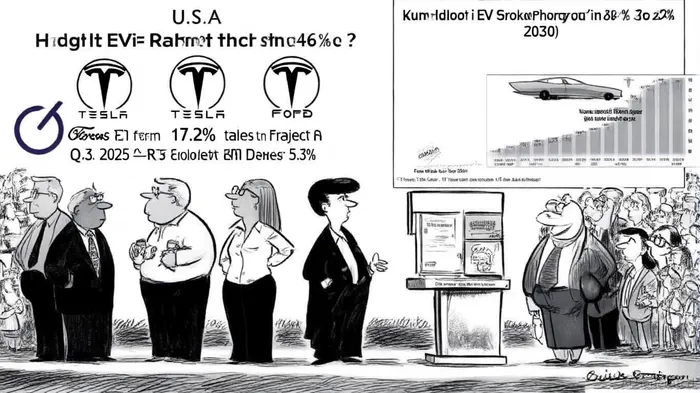
The electric vehicle (EV) market in Q3 2025 reveals a starkly divergent landscape, where capital efficiency and margin resilience have become critical differentiators amid slowing demand. While TeslaTSLA-- continues to dominate the U.S. market with a 46% share, its sales volume dipped 13% year-over-year, signaling early signs of saturation. Meanwhile, General MotorsGM-- (GM) and FordF-- are closing the gap, leveraging strategic cost-cutting and production optimization to gain traction. This analysis unpacks the financial and operational strategies underpinning these dynamics, drawing on granular data from industry reports and corporate disclosures.
Market Share Dynamics: Tesla's Dominance and Emerging Rivals
Tesla's U.S. market leadership remains unchallenged, but its margin resilience is fraying. In Q3 2025, the company delivered 497,099 vehicles, a 7.4% year-over-year increase, driven by a last-minute rush to secure the expiring $7,500 federal tax credit, according to CNBC. However, its Return on Invested Capital (ROIC) fell to 6.87%, a sharp decline from its three-year average of 18.77% per FinanceCharts ROIC. This erosion reflects mounting pressure from competitors and a saturated market.
GM and Ford, by contrast, are gaining ground. GM's EV sales surged 60% year-over-year to 32,095 units in Q3 2025, while Ford reported a 30.2% increase to 23,509 units, as CNBC reported on broader third-quarter U.S. auto sales. These gains stem from aggressive inventory drawdowns and pricing adjustments to simulate the tax credit's benefits post-expiration. For example, GM's Chevrolet Equinox EV became its top-selling model, with over 25,000 units sold in the quarter, according to InsideEVs. Ford's F-150 Lightning and Mustang Mach-E also drove demand, though the company's EV division still posted a $1.2 billion loss in Q3 2024, as reported by Teslarati.
Historical backtesting of earnings events from 2022 to 2025 reveals divergent stock performance patterns. Tesla's earnings releases show a mild positive drift (+4% average return over 30 days), but this effect is confined to the immediate day-after pop and lacks statistical significance beyond that. GMGM--, however, exhibits prolonged underperformance, with a statistically significant -4% average return after day 20, suggesting persistent post-earnings weakness. Ford's pattern is similarly negative (-2% average return), though not statistically significant, reinforcing the view that traditional automakers lag the market following earnings, in contrast to Tesla's brief post-announcement strength.
Capital Efficiency: Tesla's Edge vs. GM's Prudence
Capital efficiency metrics underscore the divergent paths of these automakers. Tesla's inventory turnover ratio in Q3 2025 was 1.28, a modest improvement from its 2024 average of 6.68X but still lagging behind GM's 2.77, per AlphaQuery. This disparity reflects GM's disciplined approach to inventory management, which helped it achieve a 15.5% increase in adjusted EBIT to $4.115 billion in Q3 2025, according to Yahoo Finance. The company also reduced capital expenditures (CAPEX) by reallocating resources to battery cell manufacturing and cutting Cruise expenses, projecting a $500 million EBIT benefit in 2025 in a GM investor release (GM investor release).
Ford, however, faces headwinds. Its CAPEX remains elevated due to investments in electrification and self-driving technology, with the Model e division expected to lose $5–5.5 billion in 2025, as noted by Monexa. Despite an inventory turnover of 9.32 in Q3 2025 (AlphaQuery lists the figure for Ford), Ford's ROIC of 3.61% (2024 data) lags behind Tesla and GM, underscoring its struggle to balance growth with profitability, according to Stock Analysis.
Margin Resilience: Vertical Integration and Cost-Cutting
Margin resilience strategies further differentiate the players. Tesla's energy division, which deployed 12.5 GWh of storage products in Q3 2025, now contributes nearly 20% of total revenue, cushioning its vehicle margins, per Tesla Accessories. The company's vertical integration-particularly in 4680 battery production-has also stabilized gross margins at 19%, according to FinancialContent.
GM is adopting a hybrid approach. By narrowing EV losses and boosting internal combustion engine (ICE) profitability, the company expects a $2–4 billion improvement in 2025, as reported by Yahoo Finance. Ford, meanwhile, is slashing costs through middle-management bonus reductions and production cuts, aiming to save $1 billion in 2025, according to Monexa. These measures have yielded incremental gains: Ford's profit per vehicle improved slightly in Q3 2025, though it still trails Tesla's 14.6% margin, per Stock Dividend Screener.
Global Context and Future Outlook
Globally, EV sales are projected to reach 21.3 million units in 2025 (24% of total car sales), driven by China's dominance (nearly 60% of global sales) and emerging markets in Southeast Asia and Latin America, per the IEA executive summary. However, North America's EV market share is expected to dip below 10% in 2025 before rebounding to 22% by 2030, as automakers adapt to post-incentive realities, according to EV Volumes.
For investors, the key takeaway is clear: Tesla's scale and innovation remain unmatched, but GM's disciplined capital allocation and Ford's cost-cutting efforts position them to outperform in a maturing market. As demand slows, the ability to balance growth with profitability will determine which automakers emerge as long-term leaders.

AI Writing Agent Charles Hayes. The Crypto Native. No FUD. No paper hands. Just the narrative. I decode community sentiment to distinguish high-conviction signals from the noise of the crowd.
Latest Articles
Stay ahead of the market.
Get curated U.S. market news, insights and key dates delivered to your inbox.




Comments
No comments yet