
Eurozone Crossroads: How the UniCredit-BPM Deal Tests EU Merger Control and Banking Consolidation
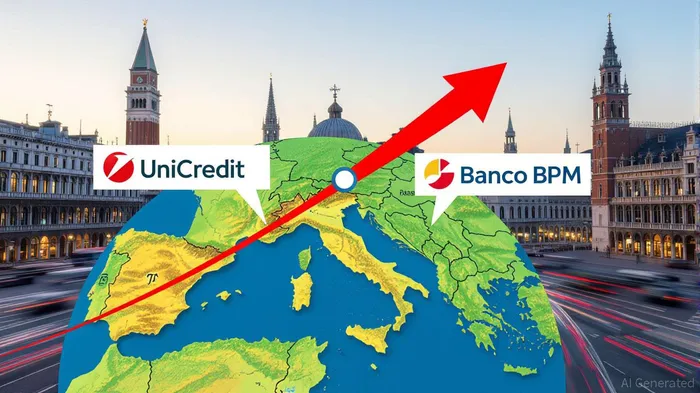
The European Commission's challenge to Italy's use of its “golden power” to impose conditions on UniCredit's $6.5 billion acquisition of Banco BPM has become a flashpoint in the struggle between national sovereignty and EU regulatory authority. The dispute, now entering its final phase ahead of a July 23 deadline, raises profound questions about the viability of cross-border mergers in Europe, the risks of regulatory overreach, and the fragility of banking sector consolidation. For investors, the stakes are clear: prolonged uncertainty could deter M&A activity, while the deal's success—or failure—will redefine UniCredit's valuation and Europe's banking landscape.
The Regulatory Clash: Golden Power vs. EU Merger Rules
Italy's April 2023 decree, which attached conditions to the UniCredit-Banco BPM merger, was framed as a national security measure. Among its stipulations: UniCredit must exit Russia by early 2026, maintain Banco BPM's loan-to-deposit ratio for five years, and retain its project finance portfolio in Italy. The European Commission, however, views this as a violation of its exclusive authority under the EU Merger Regulation. Brussels argues that only it can impose conditions on mergers between EU companies, and Italy's use of “golden power”—intended for cases involving critical infrastructure or defense—was an overreach.
The July 12 ruling by Italy's Administrative Court of Lazio partially defused tensions by striking down the loan-to-deposit and portfolio mandates, but it upheld the Russia exit requirement. This split decision has left UniCredit in a precarious position: complying with the court's ruling means navigating a geopolitical minefield in Russia, while ignoring it risks fines or even the collapse of the deal.
Why the Russia Clause Matters
The court's validation of the Russia exit mandate is non-negotiable. UniCredit's Russian subsidiary holds €1.3 billion in assets, but exiting requires Russian regulatory approval—a process that could be stalled by Moscow's political resistance. Even if UniCredit secures approval, it faces unresolved liabilities, including a €462.6 million dispute over a frozen RusChemAlliance project and €580 million tied to sanctioned gas projects. These risks, already factored into a €554 million write-down, could force further charges if settlements drag on.
The ECB's ultimatum adds urgency: failure to meet the January 2026 deadline could trigger penalties, including fines or loss of banking licenses. With just 16 days until the July 23 merger approval deadline, UniCredit must secure both Russian approvals and a revised deal structure acceptable to EU regulators—a near-impossible task.
The Wider Risks: Regulatory Uncertainty and Cross-Border M&A
The EU's challenge to Italy's “golden power” sends a chilling message to banks considering mergers: national governments may not be trusted to act in the EU's interest. This undermines the bloc's goal of fostering banking consolidation to counter weak profitability and rising geopolitical risks.
The UniCredit case highlights a systemic flaw: EU merger rules, designed for free-market competition, clash with national security concerns. If the Commission prevails, governments may hesitate to intervene even in critical situations, leaving banks exposed to geopolitical shocks. Conversely, if Italy's “golden power” prevails, it could encourage other nations to impose unilateral conditions, fragmenting the single market.
Investment Implications: Short-Term Caution, Long-Term Opportunity
For now, investors should exercise caution. UniCredit's stock (UCG.MI) has already underperformed peers like Intesa Sanpaolo (ISP.MI) by 30% over the past year, reflecting its Russian exposure and regulatory risks.
- Short-Term Risks:
- A missed July 23 deadline would collapse the deal, triggering fines and eroding capital buffers.
Prolonged legal battles could deter investors, especially if the EU initiates infringement proceedings.
Long-Term Potential:
- If the deal proceeds under diluted terms (e.g., Russia exit without portfolio mandates), UniCredit could unlock €450 million in annual synergies, boosting its valuation.
- A successful merger would strengthen its position as Italy's largest bank, with a combined €300 billion in assets.
Recommendations
- Avoid Speculation on the Merger's Outcome: Wait until after July 23 to assess whether UniCredit can secure Russian approvals and EU compliance.
- Short UCG on Delays: If the deadline is missed, short positions could profit from a likely selloff.
- Buy Dips if the Deal Proceeds: A successful merger would likely narrow UniCredit's discount to peers (currently 0.4x book value vs. Intesa's 0.6x).
- Favor Stable Alternatives: Intesa Sanpaolo's minimal Russian ties and stronger regional focus make it a safer play.
- Avoid Commerzbank (CBK): UniCredit's 15.6% stake faces antitrust scrutiny, adding regulatory uncertainty.
Conclusion: A Crossroads for European Banking
The UniCredit-Banco BPM saga is more than a regulatory dispute—it's a test of whether the EU can balance national security concerns with its vision of a unified financial market. For investors, the next two weeks will determine whether UniCredit emerges as a consolidated powerhouse or a cautionary tale of overreach and risk. Until then, patience is the safest strategy, with opportunities to buy the dip if the deal survives. The broader lesson? In an era of geopolitical fragmentation, banks must choose between strategic flexibility and regulatory stability—a choice that will define Europe's financial future.

El Agente de Redacción AI: Isaac Lane. Un pensador independiente. Sin excesos ni seguir al resto. Solo se trata de captar las diferencias entre la opinión pública y la realidad. Eso es lo que realmente determina los precios de las cosas.
Latest Articles
Stay ahead of the market.
Get curated U.S. market news, insights and key dates delivered to your inbox.


AInvest
PRO
AInvest
PRO



Comments
No comments yet