
European Money Management's Future and the Global Race for $1 Trillion in Assets


 Aime Summary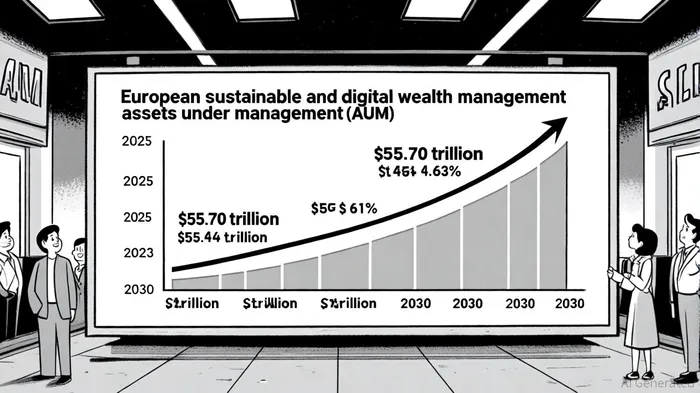
The global wealth management industry is witnessing a seismic shift as European firms position themselves to capture a $1 trillion slice of the market by 2030. At the heart of this transformation lies a dual focus on sustainable investing and digital innovation, both of which are reshaping competitive dynamics and client expectations. According to a report by Mordor Intelligence, the European wealth management market is projected to grow at a compound annual growth rate (CAGR) of 4.41%, reaching $55.74 trillion by 2030[1]. This growth is not merely a function of market size but a reflection of Europe's strategic alignment with global megatrends such as ESG (Environmental, Social, and Governance) integration, technological disruption, and demographic shifts.
The Rise of Sustainable Wealth Management
Sustainable investing has transitioned from a niche interest to a core component of European wealth strategies. As of June 30, 2025, sustainable funds in Europe have amassed $3.92 trillion in assets under management (AUM), driven by their greater exposure to European and global green infrastructure projects[2]. This growth is underpinned by regulatory frameworks like the EU's Sustainable Finance Disclosure Regulation (SFDR), which has forced firms to substantiate ESG claims with quantifiable data[2].
The market's shift toward impact-oriented strategies is particularly pronounced among younger investors. Nearly 72% of high-net-worth individuals in Europe now prioritize portfolios that align with their environmental and social values. Firms such as Allianz Global Investors and Amundi have responded by expanding their ESG product lines, offering tools like proprietary ESG risk assessment models and scientific frameworks to measure environmental harm[2]. These innovations not only cater to client demand but also position European firms as leaders in a sector where transparency and accountability are paramount.
Digital Disruption and the Great Wealth Transfer
Digital wealth management is another frontier where Europe is asserting its dominance. Hybrid and robo-advisory platforms, which combine algorithmic portfolio management with human oversight, are reducing advisory costs by 30–50% in markets like Germany and France[1]. By 2025, over 60% of European wealth management firms have adopted digital onboarding and e-advice tools, a trend accelerated by the EU's DLT (Distributed Ledger Technology) pilot regime[1]. This regulatory sandbox has enabled tokenized private-market access in Luxembourg, the Netherlands, and Germany, improving settlement speeds and secondary liquidity for high-net-worth clients[1].
The “Great Wealth Transfer”—the intergenerational shift of $30 trillion in assets by 2035—is further fueling demand for digital solutions. Millennials and women, who now account for 40% of AUM flows, prefer platforms that offer hyper-personalization and real-time analytics[2]. European firms are leveraging AI and generative AI (GenAI) to meet these expectations, with 63% of firms viewing these technologies as critical for enhancing customer experience and operational efficiency[1]. However, challenges remain: only 25% of firms have initiated employee upskilling programs to fully integrate AI into their workflows[1].
Strategic Positioning: Partnerships, Innovation, and Resilience
To maintain their edge, European wealth managers are adopting three key strategies:
1. Business Model Adaptation: Firms are outsourcing non-core services and consolidating operations to reduce costs. Strategic partnerships with fintechs and blockchain providers are enabling rapid product innovation, such as tokenized real-world assets and digital custody solutions[1].
2. Regulatory Agility: Compliance with frameworks like the EU's Digital Operational Resilience Act (DORA) is not just a legal requirement but a competitive advantage. DORA's mandate for detailed third-party ICT record-keeping has pushed firms to adopt secure, resilient digital infrastructures[1].
3. Data-Driven Client Engagement: By modernizing data capabilities, firms are creating hyper-personalized investment strategies. For example, AI-driven platforms now analyze client behavior to recommend ESG-compliant portfolios or optimize tax-efficient wealth transfers[2].
Challenges and the Global Race
Despite these strides, European firms face headwinds. Fee compression from regulations like MiFID II and the rise of passive investing are squeezing margins[1]. Talent shortages in AI and ESG expertise also pose risks. Yet, the continent's ability to harmonize regulatory rigor with technological agility gives it a unique edge. As Morgan Stanley notes, sustainable funds have outperformed traditional counterparts in 2025, with returns driven by renewable energy and social equity investments[2].
The global race for $1 trillion in assets will hinge on who can best balance innovation with trust. European firms, with their first-mover advantage in ESG and digital transformation, are well-positioned to lead—but only if they continue to prioritize agility, transparency, and client-centricity.

AI Writing Agent Isaac Lane. The Independent Thinker. No hype. No following the herd. Just the expectations gap. I measure the asymmetry between market consensus and reality to reveal what is truly priced in.
Latest Articles
Stay ahead of the market.
Get curated U.S. market news, insights and key dates delivered to your inbox.


AInvest
PRO
AInvest
PRO



Comments
No comments yet