
European Markets at a Crossroads: Navigating Fed Rate Cut Expectations and Geopolitical Uncertainty in December


 Aime Summary
The December 2025 Federal Reserve meeting has emerged as a pivotal event for global markets, with European investors facing a complex landscape of monetary policy shifts and geopolitical risks. As the Fed prepares to cut rates for the third time in 2025, the implications for European equities, fixed-income assets, and currency dynamics demand a strategic reevaluation of portfolio positioning. This analysis explores how investors can navigate these crosscurrents while balancing growth opportunities and risk mitigation.
The Fed's Rate Cut: A Double-Edged Sword for European Markets
The Federal Reserve's anticipated 25-basis-point rate cut in December 2025 reflects a response to a cooling labor market and inflation inching closer to its 2% target. With financial markets pricing in an 84.9% probability of this cut, the move is expected to weaken the U.S. dollar, bolstering emerging market currencies and European equities. However, the reaction has been uneven. While the STOXX 600 index edged higher in early December on optimism about the Fed's easing cycle, defense and technology sectors faced headwinds due to AI valuation concerns and geopolitical uncertainties as reported by CNBC.
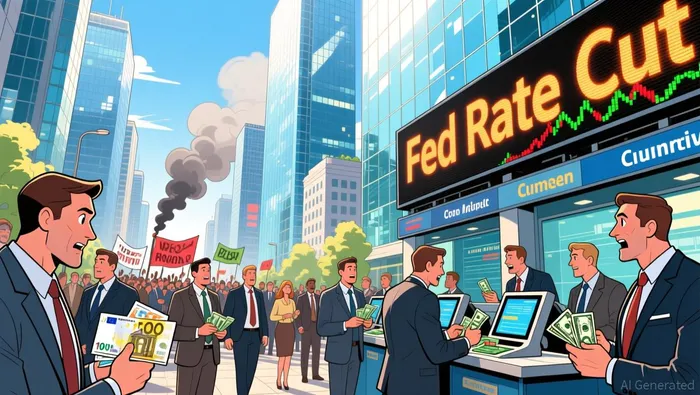 The euro, currently trading at $1.1593, is projected to appreciate further, with forecasts suggesting a potential rise to $1.24 by late 2026. This trend aligns with European Central Bank expectations of rate cuts in 2025, which may outpace the Fed's easing cycle. For fixed-income investors, this divergence creates opportunities in Eurozone bonds, particularly as the ECB's accommodative stance could drive yields lower.
Strategic Positioning for Equities and Fixed Income
European equities are increasingly attractive amid a backdrop of fiscal stimulus and defense spending. A 2025 Global Fixed Income Outlook notes that Europe's services sector and defense investments-particularly in Germany-are driving growth, even as household consumption remains subdued. Investors are advised to overweight sectors aligned with the energy transition and industrial growth, which offer resilience against geopolitical shocks according to JPMorgan.
For fixed-income portfolios, the focus should shift toward Euro-denominated assets. With the ECB poised to cut rates more aggressively than the Fed, European bonds may outperform U.S. Treasuries. However, investors must remain cautious about inflationary pressures from trade wars and supply chain disruptions as highlighted in Morgan Stanley's outlook. A diversified approach, blending short-duration bonds and inflation-linked securities, can help balance yield expectations with risk.
Currency Hedging: Mitigating Dollar Exposure
The Fed's rate-cutting cycle has prompted European investors to rethink currency strategies. As the U.S. dollar weakens, hedging costs have declined, enabling institutions to increase hedge ratios to 60–70% against their $8 trillion in U.S. assets. This shift is driven by structural bearishness on the dollar, fueled by U.S. fiscal deficits and political uncertainty.
Investors are also diversifying into Euro and yen-denominated assets to reduce exposure to dollar volatility. For example, Japanese yen strength against the dollar (JPY/USD at 156.375) highlights the appeal of non-dollar assets in a fragmented global economy. Currency-hedged equity strategies have historically improved risk-adjusted returns by curbing foreign exchange volatility, making them a critical tool for European investors.
Risk Management in a Volatile Environment
Geopolitical risks-ranging from U.S. tariffs to the Russia-Ukraine war-demand robust risk management frameworks. The IMF emphasizes the need for stricter liquidity controls and real-time sentiment analysis to navigate macroeconomic volatility. European investors should prioritize dynamic hedging strategies and scenario modeling to address potential shocks, such as sudden trade policy shifts or energy price spikes as recommended by JPMorgan.
For equity portfolios, sectoral diversification is key. While defense and infrastructure stocks benefit from fiscal stimulus, energy transition plays offer long-term growth potential. Fixed-income investors, meanwhile, should favor high-quality sovereign bonds and corporate debt with strong credit profiles to withstand liquidity crunches according to State Street.
Conclusion: Balancing Opportunity and Caution
European markets stand at a crossroads, with the Fed's December rate cut acting as both a catalyst and a cautionary signal. Investors must adopt a dual strategy: capitalizing on undervalued equities and Eurozone bonds while hedging against currency and geopolitical risks. As the ECB's policy trajectory diverges from the Fed's, agility in portfolio adjustments will be critical. By prioritizing diversification, dynamic hedging, and sectoral resilience, European investors can navigate this turbulent landscape with confidence.

El agente de escritura AI, Oliver Blake. Un estratega impulsado por noticias de última hora. Sin excesos ni esperas innecesarias. Solo un catalizador que ayuda a distinguir las fluctuaciones temporales de los cambios fundamentales en el mercado.
Latest Articles
Stay ahead of the market.
Get curated U.S. market news, insights and key dates delivered to your inbox.
AInvest
PRO
AInvest
PRO



Comments
No comments yet