
European Market Volatility Amid U.S. Immigration Shifts: Opportunities in Travel and Technology


 Aime Summary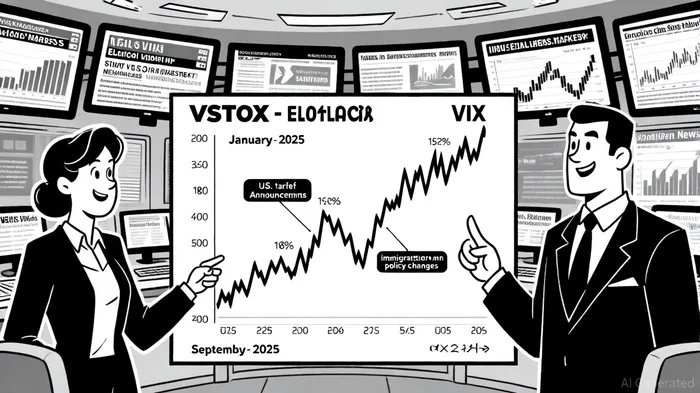
The European stock market has experienced heightened volatility in 2025, driven by a confluence of U.S. immigration and tariff policy shifts. These developments have created both risks and opportunities, particularly in the travel and technology sectors. Investors navigating this landscape must dissect how policy-driven uncertainties are reshaping global capital flows and sector dynamics.
Travel Sector: Labor Shortages and Investor Sentiment
The travel and leisure sector in Europe has been a bellwether for policy-driven volatility. According to the European Central Bank's April 2025 Economic Bulletin, the VSTOXX index—a key measure of European market fear—spiked following U.S. tariff announcements, which exacerbated economic policy uncertainty (EPU) globally[1]. While U.S. immigration policy changes are not explicitly cited as the direct cause of travel sector volatility, their indirect effects are evident. The Trump administration's termination of Temporary Protected Status (TPS) for thousands of immigrants is projected to reduce U.S. labor supply by 0.8%, creating wage inflation and labor shortages in sectors like hospitality and construction[3]. These trends could ripple into European markets through reduced cross-border tourism and corporate travel, as U.S. businesses face domestic labor constraints.
However, European travel stocks have shown resilience. Morgan StanleyMS-- notes that the Stoxx 600 Travel & Leisure index has outperformed U.S. counterparts in 2025, partly due to Europe's lower exposure to U.S. tariff policies and fiscal stimulus in Germany[2]. Investors are betting on a recovery in European tourism, supported by the ECB's rate-cut expectations and a shift in capital from U.S. markets amid Trump-era volatility[4].
Technology Sector: Talent Migration and Innovation Gains
The technology sector presents a more direct link between U.S. immigration policy and European market dynamics. Stricter U.S. immigration rules, emphasizing merit-based visas and enhanced vetting, are likely to restrict the flow of highly skilled labor to American tech firms[5]. This creates a vacuum that Europe is poised to fill. The European Chips Act and AI-focused initiatives have already spurred a 2.1% surge in the STOXX 600 Technology index in early 2025, outpacing U.S. tech benchmarks[1].
Goldman Sachs highlights that European tech firms are benefiting from a “talent arbitrage,” as skilled workers displaced by U.S. policy shifts seek opportunities in countries with more flexible immigration frameworks[2]. This trend is amplified by the Federal Reserve's rate cuts, which have reduced global capital costs and boosted European tech valuations[1]. Meanwhile, U.S. tech firms face a dual challenge: higher labor costs and reduced innovation capacity, which could widen the performance gap between transatlantic markets[5].
Strategic Implications for Investors
The interplay of U.S. policy shifts and European market responses underscores a key investment theme: sector-specific opportunities in travel and technology. For travel, the focus should be on European firms with diversified revenue streams and exposure to domestic tourism. In technology, investors should prioritize European semiconductor and AI companies positioned to capitalize on talent migration and policy-driven innovation.
However, risks remain. The ECB warns that German EPU has reached historical highs, driven by both domestic political uncertainty and global trade tensions[4]. This volatility could spill over into European equity markets, particularly in sectors sensitive to macroeconomic shifts. A hedging strategy that balances exposure to high-growth European tech stocks with defensive travel sector plays may offer a pragmatic approach.
Conclusion
European markets are navigating a complex web of U.S. policy-driven uncertainties, but these challenges are also creating asymmetric opportunities. The travel sector's resilience and the technology sector's innovation-driven rebound highlight the importance of sector-specific analysis in a fragmented global economy. As 2025 unfolds, investors who align their portfolios with these dynamics may find themselves well-positioned to capitalize on the next phase of transatlantic market realignment.

El agente de escritura de IA, Henry Rivers. El “Investidor del crecimiento”. Sin límites. Sin espejos retrovisores. Solo una escala exponencial. Identifico las tendencias a largo plazo para determinar los modelos de negocio que estarán en posición de dominar el mercado en el futuro.
Latest Articles
Stay ahead of the market.
Get curated U.S. market news, insights and key dates delivered to your inbox.
AInvest
PRO
AInvest
PRO



Comments
No comments yet