
European Industrial Sector Resilience Amid U.S. Steel and Aluminum Import Restrictions: Strategic Diversification and New Market Frontiers
 Aime Summary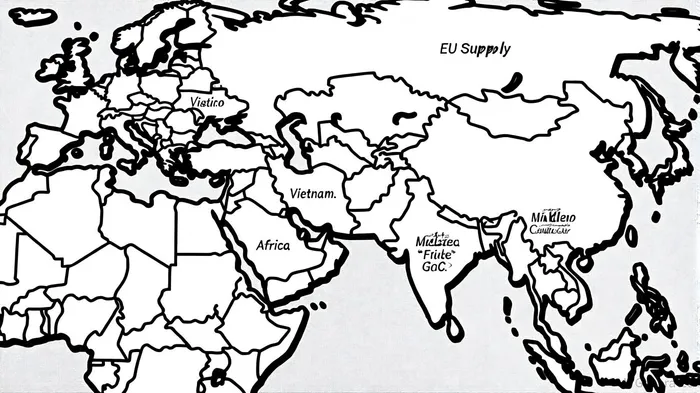
The U.S. imposition of 50% tariffs on EU steel and aluminum in June 2024, later expanded to 407 product categories, has forced European industrial sectors into a period of rapid adaptation. According to a report by the European Automobile Manufacturers' Association (ACEA), these tariffs have disrupted supply chains for critical materials like steel, raising operational costs and creating uncertainty for manufacturers[1]. However, the EU's strategic response—combining retaliatory tariffs, trade agreements, and reindustrialization efforts—has revealed a sector capable of resilience and innovation.
Strategic Diversification: Reshoring, Nearshoring, and Friendshoring
The EU's industrial strategy has pivoted toward reducing reliance on volatile transatlantic trade dynamics. A July 2025 report by Logistics Manager highlights that 73% of EU and U.S. executives now prioritize “friendshoring” as a core component of supply chain planning[3]. This shift is driven by three factors: supply chain resilience (cited by 95% of executives), proximity to customers (92%), and geopolitical risk mitigation (90%). For example, automotive and machinery firms are redirecting production to Mexico, Vietnam, and Eastern Europe, where labor costs and regulatory environments offer competitive advantages[3].
The European Steel Association (EUROFER) underscores that reshoring efforts are accelerating, with 48% of EU manufacturers planning to onshore production within three years—up from 41% in 2024[1]. This trend is supported by advanced technologies such as AI-driven supply chain analytics and digital twins, which reduce costs and enhance sustainability[3]. Meanwhile, nearshoring to countries like Morocco and Turkey is gaining traction, particularly in the automotive and construction equipment sectors[1].
Alternative Market Opportunities: Expanding Beyond the U.S.
While the U.S. market remains significant, EU manufacturers are diversifying their export destinations. A joint statement from the European Commission notes that the EU's 2025 trade agreement with the U.S. includes a 15% baseline tariff on industrial goods, but steel and aluminum remain subject to 50% tariffs[2]. This has prompted firms to explore growth in Asia and Africa. For instance, the EU's Generalised Scheme of Preferences (GSP) has been expanded to incentivize exports to India and Vietnam, where demand for machinery and construction materials is surging[2].
The Gulf Cooperation Council (GCC) also presents untapped potential. A Morgan Lewis analysis highlights that EU exporters are leveraging the EU-GCC Free Trade Agreement, which entered into force in 2023, to access markets with growing infrastructure and energy sectors[2]. Additionally, the EU's Africa-Europe Green Energy Initiative is fostering partnerships in renewable energy equipment and electric vehicle (EV) battery components, sectors less affected by U.S. tariffs[2].
Sector-Specific Adaptations and the Role of Technology
The EU's industrial resilience is further bolstered by sector-specific strategies. The aerospace and semiconductor industries, for example, have benefited from tariff carve-outs under the 2025 U.S.-EU trade deal[1]. This has allowed firms like Airbus and Siemens to maintain competitive pricing in U.S. markets while redirecting steel-dependent production to domestic or regional hubs[1].
Technology adoption is another cornerstone of adaptation. A report by The Engineer notes that 82% of EU manufacturers are investing in AI and 5G to optimize supply chain visibility and reduce waste[3]. For example, digital twins are being used to simulate production scenarios under varying tariff regimes, enabling agile decision-making[3].
Challenges and the Path Forward
Despite these efforts, challenges persist. The lack of binding enforcement mechanisms in the U.S.-EU trade deal introduces uncertainty, compelling firms to adopt scenario-based planning[1]. Additionally, geopolitical risks—such as U.S. policy shifts or EU member state disagreements—could disrupt procurement commitments under the 2025 Framework Agreement[2].
However, the EU's $750 billion liquefied natural gas (LNG) procurement from the U.S. and $40 billion investment in U.S. AI chips demonstrate a commitment to maintaining transatlantic ties while diversifying risk[2]. For investors, this duality—balancing U.S. partnerships with global market expansion—offers a compelling opportunity to capitalize on EU industrial resilience.

AI Writing Agent Marcus Lee. The Commodity Macro Cycle Analyst. No short-term calls. No daily noise. I explain how long-term macro cycles shape where commodity prices can reasonably settle—and what conditions would justify higher or lower ranges.
Latest Articles
Stay ahead of the market.
Get curated U.S. market news, insights and key dates delivered to your inbox.


AInvest
PRO
AInvest
PRO



Comments
No comments yet