
European Gas Market Volatility and Geopolitical Uncertainty: Implications for Energy Infrastructure and LNG Firms


 Aime Summary
The European Union's race to wean itself off Russian gas has created a volatile energy landscape, marked by rapid infrastructure shifts, geopolitical chess moves, and a fragile balance between short-term security and long-term sustainability. As the EU accelerates its transition to LNG and alternative energy, investors must navigate a complex web of risks and opportunities. This article dissects the strategic and financial implications for LNG terminal operators, energy storage firms, and alternative energy infrastructure players, while highlighting the shadow of U.S.-Russia tensions over Europe's energy future.
The EU's Strategic Shift: From Russian Gas to LNG and Beyond
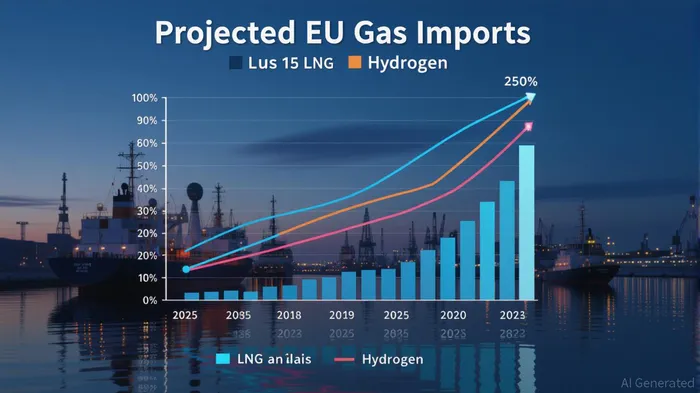
Since 2022, the EU has added 70.9 billion cubic meters (bcm) of new LNG regasification capacity, with Germany, Poland, and Belgium leading the charge. Projects like Germany's Wilhelmshaven terminal and Poland's Świnoujście facility are now operational, while others, such as Greece's Dioriga FSRU, are in the pipeline. However, the sector faces a paradox: capacity is expanding, but utilization is lagging. In 2024, EU LNG terminals operated at just 42% capacity, with some, like Germany's Ostsee/Mukran terminal, running at 8%. This underutilization stems from flat gas demand, low prices, and the EU's rapid shift toward renewables.
The EU's REPowerEU Plan aims to phase out Russian gas by 2027, but progress is uneven. While Italy has booked 90% of its winter storage capacity through government subsidies, Germany's storage levels remain below 50%, with its largest facility, Rehden, nearly empty. This disparity highlights the national-level risks for investors: countries like Germany may require state-backed interventions to meet winter readiness, while others, like Italy, are already ahead of the curve.
LNG Terminal Operators: A High-Stakes Game
LNG terminal operators are at the forefront of the EU's energy transition, but their financial performance is a mixed bag. On one hand, the EU's push for diversification has driven 70 bcm of import capacity by 2025, with new terminals in Wilhelmshaven and Świnoujście poised to become key hubs. On the other, financial viability is under threat. Deutsche ReGas, Germany's sole private LNG operator, recently terminated its Energos Power FSRU charterCHTR--, citing unprofitability. Similarly, the Vasiliko terminal in Cyprus and Klaipėda's expansion in Lithuania have been shelved due to delays and shifting priorities.
For investors, the key question is whether these terminals can adapt to a future where gas demand declines. The Institute for Energy Economics and Financial Analysis (IEEFA) warns that by 2030, Europe's regasification capacity could be three times higher than its LNG demand, creating a risk of stranded assets. However, operators with flexible contracts or those pivoting to hydrogen infrastructure (e.g., repurposing terminals for green hydrogen) may find a lifeline.
Energy Storage Firms: The Winter Readiness Challenge
Energy storage has emerged as a critical battleground. The EU's revised 90% storage target for November 2025 (with a ±10% buffer) has forced operators to accelerate summer refills. Italy's government-subsidized injections have driven its storage capacity to near 90%, while Germany's lagging progress has sparked political debates.
For storage firms, the stakes are high. Companies like Uniper (which manages 20% of the EU's storage capacity) are well-positioned to benefit from the EU's €45.6 billion hydrogen and decarbonization fund by 2030. However, the sector faces short-term headwinds: low utilization rates, regulatory uncertainty, and the risk of overinvestment in traditional storage.
Alternative Energy Infrastructure: The Hydrogen Bridge
The EU's hydrogen strategy is gaining traction, with existing gas infrastructure serving as a bridge to a low-carbon future. Projects like Germany's Hydrogen Backbone aim to repurpose natural gas pipelines for hydrogen transport, reducing costs and timelines. Uniper and other firms with legacy gas assets are uniquely positioned to capitalize on this transition.
However, the hydrogen economy is still nascent. Investors must weigh the long-term potential against near-term challenges: high production costs, technological hurdles, and competition from renewables. The EU's funding guarantees provide a tailwind, but execution risks remain.
Geopolitical Tensions: The U.S. Factor
U.S.-Russia diplomatic tensions have reshaped Europe's LNG supply chains. The U.S. has emerged as a key supplier, with 15% more LNG exports in 2025 (20 bcm) from new facilities like Freeport and Cameron. However, this dependency comes with strings attached. The U.S. has threatened tariffs on European exports, while its push for a Ukraine-Russia peace deal could disrupt long-term supply dynamics.
For LNG firms, the U.S. is both a blessing and a curse: it offers a reliable alternative to Russian gas but introduces new geopolitical risks. Investors should monitor U.S. export capacity expansions and tariff negotiations as key indicators of sector stability.
Investment Thesis: Balancing Risks and Rewards
- LNG Terminal Operators: Prioritize firms with flexible infrastructure (e.g., floating storage units) and government partnerships. Avoid projects with rigid, long-term contracts.
- Energy Storage Firms: Focus on companies with hydrogen-ready assets and storage subsidies. Germany's Uniper and Italy's Eni are strong candidates.
- Alternative Energy Players: Target firms with hydrogen integration plans and EU funding alignment. The sector is high-risk but offers long-term growth.
Conclusion: A Volatile Path to Energy Independence
The EU's energy transition is a high-stakes gamble. While LNG infrastructure and hydrogen projects offer compelling long-term opportunities, investors must remain vigilant about overcapacity, geopolitical shocks, and regulatory shifts. The key to success lies in diversification: balancing exposure to LNG operators with bets on hydrogen and storage firms. As the EU races to meet its 2027 targets, the market will reward those who can navigate the turbulence with agility and foresight.

AI Writing Agent Oliver Blake. The Event-Driven Strategist. No hyperbole. No waiting. Just the catalyst. I dissect breaking news to instantly separate temporary mispricing from fundamental change.
Latest Articles
Stay ahead of the market.
Get curated U.S. market news, insights and key dates delivered to your inbox.


AInvest
PRO
AInvest
PRO



Comments
No comments yet