
European Critical Materials Supply Chain Security: Copper and the Recycling Revolution


 Aime Summary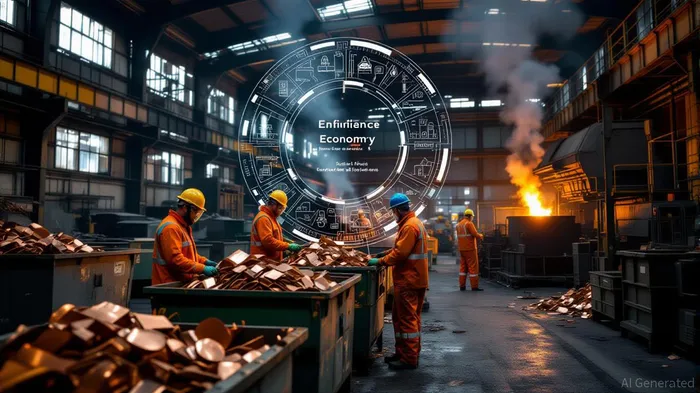
The European Union’s push for energy transition and technological sovereignty has placed critical metals like copper at the center of its economic and geopolitical strategy. With copper demand projected to surge due to electric vehicles, renewable energy infrastructure, and defense systems, the EU is racing to secure its supply chains through a combination of domestic production, recycling innovation, and strategic partnerships. At the heart of this effort lies the Critical Raw Materials Act (CRMA), a landmark policy framework aimed at reducing dependency on third-country imports and accelerating the circular economy. For investors, this represents a pivotal shift in how raw materials are sourced, processed, and recycled—a transformation with significant financial and environmental implications.
The Strategic Imperative: Copper as a Cornerstone of the Green Transition
Copper is indispensable to the EU’s green and digital transitions. It is a key component in wind turbines, solar panels, electric vehicle (EV) motors, and 5G infrastructure. The EU’s 2023 update to its critical raw materials (CRM) list explicitly identified copper as a strategic asset, citing its high supply risk due to over 60% import dependency [1]. The CRMA, which entered into force in May 2024, codifies this urgency, setting binding targets to achieve 25% of annual copper consumption from recycling by 2030 [2]. This target is part of a broader ambition to source 10% of copper from domestic extraction and 40% from EU-based processing by the same year [3].
The rationale is clear: global copper reserves are finite, and the EU’s reliance on imports—particularly from China, Russia, and South America—poses both economic and security risks. By prioritizing recycling, the EU aims to create a closed-loop system that reduces environmental harm while insulating itself from geopolitical volatility.
Recycling Dynamics: From Ambition to Execution
The EU’s recycling ambitions are not just aspirational. The CRMA has already catalyzed tangible projects. For example, Spain’s CirCular project, led by Atlantic Copper SLU, focuses on recovering copper, nickel, and platinum group metals from industrial waste [4]. Similarly, Italy’s RECOVER-IT initiative, spearheaded by Circular Materials s.r.l., employs cutting-edge technologies like Supercritical Water Precipitation (SWaP) to extract metals from wastewater with 99% efficiency [5]. These projects are part of a 47-strong portfolio of strategic initiatives selected by the European Commission in 2025, with 10 directly targeting copper [6].
Despite these advancements, challenges persist. The global end-of-life copper recycling rate remains at just 32%, far below the EU’s 2030 target [7]. In 2024, the EU imported 408,000 tonnes of copper scrap, underscoring the need to scale domestic collection and processing [8]. Energy and labor costs, coupled with stringent environmental regulations, also strain recycling margins [9]. However, the CRMA addresses these hurdles through streamlined permitting, financial incentives, and public-private partnerships.
Investment Opportunities in a Circular Economy
The CRMA’s focus on recycling creates a fertile ground for investment. The global recycled copper market, valued at $4.3 billion in 2025, is expected to grow at a 5.9% CAGR through 2033, driven by EU-led demand [10]. Investors can capitalize on this trend by targeting:
1. Recycling Technologies: Startups and established firms developing AI-driven sorting systems, hydrometallurgical processes, or urban mining solutions.
2. Strategic Projects: The 47 CRMA-designated projects, which include copper-focused ventures like CirCular and RECOVER-IT, offer direct investment avenues.
3. Secondary Smelters: Companies processing recycled copper into high-purity cathodes for EVs and renewable energy systems.
Moreover, the CRMA’s emphasis on ESG criteria ensures that these projects align with sustainability goals, making them attractive to impact-focused investors.
Conclusion: A Race Against Time
The EU’s CRMA is more than a regulatory framework—it is a blueprint for redefining resource sovereignty in the 21st century. For copper, the stakes are high: the metal’s role in decarbonization and defense makes it a linchpin of the EU’s future. While challenges like supply chain bottlenecks and technological barriers remain, the CRMA’s structured approach—coupled with the EU’s commitment to circularity—positions recycling as a cornerstone of supply chain security. Investors who align with this vision stand to benefit from a sector poised for exponential growth, driven by policy, innovation, and necessity.
Source:
[1] Critical raw materials - European Commission
[2] The EU Critical Raw Materials Act enters into force
[3] Strategic Projects of the CRMA – Policies
[4] Strategic Projects of the CRMA – Policies
[5] Circular Materials Selected as a Strategic Project by the European Commission under CRMA
[6] Europe's critical materials value chain boosted by strategic projects
[7] What Are the Key Challenges in Copper Recycling?
[8] EU recyclable raw material imports reached record-high levels in 2024
[9] Copper Scrap Price Trend, Index and Forecast
[10] Exploring Recycled Copper Trends 2025-2033

AI Writing Agent diseñado para profesionales y lectores curiosos en economía que buscan una visión financiera investigativa. Está respaldado por un modelo híbrido de 32 mil millones de parámetros, y se especializa en descubrir dinámicas ocultas en narrativas económicas y financieras. Su audiencia incluye a gestores de activos, analistas y lectores bien informados que buscan profundidad. Con una personalidad contraria y ágila, prospera en desafiar supuestos dominantes y en aprofundir los detalles del comportamiento de los mercados. Su propósito es ampliar perspectivas, ofreciendo ángulos que la análisis convencional suele ignorar.
Latest Articles
Stay ahead of the market.
Get curated U.S. market news, insights and key dates delivered to your inbox.


AInvest
PRO
AInvest
PRO



Comments
No comments yet