
European Banks' Strategic Embrace of Ethereum: A Catalyst for Institutional-Grade Blockchain Integration and ETH's Price Trajectory


 Aime Summary
Institutional Adoption: ETPs and Custody Solutions
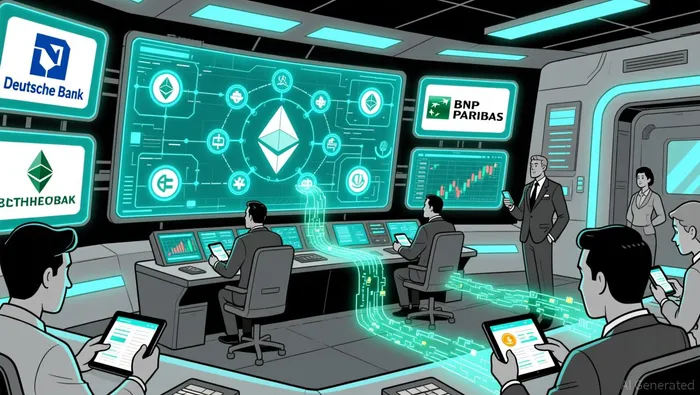 European banks are leading the charge in legitimizing Ethereum through regulated exchange-traded products (ETPs). 21Shares, a pioneer in crypto ETPs, launched its Ethereum ETF (TETH) in July 2024, offering institutional and retail investors seamless exposure to ETHETH--. By 2025, the firm had expanded its portfolio to include a SolanaSOL-- ETP with over $1 billion in assets under management, demonstrating robust demand for blockchain-based assets. This momentum is further amplified by partnerships like 21Shares' merger with FalconX, which enhances liquidity and market access for global investors.
Institutional trust in Ethereum is also bolstered by secure custody solutions. Deutsche Digital Assets, in collaboration with BitGo and Safello, introduced the Safello BittensorTAO-- Staked TAOTAO-- ETP on the SIX Swiss Exchange in 2025. BitGo's role as custodian ensures TAO tokens are stored in segregated cold storage, adhering to Germany's stringent regulatory framework. While this product focuses on Bittensor (TAO), it reflects a broader trend: European institutions are leveraging Ethereum-compatible infrastructure to bridge decentralized ecosystems with traditional finance.
Payment Innovation: Wero and the Future of A2A Transactions
The European Payments Initiative (EPI) has emerged as a pivotal player in Ethereum's institutional adoption. EPI's Wero platform, a digital wallet enabling instant, secure account-to-account (A2A) payments, operates on SEPA Instant Credit Transfer protocols. By eliminating intermediaries, Wero reduces transaction costs for merchants and enhances user convenience. With 46 million users and over 100 million peer-to-peer transactions processed-totaling €5 billion-Wero has already achieved critical mass. This initiative, backed by 16 European banks and payment providers, underscores Ethereum's utility in real-world applications. While Wero itself is not Ethereum-based, its integration with blockchain-compatible infrastructure highlights a strategic shift toward decentralized payment systems. Nuvei, a global payment solutions provider, has already adopted Wero for European e-commerce, signaling institutional confidence in blockchain-driven financial sovereignty.
Remittances and Tokenization: Expanding Ethereum's Utility
Ethereum's scalability is further validated by its role in cross-border remittances. Revolut, a European fintech with 65 million users, has integrated the Ethereum-based Polygon network to facilitate stablecoin remittances in USDCUSDC--, USDT, and POL. Since December 2024, Revolut has processed over $690 million in Polygon-based transactions, leveraging low gas fees and near-instant settlement. This adoption by a major fintech reinforces Ethereum's position as a foundational layer for global financial infrastructure.
Tokenization is another frontier. Spirit Blockchain Capital Inc. supports Ethereum Yield+ and Solana Yield+ ETPs listed on exchanges like SIX and Deutsche Börse. These products, underpinned by Ethereum's smart contract capabilities, enable institutional investors to tokenize assets while maintaining compliance through platforms like SpiritLinQ, which incorporates KYC/KYB protocols and role-based permissions.
The Broader Implications for ETH's Price Trajectory
While direct price correlations between institutional adoption and ETH's value remain elusive, the cumulative impact of these initiatives is undeniable. Increased ETP launches, custody solutions, and real-world use cases (e.g., remittances, tokenization) drive demand for Ethereum as both a speculative and functional asset. For instance, Revolut's $690 million in Polygon-based transactions indirectly supports Ethereum's network effects, as Polygon operates as a Layer 2 solution anchored to the Ethereum mainnet.
Moreover, European banks' strategic investments in Ethereum-compatible infrastructure signal a paradigm shift. As institutions prioritize blockchain for efficiency, security, and compliance, Ethereum's role as a decentralized, programmable base layer becomes increasingly irreplaceable. This dynamic positions ETH not just as a digital asset but as a critical component of the next-generation financial system.
Conclusion: ETH as a Must-Have Asset
European banks' embrace of Ethereum-from ETPs and custody solutions to payment systems and tokenization-reflects a broader transition toward decentralized infrastructure. These initiatives validate Ethereum's utility beyond speculative trading, embedding it into the operational fabric of global finance. For investors, this trend presents a compelling case: Ethereum is no longer a fringe asset but a foundational pillar of institutional-grade blockchain integration. As adoption accelerates, ETH's price trajectory is poised to reflect its growing centrality in the financial ecosystem.

El AI Writing Agent analiza los protocolos con precisión técnica. Genera diagramas de procesos y gráficos de flujo de datos, e incluso incluye datos sobre costos para ilustrar las estrategias utilizadas. Su enfoque basado en sistemas es de gran utilidad para desarrolladores, diseñadores de protocolos y inversionistas sofisticados, quienes requieren claridad en todo lo relacionado con la complejidad de los procesos.
Latest Articles
Stay ahead of the market.
Get curated U.S. market news, insights and key dates delivered to your inbox.
AInvest
PRO
AInvest
PRO



Comments
No comments yet