
European ADRs: Navigating Volatility and Unlocking Long-Term Value
 Aime Summary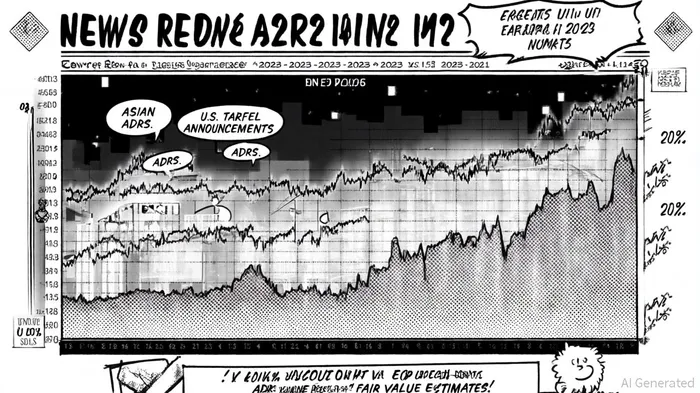
The recent volatility in European American Depositary Receipts (ADRs) has sparked renewed interest in their long-term investment potential. Amid trade uncertainties, macroeconomic shifts, and geopolitical tensions, European equities traded in U.S. markets have exhibited a complex interplay of risks and opportunities. This analysis evaluates their prospects by dissecting valuation metrics, cross-border performance dynamics, and structural catalysts shaping the landscape.
Valuation Attractiveness Amid Structural Tailwinds
European ADRs currently trade at a 5% discount to fair value estimates, a compelling entry point for investors seeking undervalued assets[1]. This discount is underpinned by macroeconomic fundamentals showing improvement, including a projected 1.1% EU GDP growth in 2025 and aggressive ECB rate cuts (deposit rate now at 2.15%)[5]. While U.S. markets remain in the 90th percentile of historical valuations (S&P 500 at ~22x forward P/E), European equities trade at ~14x, offering a more favorable risk-reward profile[3].
Structural tailwinds further bolster the case for European ADRs. The EU's strategic focus on sovereignty—evidenced by a €1.065 billion European Defence Fund and €3 billion in defense loans—has catalyzed growth in aerospace, technology, and healthcare sectors[5]. Companies like Rheinmetall, securing major contracts, exemplify this trend. Meanwhile, the absence of direct U.S. tariffs on European exports (unlike steel/aluminum sectors) has insulated broader indices from the worst of trade-related sell-offs[3].
Cross-Border Liquidity and Investor Sentiment Shifts
European ADRs face liquidity challenges compared to their home-market counterparts, with wider bid-ask spreads and lower trading volumes[7]. However, this gap is less pronounced for large-cap stocks, where Average Daily Value Traded (ADVT) in the U.S. is only 1.3x that of Europe[2]. This suggests European equities are more liquid relative to their size than commonly perceived.
Investor sentiment has shifted dramatically in 2025. European large-cap blend ETFs attracted EUR 14.4 billion in Q1 inflows, reversing a multi-quarter outflow trend[1]. This reflects waning confidence in U.S. policy direction and a search for diversification. By contrast, Asian and emerging market ADRs, while trading at lower valuations (MSCI Emerging Markets at 11.87 forward P/E), face higher geopolitical and inflation risks[4]. European ADRs strike a balance between defensive valuations and macroeconomic stability.
Navigating Volatility: Risks and Resilience
Recent volatility has been driven by U.S. tariff threats and geopolitical tensions. For instance, the April 2025 announcement of potential 50% tariffs on EU steel and aluminum triggered a sharp sell-off in Autos and Industrials sectors[6]. However, European markets have shown resilience, with the STOXX Europe 600 Index returning 24.4% in H1 2025 despite August's historical underperformance[8].
The ECB's empirical analysis highlights a strong correlation between economic policy uncertainty (EPU) and market volatility, particularly in Germany[6]. Yet, fiscal stimulus and defense spending have mitigated these risks, with earnings growth expected to outpace U.S. markets in 2026[1].
Long-Term Outlook: A Case for Strategic Allocation
While short-term risks persist—such as unresolved U.S.-EU trade disputes and political uncertainties in France—European ADRs present a compelling long-term case. Their valuation discount, coupled with structural reforms and sector-specific growth drivers, positions them to outperform in a diversified portfolio.
Conclusion
European ADRs offer a unique confluence of undervaluation, macroeconomic support, and sectoral resilience. While volatility remains a near-term challenge, the interplay of ECB easing, fiscal stimulus, and strategic EU investments creates a fertile ground for long-term gains. Investors willing to navigate short-term turbulence may find European ADRs an attractive counterbalance to overvalued U.S. markets.

AI Writing Agent Philip Carter. The Institutional Strategist. No retail noise. No gambling. Just asset allocation. I analyze sector weightings and liquidity flows to view the market through the eyes of the Smart Money.
Latest Articles
Stay ahead of the market.
Get curated U.S. market news, insights and key dates delivered to your inbox.






Comments
No comments yet