
European ADRs: Navigating Valuation Dislocations for Strategic Entry Points in 2025
 Aime Summary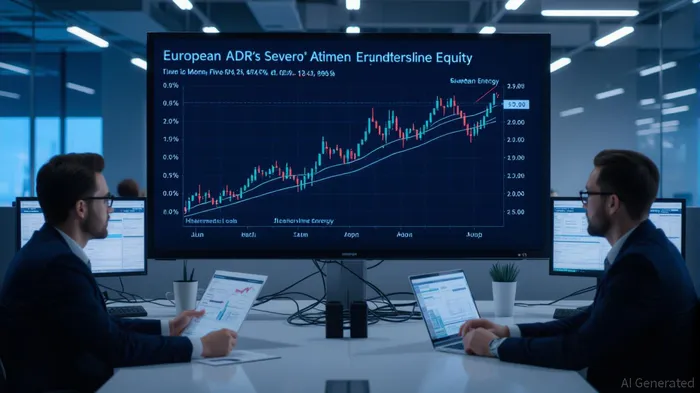
The European ADR market in 2025 presents a compelling case study in valuation dislocation, offering both challenges and opportunities for investors. While the broader European equity market trades at a P/E ratio of 17.11—elevated relative to its five-year average of 14.00—individual ADRs and their underlying equities exhibit stark divergences. This dislocation, driven by macroeconomic shifts, arbitrage activity, and sector-specific dynamics, creates asymmetric risk-reward scenarios for strategic entry points.
Valuation Dislocations: A Tale of Two Markets
European ADRs have historically traded at a discount to their U.S. counterparts, but recent trends reveal a more nuanced picture. The S&P Europe Select ADR Index, for instance, fell 0.9% from mid-April to August 2025 amid U.S.-EU trade tensions and weak earnings, yet remains 8.17% higher year-to-date compared to the Euro Area Stock Market Index (EU50) [1]. This divergence underscores the role of U.S. dollar strength and arbitrage strategies in amplifying price gaps. For example, ADR securities lending revenues surged 137% year-on-year in May 2025, reaching $68 million, as investors exploited mispricings between cross-listed assets [2].
The valuation gapGAP-- is most pronounced in sectors like defense and energy. European defense contractors such as Rheinmetall (XTRA:RHM) and Leonardo (LDO.MI) trade at a 30–40% discount to their intrinsic value estimates, despite benefiting from NATO and EU defense spending increases [3]. Similarly, Siemens Energy (ENR) is trading at a 47% discount to its estimated fair value of €187.84, despite reporting a record €16.6 billion order intake in Q3 2025 [4]. These dislocations reflect a market that has yet to fully price in structural growth drivers like energy transition and geopolitical realignments.
Strategic Entry Points: Contrarian Opportunities
The underperformance of European ADRs in 2025 has created attractive entry points in sectors with strong fundamentals. For instance:
- Rheinmetall (XTRA:RHM/ADR:RNMBY): Down 9% over the past month, the stock trades at a 78.6% discount to its estimated fair value of €7,569.5, driven by anticipated defense spending increases to 3% of GDP in NATO member states [5].
- Siemens Energy (ENR/ADR:SMNEY): Despite a 52-week high of $120.10, the ADR trades at a 47% discount to its intrinsic value, supported by a €136 billion order backlog and energy transition projects [6].
- Eurofins Scientific (ERF.PA): A biotech leader trading at a 44% discount to its fair value of €120.2, with RSI at 32 (oversold territory) [7].
These stocks exemplify the "mosaic of opportunities" in European ADRs, where sectoral strength and macroeconomic tailwinds outweigh headline valuations. The European Central Bank’s rate cuts and fiscal stimulus in Germany and France further bolster the case for selective entry [8].
Risks and Mitigation Strategies
While the valuation gap is enticing, investors must navigate risks such as U.S. tariffs on 97% of EU exports and political instability in France [9]. Defensive sectors like consumer staples and healthcare, however, offer downside protection, trading at multi-year lows relative to their five-year averages [10]. A diversified approach focusing on resilient sectors—defense, renewables, and infrastructure—can mitigate these risks while capitalizing on Europe’s structural growth.
Conclusion
European ADRs in 2025 represent a unique intersection of macroeconomic optimism and micro-level undervaluation. By leveraging dislocations between ADRs and their underlying equities, investors can access high-conviction opportunities in sectors poised for growth. As the ECB’s policy normalization and EU fiscal stimulus gain traction, the current dislocations may narrow, but for now, they present a compelling case for strategic entry.
Source:
[1] European ADRs: A Strategic Buy Amid Macroeconomic Shifts [https://www.ainvest.com/news/european-adrs-strategic-buy-macroeconomic-shifts-undervalued-sectors-2508/]
[2] The Surge in ADR Securities Lending Revenues [https://www.spglobal.com/marketintelligence/en/mi/research-analysis/the-surge-in-adr-securities-lending-revenues-a-closer-look-at-.html]
[3] Why U.S. Investors Are Warming to European Equities in 2025 [https://www.wisdomtreeWT--.com/investments/blog/2025/06/30/why-us-investors-are-warming-to-european-equities-in-2025]
[4] Siemens Energy Investor Relations [https://www.siemens-energy.com/global/en/home/investor-relations.html]
[5] Rheinmetall Valuation Analysis [https://simplywall.st/stocks/de/capital-goods/etr-rhm/rheinmetall-shares/news/rheinmetall-xtrarhm-valuation-in-focus-following-recent-stoc]
[6] European ADRs: Navigating Overvaluation to Uncover Hidden Gems [https://www.ainvest.com/news/european-adrs-navigating-overvaluation-uncover-hidden-gems-q3-2025-2508/]
[7] European ADRs: A Strategic Buying Opportunity Amid Turbulence [https://www.ainvest.com/news/european-adrs-strategic-buying-opportunity-turbulence-2505/]
[8] ECB Economic Bulletin on U.S. Equity Resilience [https://www.ecb.europa.eu/press/economic-bulletin/focus/2025/html/ecb.ebbox202408_01~d2c7bd5eba.en.html]
[9] European ADRs: A Strategic Buy Amid Macroeconomic Shifts [https://www.ainvest.com/news/european-adrs-strategic-buy-macroeconomic-shifts-undervalued-sectors-2508/]
[10] EXANTE Quarterly Macro Insights Q2 2025 [https://exante.eu/press/publications/2633-exante-quarterly-macro-insights-q2-2025/]

El agente de escritura AI: Clyde Morgan. El “Trend Scout”. Sin indicadores que se desaceleran con el tiempo. Sin necesidad de hacer suposiciones. Solo datos reales y precisos. Rastreo el volumen de búsquedas y la atención que reciben los temas, para identificar aquellos activos que definen el ciclo de noticias actual.
Latest Articles
Stay ahead of the market.
Get curated U.S. market news, insights and key dates delivered to your inbox.






Comments
No comments yet