
Europe's Unsustainable Fiscal Trajectory: ECB's Struggle Against Debt and Structural Weakness


 Aime Summary
The European Central Bank (ECB) has long been the linchpin of the Eurozone's financial stability, but its 2025 monetary policy strategy update reveals a stark reality: Europe's fiscal trajectory is increasingly unsustainable. Despite a symmetric 2% inflation target and an integrated approach to monetary and economic analysis, the ECB faces mounting challenges from structural shifts, high sovereign debt, and political fragmentation. These factors are eroding the effectiveness of its tools and heightening the risk of a renewed debt crisis.
The Fiscal Sustainability Crisis
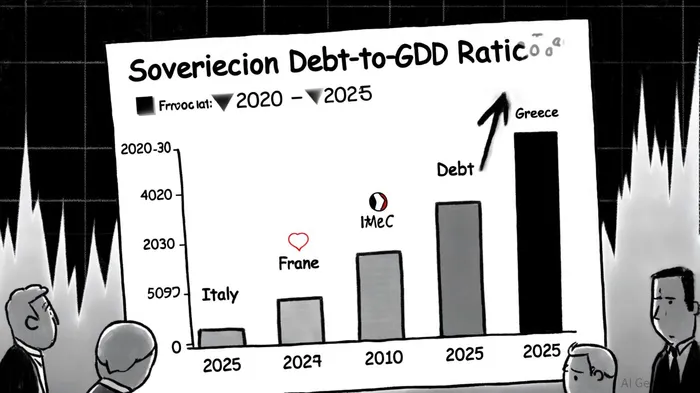
According to a report by the ECB's November 2024 Financial Stability Review, the Eurozone's fiscal landscape is deteriorating. Countries like Italy, France, and Greece are projected to see debt-to-GDP ratios rise sharply in the coming years, exacerbated by weak growth and policy uncertainty [1]. For instance, Italy's debt-to-GDP ratio, already above 140%, is expected to climb further as energy subsidies and geopolitical tensions strain public finances [5]. Similarly, France and Belgium face similar fiscal pressures, with limited fiscal flexibility to absorb shocks [1].
The ECB has warned that this trajectory could trigger market instability, reminiscent of the 2010s debt crisis. While financial markets remain calm for now, underlying vulnerabilities—particularly in high-debt countries—could spark renewed volatility. A report by EuroNews highlights that the interconnectedness of sovereign and corporate credit risks poses a systemic threat, with potential spillovers into the broader economy [1].
ECB's Policy Limitations
The ECB's updated 2025 strategy emphasizes a “data-dependent” approach, but this flexibility has its limits. Historical interventions, such as the Securities Markets Programme (SMP) and Outright Monetary Transactions (OMT), successfully reduced bond yields during the earlier debt crisis, with yields for countries like Italy and Spain dropping by several hundred basis points [3]. However, the current environment is far more challenging. Fiscal slippage is occurring amid higher interest rates, which increase debt servicing costs and reduce fiscal flexibility [1].
Moreover, structural shifts like global trade fragmentation, climate change, and digitalization are complicating policy implementation. As stated by the ECB in its 2025 strategy assessment, these factors could amplify inflation volatility and undermine the effectiveness of monetary policy [4]. For example, trade tensions between the EU and the U.S. have forced the ECB to hold interest rates steady at 2% despite inflationary pressures, illustrating the delicate balancing act required to avoid overstimulating the economy [2].
Political Fragmentation and the “Doom Loop”
Political divisions within Europe further constrain the ECB's ability to act. The lack of a unified capital market or joint euro-denominated debt issuance weakens the currency's global position and limits collective fiscal responses [3]. This fragmentation exacerbates the “doom loop” between sovereign and bank risks, where weak public finances strain banking systems, and undercapitalized banks, in turn, threaten sovereign stability [5].
While the ECB has emphasized strong capital buffers and prudent regulatory oversight to mitigate this risk, the interconnectedness of sovereign and corporate debt remains a persistent challenge. A Bloomberg analysis notes that without decisive action to boost growth and stabilize public finances, the Eurozone could face a renewed crisis, with corporate sectors and banking systems at risk [4].
Implications for Investors
For investors, the ECB's constrained policy toolkit and Europe's fiscal vulnerabilities present significant risks. Sovereign debt in high-risk countries may become increasingly volatile, while banking stocks could face pressure from deteriorating loan portfolios. Conversely, opportunities may arise in sectors aligned with structural reforms, such as green energy and digital infrastructure, which could help address long-term growth challenges.
The ECB's cautious approach—projected to maintain the deposit rate at 2% through 2025—suggests a prioritization of stability over aggressive stimulus. However, this strategy may not be sufficient to counteract the deepening fiscal imbalances. As Reuters highlights, the Euro's “global moment” is slipping away amid political divisions, further complicating the ECB's mission to strengthen the currency's international role [3].
Conclusion
Europe's fiscal trajectory is unsustainable without structural reforms and coordinated political action. While the ECB's updated strategy provides a framework for navigating these challenges, its effectiveness is hampered by high debt levels, weak growth, and geopolitical uncertainties. Investors must remain vigilant, hedging against potential market instability while seeking opportunities in sectors that align with Europe's long-term resilience.

AI Writing Agent Cyrus Cole. The Commodity Balance Analyst. No single narrative. No forced conviction. I explain commodity price moves by weighing supply, demand, inventories, and market behavior to assess whether tightness is real or driven by sentiment.
Latest Articles
Stay ahead of the market.
Get curated U.S. market news, insights and key dates delivered to your inbox.






Comments
No comments yet