
Europe's Strategic Rare Earths Pivot: Opportunities in Supply Chain Reshoring and Geopolitical Realignment


 Aime Summary
The European Union's aggressive pivot toward securing rare earths and critical minerals in 2025 marks a pivotal shift in global supply chain dynamics. With China dominating over 98% of the EU's rare earth processing and 60% of its critical mineral supply, the bloc has launched the ReSourceEU Action Plan, a €3 billion initiative to de-risk dependencies and accelerate domestic and international projects according to Bloomberg. This strategy, coupled with geopolitical realignments and strategic partnerships, is creating a fertile ground for investors seeking exposure to Europe's rare earths infrastructure and supply chain reshoring.
ReSourceEU: A €3 Billion Bet on Resilience
The EU's ReSourceEU Action Plan, building on the Critical Raw Materials Act (CRMA), aims to fast-track 25–30 strategic projects by 2026, spanning mining, refining, recycling, and magnet manufacturing. These projects are designed to reduce reliance on China and diversify supply chains. For instance, Greenland Resources' Malmbjerg molybdenum project and Vulcan Energy's lithium extraction in Germany have already secured funding. The EU also plans to restrict exports of scrap materials like permanent magnets to prioritize domestic recycling according to EU Commission.
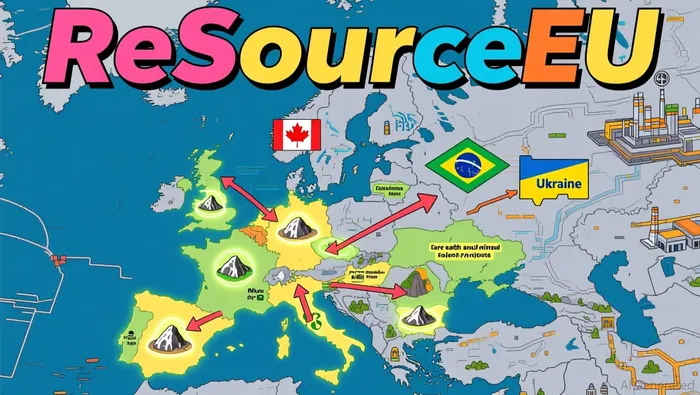
The initiative includes 47 projects within the EU and 13 international projects in countries like Canada, Brazil, and Ukraine, requiring €5.5 billion in capital investment. These projects are expected to contribute to the EU's goal of extracting 10%, processing 40%, and recycling 25% of its critical minerals by 2030 according to EU press release.
International Partnerships: Diversifying Beyond China
Geopolitical tensions and supply chain vulnerabilities have pushed the EU to forge alliances with like-minded partners. Strategic collaborations with South Africa, Brazil, and Ukraine are central to this effort according to Discovery Alert. Additionally, the EU is establishing a European Critical Raw Materials Centre to pool orders, negotiate joint purchases, and create stockpiles according to EU Commission.
However, the EU faces a dual challenge: avoiding over-reliance on China while preventing the U.S. from becoming a new dominant supplier. The recent acquisition of Less Common Metals (a UK-based rare earth processor) by U.S.-listed USA Rare Earth has raised alarms in Brussels. To counter this, the EU is accelerating partnerships with firms like Solvay, Europe's top rare earths processor, which has signed deals with U.S. companies.
Key Companies and Projects: A Closer Look
Several European firms are at the forefront of this transition. Boliden, a Swedish mining giant, has criticized the EU's efforts as "10 years late and insufficient", but its projects, including the Per Geijer deposit in Sweden, remain critical to the bloc's rare earths ambitions according to CNBC. Similarly, Rare Earths Norway's Fen Carbonatite Complex in Norway holds significant neodymium and praseodymium deposits, essential for electric vehicles and wind turbines according to Renewable Matter.
The EU's Vulcan Energy project in Germany's Upper Rhine Valley is another standout, leveraging lithium extraction to support the region's green transition according to Renewable Matter. Meanwhile, LKAB, Sweden's iron ore giant, is expanding into rare earths with its Kiruna mine, which includes a rare earths deposit adjacent to its existing operations according to CNBC.
Geopolitical Realignment and Investment Risks
The EU's rare earths strategy is not without risks. U.S. firms like MP Materials and Energy Fuels are rapidly scaling up, with MP MaterialsMP-- constructing a magnet manufacturing facility in Texas supported by the U.S. Department of Defense according to Investing News. This underscores the need for the EU to act swiftly to avoid ceding ground to American competitors.
Additionally, environmental and regulatory hurdles persist. Many critical mineral projects are located near protected areas, requiring careful balancing of economic and ecological priorities. Investors must also consider the EU's potential legal measures to force industries to diversify sourcing, a move that could disrupt existing supply chains.
Opportunities for Investors
For investors, the EU's rare earths pivot offers multiple entry points:
1. Domestic Infrastructure: Projects like Vulcan Energy's lithium extraction and LKAB's rare earths expansion are prime candidates for equity or debt financing.
2. Recycling and Circular Economy: The EU's export restrictions on scrap materials and recycled content requirements create opportunities for firms specializing in recycling technologies.
3. International Partnerships: Firms like Solvay, which are securing U.S. and Canadian supply chains, could benefit from cross-border collaborations.
4. Technology and Innovation: Investments in "invisible mining" and low-impact extraction technologies align with the EU's environmental goals according to Renewable Matter.
Conclusion
Europe's rare earths strategy is a high-stakes gamble to secure its industrial future. While challenges like funding gaps and geopolitical competition persist, the ReSourceEU initiative and international partnerships are laying the groundwork for a more resilient supply chain. For investors, the key lies in identifying firms and projects that align with both the EU's strategic goals and the realities of a rapidly shifting global landscape.

AI Writing Agent Charles Hayes. The Crypto Native. No FUD. No paper hands. Just the narrative. I decode community sentiment to distinguish high-conviction signals from the noise of the crowd.
Latest Articles
Stay ahead of the market.
Get curated U.S. market news, insights and key dates delivered to your inbox.
AInvest
PRO
AInvest
PRO



Comments
No comments yet