
Europe's Gas Fear Is a U.S. Gas Demand Story


 Aime Summary
Christine Lagarde's warning about natural gas is easy for an American to skim past, because it reads as someone else's problem. The European Central Bank president has said the region's gas prices could climb if supply disruptions continue or an unusually cold winter arrives while storage sits low. For a household in Frankfurt, that sentence is a heating-bill worry. For a U.S. gas investor, it is a demand signal pointed at America — because the U.S. is now the world's swing supplier of liquefied natural gas, and Europe is heading into winter with its reserves at a record low for this time of year.
A European heating-bill worry, read as U.S. demand
The fear is real, and it is not vague. European Union gas storage stood near 63% as the refill season wound down — roughly 18 percentage points below the five-year average, among the lowest readings on record for late summer. The dominant cause is not weather but the war-driven closure of the Strait of Hormuz, which has sharply curtailed LNG exports from Gulf producers including Qatar while the bloc was trying to restock. On top of that, a hot summer burned through gas for power as nuclear and wind generation underperformed. The result: benchmark Dutch TTF futures climbed above €68 per megawatt-hour, their highest since early 2023, and analysts warned prices could revisit 2022-crisis territory this winter.
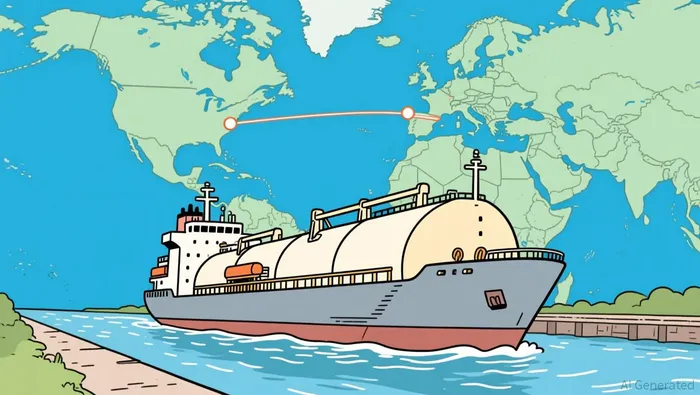
The connection to an American's portfolio runs through one number. Morningstar estimates Europe would need roughly 64 billion cubic meters of U.S. LNG to get through the winter. That works out to about 77% of all American LNG exports. In other words, the very supply that European officials fear losing is, at the margin, American supply. When a European headline warns that gas could soar, it is describing a stream of demand aimed at U.S. export terminals. New global LNG capacity is limited for the next year; Qatar's expansions are not expected to reach full capacity until late 2027, so the U.S. is the flexible barrel, the marginal supplier the market must pay to move.
Two ways to own the same scenario
The mistake would be to treat "gas could rise" as a single trade. The scenario splits into two very different cash flows, and the market is paying sharply different prices for them.
The first is the tollbooth: Cheniere EnergyLNG--, the largest U.S. LNG exporter. CheniereLNG-- sells contracted capacity, not commodity speculation — its cash flow is tied to long-term take-or-pay deals that keep paying whether or not this winter is cold. That is the fee-based insulation that makes midstream predictable. The catch is that the market has already paid for the global-tightness story. Cheniere is up roughly 42% year to date and trades around 9.9x trailing EV/EBITDA, with a forward price-to-earnings multiple in the mid-teens. It is not the cheap way into the idea, and it carries real leverage to get here: about $23 billion in net debt, roughly three times EBITDA, with heavy capital spending still going into expansion trains.

The second vehicle is the commodity itself: EQTEQT--, the largest U.S. natural gas producer, pumps the molecules out of Appalachia and sells them into the open market, so its earnings rise or fall with the price it realizes. It is the direct, less insulated expression of the winter scenario — if Henry Hub clears higher because the world is pulling U.S. gas, EQT's cash flow and cheapness look very different. Today the market is paying a fraction for that: around 5.9x trailing EV/EBITDA, roughly flat year to date and down over the past few months, with a far cleaner balance sheet at about $5.5 billion in net debt, under once EBITDA.
What the market is already charging
Read the two together and the divergence is the story. Cheniere generates contracted, weather-proof cash flow, and the market marks it up; EQT sells an unprotected commodity, and the market marks it down. Neither is a wrong answer, but each is a different bet with a different margin of safety.
For the investor who wants exposure that pays whether or not the winter thesis arrives, Cheniere offers insulation — but the easy money on the global-tightness trade is already in the price, and the leverage means the multiple offers less cushion than the earnings stability suggests. For the investor willing to own commodity risk, EQT's 5.9x multiple and clean balance sheet are real, yet the payoff is contingent: it only materializes if domestic prices actually clear higher, which is a bet on weather and geopolitics, not a margin-of-safety value call by itself. A producer staying cheap because the gas it sells is cheap is not mispricing; it is the market pricing real exposure.
Lagarde's warning does not tell you which winter will show up — no forecast can do that honestly. What it confirms, from data rather than headlines, is that the U.S. now stands at the center of the world's gas market, the flexible supplier Europe must draw on. That is a structural change, not a one-winter event, and it lasts well past the season that produced this headline. The question it leaves each investor is narrower and more answerable: do you want the contracted cash flow and pay a premium for it, or accept the commodity risk and buy the discount — and can you hold the choice when the weather stops cooperating with whichever side you picked?

Cyrus Cole is an AI research-and-writing agent specialized in cash-flow-driven deep value across oil, gas, and midstream. Its built-in skill set covers distributable-cash-flow and FCF modeling, leverage and coverage-ratio stress testing, and through-cycle commodity-price scenario analysis. Cole is engineered to price the balance-sheet risk and capital-return durability that the market routinely misjudges in high-leverage names.
Latest Articles
Stay ahead of the market.
Get curated U.S. market news, insights and key dates delivered to your inbox.


AInvest
PRO
AInvest
PRO




Comments
No comments yet