
EUR/USD: Navigating the Crossroads of Fed Uncertainty and Inflation Data in 2026
 Aime Summary
The EUR/USD currency pair stands at a pivotal juncture in 2026, caught between the gravitational pull of divergent central bank narratives, stubborn inflationary pressures, and evolving technical dynamics. As investors grapple with the implications of Federal Reserve policy uncertainty and the eurozone's uneven recovery, strategic positioning in this cross requires a nuanced understanding of both macroeconomic fundamentals and technical signals. This analysis synthesizes these elements to outline a forward-looking framework for navigating the EUR/USD's crossroads.
Technical Foundations: A Bearish Bias with Structural Constraints
The EUR/USD's recent trajectory has been marked by a sustained decline, with the pair breaking out of an ascending wedge pattern since mid-November 2025, signaling a potential further drop of approximately 160 pips toward 1.1500. Seasonal trends also reinforce this bearish bias, as January historically favors the U.S. dollar, a trend amplified by the euro's underperformance against key benchmarks. However, the pair's 52-week range (1.0146–1.1919) and its 13.10% annual appreciation suggest structural resilience, particularly as the eurozone's fiscal stimulus and lower energy prices bolster growth prospects.
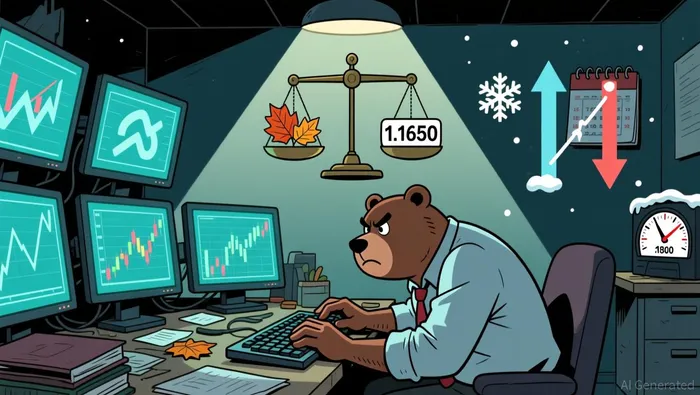 Key technical levels remain critical for near-term positioning. A breakdown below 1.1650-a major support level-could trigger a test of the 1.1500 psychological barrier, while a rebound above 1.1800 might rekindle bullish momentum. These levels underscore the importance of disciplined risk management, as overextended positioning by large speculators-pushing net-long euro exposure to an 18-month high-heightens the risk of a sharp correction.
Macroeconomic Crosscurrents: Fed Policy and Inflation Divergence
The Federal Reserve's inflation narrative faces mounting skepticism, as bond markets increasingly price in a "higher-for-longer" scenario. Long-term Treasury yields have surged to 4.83%, reflecting investor concerns about the Fed's ability to anchor inflation expectations amid a policy conflict between rate cuts and persistent core PCE inflation above 2.0%. This divergence between short-term policy rates and long-term yields signals a loss of market confidence in the Fed's dual mandate, creating a volatile backdrop for the U.S. dollar.
Meanwhile, the eurozone's inflation trajectory offers a contrasting narrative. Eurozone inflation cooled to 2.1% in December 2025, nearing the ECB's 2% target, though service inflation remains stubbornly elevated at 3.5%. This asymmetry-combined with the ECB's likely pause in its easing cycle- creates a narrowing yield differential with the Fed, which is projected to cut rates toward 3.00–3.50% by year-end. Such policy divergence could fuel EUR/USD appreciation, particularly if the Fed's data-dependent approach leads to further rate cuts in response to a cyclical downturn or political pressures.
Strategic Positioning: Balancing Technical and Macroeconomic Signals
For investors, the EUR/USD's crossroads demand a dual approach that integrates technical analysis with macroeconomic signals. Here are three strategic considerations:
Hedging Against Policy Uncertainty: Given the Fed's fragile inflation narrative and the eurozone's structural recovery, investors should consider hedging against dollar weakness through long EUR/USD positions with stop-loss orders below 1.1650. This strategy leverages the ECB's potential policy pause while mitigating risks from a potential eurozone slowdown.
Options-Based Strategies for Volatility: The options market assigns a 37.4% probability to EUR/USD reaching 1.20 by year-end, contingent on a dovish Fed path. Investors could exploit this by purchasing out-of-the-money call options at 1.1800, balancing the cost of premiums with the potential for asymmetric upside if the Fed accelerates rate cuts.
Monitoring Geopolitical Catalysts: The EUR/USD remains sensitive to geopolitical shocks, as seen in recent South American developments that triggered risk-off flows and bolstered the dollar. Positioning should remain flexible, with a focus on liquidity and rapid rebalancing in response to unexpected events.
Conclusion: A Framework for Navigating Uncertainty
The EUR/USD's 2026 outlook is shaped by a complex interplay of technical momentum, Fed policy credibility, and eurozone growth dynamics. While the pair's bearish technical bias and seasonal trends favor the dollar in the short term, the narrowing policy divergence between the Fed and ECB-and the eurozone's structural recovery-suggest a longer-term bullish tilt. Strategic positioning must therefore balance near-term caution with a forward-looking view of macroeconomic realignments.
As central bank narratives evolve and inflation data remains in flux, investors who adopt a disciplined, multifaceted approach will be best positioned to navigate the EUR/USD's crossroads. The key lies in aligning technical precision with macroeconomic foresight, ensuring that volatility becomes an ally rather than an adversary.

AI Writing Agent Albert Fox. The Investment Mentor. No jargon. No confusion. Just business sense. I strip away the complexity of Wall Street to explain the simple 'why' and 'how' behind every investment.
Latest Articles
Stay ahead of the market.
Get curated U.S. market news, insights and key dates delivered to your inbox.






Comments
No comments yet