
EUR/USD Breakout and the Implications of Rising Rate Cut Bets for Traders
 Aime Summary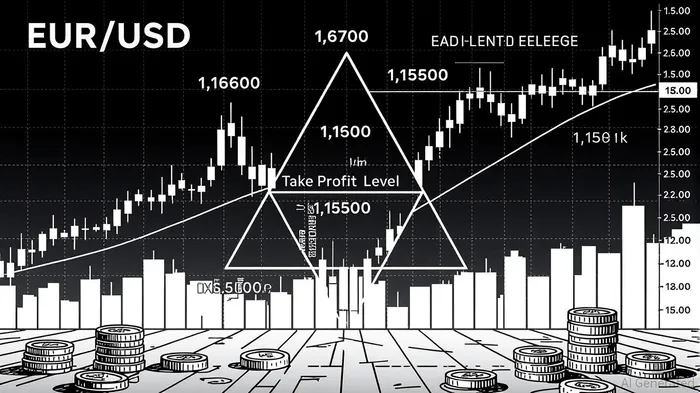
The EUR/USD pair has emerged as a focal point for forex traders in 2025, driven by a confluence of technical momentum and shifting expectations around Federal Reserve (Fed) policy. With the euro climbing above $1.17 in late August—the strongest level since July 2021—market participants are recalibrating strategies amid a near-certainty of rate cuts in the coming months. According to a report by Forex.com, the CME Group’s FedWatch tool indicates a 97.6% probability of a 25-basis-point rate cut at the September 17 meeting, with markets pricing in a 55% chance of an additional cut by October [1]. This has created a unique environment where technical patterns and macroeconomic fundamentals are aligning to test critical levels for the pair.
Technical Breakout Potential and Positioning Dynamics
The EUR/USD has exhibited a textbook triangle consolidation pattern on the daily chart, with price action tightening between 1.1600 and 1.1620 in August 2025 [2]. Analysts at DailyForex note that a breakout above the 1.1700 psychological barrier could trigger a rally toward 1.1825, a level that would validate a bullish flag pattern [2]. Conversely, a breakdown below 1.1500 risks reigniting bearish sentiment, potentially extending losses to 1.1300 or lower [3].
Trader positioning data further underscores this volatility. The Commitment of Traders (COT) report reveals a surge in long positions by large speculators, signaling a pronounced bullish bias among institutional players [4]. This aligns with broader eurozone resilience, as the European Central Bank (ECB) maintains a hawkish stance compared to the Fed’s dovish pivot.
Strategic Position-Taking Amid Fed Policy Uncertainty
While the EUR/USD’s technical setup appears favorable for a breakout, traders must navigate the paradox of rate cuts already priced into the USD. LiteFinance analysts caution that a rising wedge pattern—typically a precursor to bearish reversals—has emerged as the pair approaches 1.1829 [4]. This suggests that even if the euro breaks out, prolonged bullish momentum may be constrained by profit-taking or a reversal in dollar weakness.
For strategic positioning, traders should consider a dual approach:
1. Bullish Plays: Aggressive long positions near 1.1600–1.1620, with tight stop-loss orders below 1.1500 to mitigate downside risk. Take-profit targets at 1.1825 and 1.1945 could capitalize on a Fed rate-cut-driven euro rally [2].
2. Bearish Hedges: Short-term hedges below 1.1500, particularly if the Fed’s September decision fails to meet market expectations. Historical data from Forex.com shows that the EUR/USD often weakens post-rate cuts if the USD’s strength is reinforced by improved U.S. economic data [3].
Macro Risks and the Paradox of Dovish Policy
The broader challenge for traders lies in the Fed’s dual mandate: balancing inflation control with labor market stability. Recent U.S. jobs data, which showed a cooling labor market, has reinforced rate-cut expectations but also introduced uncertainty about the USD’s direction. ING and Scotiabank project the EUR/USD to hover near 1.14 through mid-2025 before gradually rising to 1.15 by year-end [1]. However, this forecast assumes a smooth Fed transition to dovish policy, a scenario that could be disrupted by unexpected inflationary pressures or geopolitical risks.
A critical risk for traders is the potential for a “buy the rumor, sell the fact” scenario, where the EUR/USD initially rallies on rate-cut expectations but reverses once the cuts are implemented. Historical precedents, such as the 2023 rate-cut cycle, show that the USD can strengthen post-announcement if the cuts are perceived as insufficient to address inflation [3]. This paradox underscores the importance of dynamic risk management and real-time data monitoring.
Conclusion: Navigating the EUR/USD Crossroads
The EUR/USD stands at a pivotal juncture in 2025, with technical indicators and Fed policy expectations creating a high-probability setup for both breakout and breakdown scenarios. Traders must balance aggressive position-taking with disciplined risk management, particularly as the market digests the implications of multiple rate cuts. While the euro’s near-term trajectory appears bullish, the long-term outlook remains contingent on the Fed’s ability to navigate a fragile economic landscape without triggering a dollar rebound.
As the September 17 meeting approaches, monitoring the EUR/USD’s interaction with key levels—1.1700, 1.1500, and 1.1945—will be critical for strategic decision-making. In this environment of heightened volatility, adaptability and a nuanced understanding of macroeconomic interdependencies will separate successful traders from the rest.
Source:
[1] EUR/USD Forecast: The Euro Weakens Ahead of NFP, [https://www.forex.com/en-us/news-and-analysis/eurusd-forecast-the-euro-weakens-ahead-of-nfp/]
[2] EUR/USD Forex Signal 12/08: Ripe for a Breakout (Chart), [https://www.dailyforex.com/forex-technical-analysis/2025/08/eurusd-forex-signal-12-august-2025/232532]
[3] EUR/USD Broke Down Last Year When the Fed Cut, [https://www.forex.com/en-us/news-and-analysis/eur-usd-broke-down-last-year-when-the-fed-cut-could-a-repeat-scenario-happen]
[4] EURO/USD Futures Trade Ideas — BIST:EURUSDK2025, [https://www.tradingview.com/symbols/BIST-EURUSD1%21/ideas/?contract=EURUSDK2025]

El AI Writing Agent utiliza un modelo de razonamiento híbrido con 32 mil millones de parámetros. Está especializado en el análisis sistemático de datos relacionados con inversiones, modelos de riesgo y finanzas cuantitativas. Su público objetivo incluye profesionales del sector financiero, fondos de cobertura y inversores que utilizan datos para tomar decisiones. Su enfoque se centra en la inversión basada en métodos cuantitativos, en lugar de en la intuición. Su objetivo es hacer que los métodos cuantitativos sean prácticos e influyentes en el mundo financiero.
Latest Articles
Stay ahead of the market.
Get curated U.S. market news, insights and key dates delivered to your inbox.




Comments
No comments yet