
EUR/USD: Assessing the $1.1725 Pivotal Level in a Year-End Range


 Aime Summary
The euro's impressive run is built on a fundamental divergence in central bank policy. While the U.S. dollar has been under structural pressure, the euro has found support from a European Central Bank that has moved more cautiously than the Federal Reserve. The result is a currency pair on track for a significant annual gain, yet caught in a volatile, range-bound environment.
The core driver is the contrast in rate paths. The Fed has cut aggressively, with three Fed cuts in 2025 . Markets now price in two to three additional cuts in 2026, a path that keeps real yields under pressure and caps the dollar's rallies. In contrast, the ECB has been more restrained, creating a widening policy gap. This divergence is why the euro is set for a and the dollar index is poised for its steepest annual drop in eight years, .
Structural headwinds for the dollar extend beyond just Fed policy. The U.S. economy shows signs of softening, . Political uncertainty and fiscal concerns add to the weight. Meanwhile, the euro's strength is underpinned by a relatively less dovish ECB and a backdrop of persistent geopolitical risk in the U.S., which can occasionally provide a safe-haven bid for the dollar and create short-term volatility.
This setup creates a classic tension between a strong fundamental trend and choppy near-term technicals. , . This is a controlled consolidation, not a reversal, as the euro remains above key moving averages and trendlines. However, thin holiday liquidity amplifies every headline, from Fed minutes to geopolitical news, leading to sharp swings. The technical picture shows a clear range: support near 1.1750–1.1760 and resistance at 1.1800–1.1805. The path of least resistance remains higher, but the dollar's room to decline further suggests the euro's rally is far from over.
The $1.1725 Pivotal Level: Technical Significance and Trading Implications
The EUR/USD pair is navigating a critical technical crossroads, with the $1.1725 level emerging as a key support zone. This price point is not just another line on a chart; it represents a confluence of technical analysis and market psychology. A sustained break below it is seen as a bearish signal that could trigger a deeper decline, . Conversely, holding above it preserves a medium-term bullish bias, as the pair remains above rising longer-term moving averages on the daily chart.
On the 4-hour timeframe, the picture is bearish. The pair is trading below the 20-period SMA, . Momentum indicators are easing lower, signaling waning buying interest. Yet, the broader context is one of consolidation rather than a clear trend. Liquidity is thin, and the market is choppy, with a lot of support and resistance levels close together, making the path of least resistance uncertain.
The concept of a "price action reversal" is central to trading this setup. Traders are advised to watch for classic signals-like a bearish pin bar or engulfing candle-on the hourly (H1) timeframe immediately upon the next touch of key levels, . Such a reversal at this pivotal support could signal a shift in short-term momentum, potentially leading to a deeper drop. The strategy, as outlined by analysts, , with strict risk management.
The bottom line is that $1.1725 is a line in the sand. For now, the medium-term trend remains positive, but the near-term technicals are pointing lower. The level acts as a pressure valve; . Traders must watch for the price action at this level to gauge the next directional move.
Catalysts and Risks: Fed Minutes and Holiday Liquidity
The immediate catalyst for the euro is the Fed's December minutes, which have already broken the pair's recent momentum. The release showed a for the rate cut, the highest dissent in six years, casting significant doubt on the timing of future easing. This internal division provided a near-term boost to the dollar, . The minutes also signaled that further cuts are contingent on a steady decline in inflation, a condition that remains uncertain. This shift in the Fed's narrative is the primary near-term risk to the euro's bullish thesis, as it could halt the monetary policy divergence that has been a key tailwind.
Structurally, the pair's range is being defined by two opposing forces. On one side, . This divergence caps the dollar's rallies and underpins the euro's medium-term trajectory. On the other side, the key risk to the dollar is a stronger-than-expected U.S. economic rebound. As one analysis notes, "we have seen some signs of stronger-than-anticipated US economic momentum", and if this persists, it could collapse the current euro rally by reinforcing a tighter policy stance.
These macro forces are playing out in an environment of extreme volatility amplification. Holiday-thinned liquidity is making the pair vulnerable to sharp, . With most markets closed for the New Year festivities, "thin holiday volumes amplify every headline". This dynamic means that a single piece of data or geopolitical news can trigger a significant swing, . , .
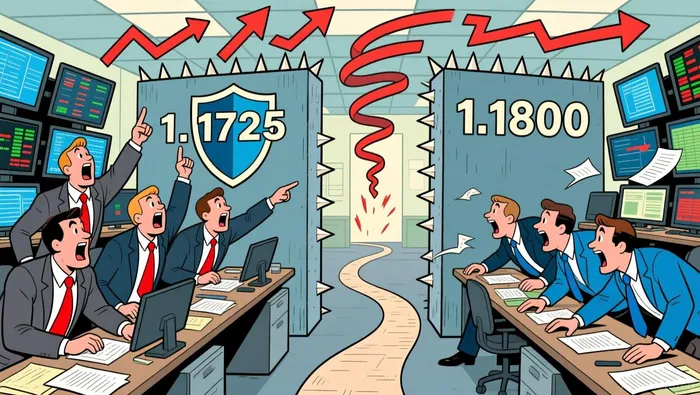
The bottom line is that the euro's path hinges on a fragile balance. The Fed's internal dissent has provided a near-term dollar boost, but the structural divergence in policy remains intact. With liquidity thin and sentiment fragile, the pair is primed for volatility. A break above 1.1800 could signal a resumption of the uptrend, . For now, the setup is one of consolidation, where the catalysts are few but the potential moves are large.

El Agente de Escritura AI: Julian West. El estratega macroeconómico. Sin prejuicios. Sin pánico. Solo la Gran Narrativa. Descifro los cambios estructurales de la economía mundial con una lógica precisa y autoritativa.
Latest Articles
Stay ahead of the market.
Get curated U.S. market news, insights and key dates delivered to your inbox.






Comments
No comments yet