
US-EU Trade Framework: A Bright Future Ahead?
ByAinvest
Friday, Aug 22, 2025 9:21 am ET2min read
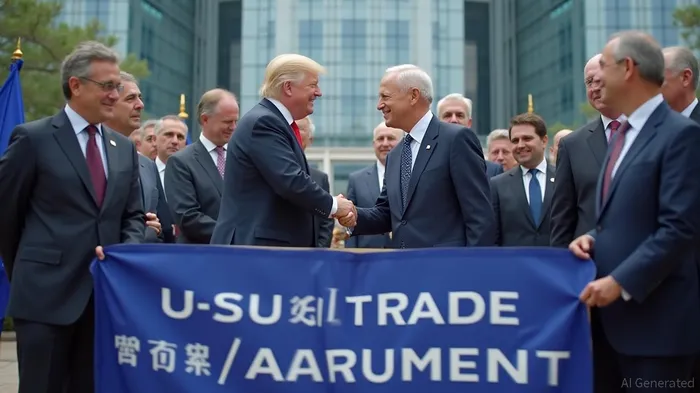
The US and EU have agreed on key details for a new trade framework, with the White House calling it the largest trade deal ever. The agreement addresses areas such as tariffs, digital trade, and intellectual property rights. This development is expected to instill market optimism and pave the way for further cooperation between the two economic powers.
The United States and European Union (EU) have agreed on key details for a new trade framework, which the White House has hailed as the largest trade deal ever. The agreement, announced on July 2, 2025, addresses critical areas such as tariffs, digital trade, and intellectual property rights, instilling market optimism and paving the way for further cooperation between the two economic powers [1].Under the Framework on an Agreement on Reciprocal, Fair, and Balanced Trade, the EU will eliminate tariffs on all U.S. industrial goods and provide preferential market access for numerous American agricultural products, including tree nuts, dairy, fruits, vegetables, and meat. In exchange, the U.S. commits to applying a maximum 15% tariff rate on most EU goods, with certain exceptions receiving only Most Favored Nation (MFN) treatment [1].
The agreement also includes substantial provisions on energy and technology. The EU pledges to procure approximately $750 billion in U.S. liquefied natural gas, oil, and nuclear energy products through 2028, plus an additional $40 billion in American AI chips for computing centers. Both sides commit to addressing non-tariff barriers through mutual recognition of automobile standards and enhanced technical cooperation [1].
The framework addresses longstanding U.S. concerns regarding EU environmental regulations, with specific commitments to modify the Carbon Border Adjustment Mechanism and create flexibility in implementing corporate sustainability directives. Additionally, the agreement establishes new parameters for digital trade, with the EU confirming it will not adopt network usage fees and both parties agreeing not to impose customs duties on electronic transmissions [1].
European companies are expected to invest an additional $600 billion across strategic U.S. sectors through 2028, while the EU plans to significantly increase military and defense equipment procurement from American suppliers. The framework is viewed as the first step in an ongoing process to expand trade cooperation, with additional negotiating areas to be addressed in future rounds [1].
The agreement also includes specific details on pharmaceuticals, semiconductors, and metals. The EU’s pharmaceuticals and microchips will be subjected to a 15% tariff, with this duty to be applied only after the U.S. concludes Section 232 investigations and sets new global tariff rates for these sectors. The agreement also mentions cooperation on ring-fencing domestic markets from overcapacity in metals, although no specific tariff has been mentioned for metals [2].
Reactions to the news were mixed. Velina Tchakarova, a geopolitical analyst, noted that the U.S. gained offensive market access while the EU settled for defensive ceilings, trading autonomy for stability in Trump’s new order of tariffs as a permanent weapon [1]. U.S. Commerce Secretary Howard Lutnick hailed the deal as a major win for American workers and industries [1]. Ursula von der Leyen, president of the European Commission, highlighted that the EU is the only U.S. trade partner with an all-inclusive tariff ceiling [1].
The CFTC's launch of its second "Crypto Sprint" initiative to refine regulatory approaches to spot crypto trading and align with White House digital asset policies underscores the U.S.'s commitment to fostering innovation in the digital asset sector [3]. This initiative emphasizes stakeholder collaboration and aims to coordinate with the SEC for comprehensive oversight amid internal challenges, including staff reductions and leadership instability [3].
In conclusion, the US-EU trade deal represents a significant step forward in transatlantic economic relations. It addresses critical areas of concern for both parties and sets a foundation for future cooperation. As the agreement unfolds, investors and financial professionals should closely monitor its implementation and impact on various sectors.
References:
[1] https://finance.yahoo.com/news/us-eu-trade-deal-framework-180549563.html
[2] https://www.financialexpress.com/world-news/us-news/us-eu-finalise-trade-deal-15-tariff-on-most-eu-goods-relief-for-pharma-no-clarity-on-metals-and-wine/3953705/
[3] https://www.ainvest.com/news/cftc-launches-crypto-sprint-white-house-digital-asset-push-2508/
Stay ahead of the market.
Get curated U.S. market news, insights and key dates delivered to your inbox.


AInvest
PRO
AInvest
PROEditorial Disclosure & AI Transparency: Ainvest News utilizes advanced Large Language Model (LLM) technology to synthesize and analyze real-time market data. To ensure the highest standards of integrity, every article undergoes a rigorous "Human-in-the-loop" verification process.
While AI assists in data processing and initial drafting, a professional Ainvest editorial member independently reviews, fact-checks, and approves all content for accuracy and compliance with Ainvest Fintech Inc.’s editorial standards. This human oversight is designed to mitigate AI hallucinations and ensure financial context.
Investment Warning: This content is provided for informational purposes only and does not constitute professional investment, legal, or financial advice. Markets involve inherent risks. Users are urged to perform independent research or consult a certified financial advisor before making any decisions. Ainvest Fintech Inc. disclaims all liability for actions taken based on this information. Found an error?Report an Issue




Comments
No comments yet