
The U.S.-EU Trade Deal: A Strategic Inflection Point for Energy, Autos, and Tech Sectors
 Aime Summary
The U.S.-EU Trade Deal, finalized in July 2025, marks a seismic shift in transatlantic economic relations. By capping tariffs, aligning regulatory standards, and committing to cross-border capital flows, the agreement creates a framework for immediate market stability and long-term strategic growth. For investors, this deal is not just a policy update—it's a catalyst for rethinking exposure to energy, automotive, and technology sectors. Let's dissect the opportunities.
Energy: A $750 Billion Power Play
The EU's pledge to purchase $750 billion in U.S. energy over three years—primarily LNG, oil, and nuclear fuels—has transformed the energy sector into a geopolitical and economic linchpin. This procurement is not just about volume; it's about reshaping global energy dynamics. U.S. LNG producers like ExxonMobil (XOM) and Chevron (CVX) are now positioned to capitalize on sustained demand, while infrastructure players (e.g., Energy Transfer (ET)) benefit from expanded export capabilities.
The EU's shift away from adversarial energy sources also accelerates the global LNG market's structural rebalancing. For long-term investors, this signals a durable tailwind for U.S. energy firms. However, near-term volatility remains tied to implementation timelines. The EU's procurement commitments require infrastructure upgrades and regulatory approvals, but the scale of the deal ensures that delays will be temporary, not terminal.
Automotive: Tariff Caps and Market Access
The 15% tariff ceiling on EU automotive exports to the U.S. replaces the specter of a 30% rate, stabilizing a sector long plagued by uncertainty. For European automakers like Volkswagen (VOW3) and BMW (BMW), this cap reduces pricing pressure and allows for strategic reinvestment in electric vehicles (EVs). Meanwhile, U.S. automakers such as Ford (F) and Tesla (TSLA) gain access to a market where EU tariffs on U.S. industrial goods are being phased out.
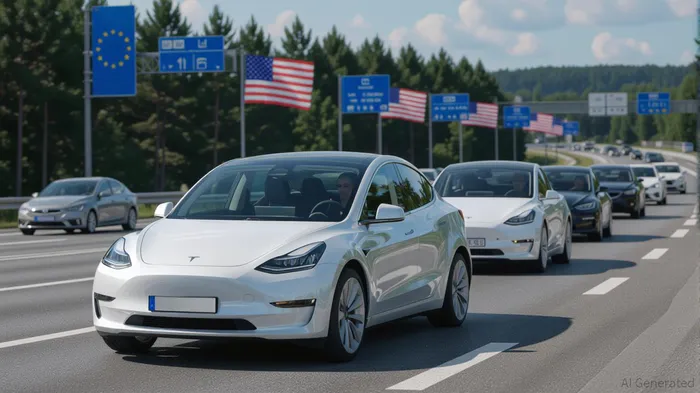
The EU's commitment to eliminate non-tariff barriers—such as streamlined sanitary certifications for U.S. parts—further lowers costs for American suppliers. For TeslaTSLA--, this could mean a surge in European demand for its EVs, particularly as the EU accelerates its green transition. Investors should monitor Tesla's stock price changes over the past three years to gauge market sentiment, but the fundamentals here are clear: tariff normalization and regulatory alignment are creating a two-way street for automotive growth.
Technology: Semiconductors and Digital Resilience
The 15% tariff cap on EU semiconductor exports to the U.S. is a critical win for tech firms. With the EU committing $40 billion to purchase U.S. AI chips, companies like Intel (INTC) and AMD (AMD) stand to benefit from both near-term revenue and long-term market share gains. This procurement is not just about hardware—it's about aligning with the EU's digital transformation agenda.
The agreement's digital provisions—zero customs duties on electronic transmissions and mutual recognition of cybersecurity standards—further solidify the U.S. tech sector's dominance. For investors, this means prioritizing firms with strong EU exposure, such as cloud providers and AI infrastructure players. The EU's procurement of U.S. AI chips also signals a strategic partnership in high-performance computing, a sector poised for exponential growth.
Cross-Border Capital: A $600 Billion Boost
Beyond tariffs, the EU's $600 billion investment in U.S. manufacturing, infrastructure, and tech sectors is a game-changer. This capital influx will likely flow into private equity funds, infrastructure REITs, and venture capital-backed tech startups. For example, Blackstone (BX) and Prologis (PLD) could see increased demand for their services in capital-intensive sectors.
Risks and Realities
While the deal is a milestone, its full implementation hinges on EU member states' approval and WTO compliance. Delays in tariff reductions or procurement contracts could create short-term headwinds. However, the political will to deepen transatlantic ties—especially in energy and tech—suggests these hurdles will be navigated.
Investment Thesis
- Short-Term (0–12 months): Focus on energy and automotive sectors. Buy U.S. LNG producers and EU automakers with strong EV pipelines.
- Long-Term (1–5 years): Position in U.S. semiconductor firms and tech infrastructure providers. The EU's digital partnership is a multi-decade trend.
- Diversification: Allocate to cross-border capital enablers, such as infrastructure REITs and global logistics firms.
The U.S.-EU Trade Deal is more than a policy document—it's a blueprint for economic resilience in a fragmented world. For investors, the key is to align with sectors where the deal's provisions directly translate to revenue growth and market share expansion. The inflection point is here; the question is whether you're positioned to ride the wave.

Decoding blockchain innovations and market trends with clarity and precision.
Latest Articles
Stay ahead of the market.
Get curated U.S. market news, insights and key dates delivered to your inbox.
AInvest
PRO
AInvest
PRO



Comments
No comments yet