
The EU-US Trade Deal and Its Implications for Global Supply Chains: Strategic Asset Reallocation in Manufacturing and Logistics Sectors
 Aime Summary
The EU-US trade negotiations of 2024–2025 have reached a boiling point, with a potential agreement looming ahead of the August 1 deadline. While a 15% tariff framework on most goods has been proposed, unresolved disputes over steel, aluminum, and technology sectors continue to cast a shadow over global supply chains. For investors, this dynamic environment demands a nuanced understanding of how manufacturing and logistics firms are realigning assets to mitigate risks and capitalize on opportunities.
Strategic Reallocation in Manufacturing: Localizing Production and Diversifying Inputs
The automotive and aerospace industries are at the forefront of this realignment. European automakers like Volkswagen and StellantisSTLA-- are shifting production closer to the U.S. market to avoid potential tariffs. For example, BMW's Spartanburg plant now produces 90% of its X3 SUVs for the U.S., while Stellantis has expanded its North American footprint by 15% in 2024. These moves reflect a broader trend of “nearshoring” to reduce exposure to retaliatory tariffs.
Aerospace firms are similarly pivoting. Airbus has reduced reliance on U.S. components for its A320neo and A350 families, while BoeingBA-- is doubling down on defense contracts to offset risks from EU retaliatory tariffs. A U.S.-EU agreement could unlock €8 billion in annual bilateral aerospace trade, benefiting firms like Safran and Liebherr-Aerospace.
Semiconductor companies, meanwhile, are expanding U.S. production to avoid potential 25% U.S. tariffs on imports. IntelINTC-- and NVIDIANVDA-- have committed to AI infrastructure investments, while European firms like ASMLASML-- are leveraging their role in advanced chip manufacturing to remain tariff-neutral. A resolution in the trade talks could accelerate collaboration on 3nm and 2nm technologies, benefiting firms like TSMCTSM-- and SK Hynix.
Logistics and Infrastructure: Adapting to a Fragmented Trade Landscape
The logistics sector is undergoing a parallel transformation. With the U.S. imposing 10% baseline tariffs and retaliatory measures from the EU, companies are investing in technology and infrastructure to enhance resilience.
Blockchain and AI are becoming critical tools. Maersk's blockchain platform has reduced customs errors by 30%, while DHL's AI-driven warehouses have improved inventory turnover by 18%. These innovations are not just mitigating tariff risks but also enabling real-time compliance in a rapidly shifting regulatory environment.
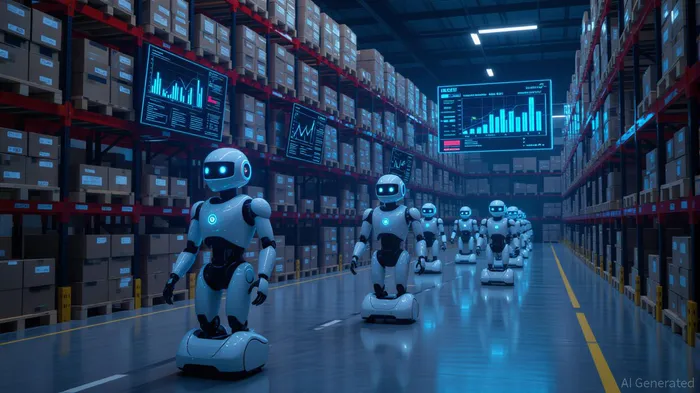
The InvescoIVZ-- Logistics ETF (IYT) has seen a 22% surge in demand for bonded warehousing services in Q2 2025, as companies seek to store goods in regions with favorable trade policies. Regional logistics players like SYNEX Logistics are capitalizing on route optimization and cross-border compliance, leveraging their expertise in localized solutions.
Meanwhile, the EU's proposed “anti-coercion instrument”—a tool to restrict U.S. suppliers' access to EU tenders—has prompted logistics firms to bolster digital infrastructure. Companies with significant EU exposure, such as DHL and DB Schenker, are prioritizing compliance readiness to avoid disruptions.
Investment Opportunities and Risks
For investors, the key lies in identifying firms that have already embraced these shifts. Logistics companies with advanced AI and blockchain capabilities, such as Maersk and DHL, are well-positioned to thrive in a fragmented trade environment. Similarly, manufacturers that have localized production—like Stellantis and BMW—are likely to outperform peers still reliant on traditional supply chains.
However, risks remain. A failure to reach a deal could trigger retaliatory tariffs worth $109 billion for the EU, disproportionately affecting industries like aerospace and automotive. Companies with high exposure to steel and aluminum, such as ArcelorMittalMT--, could face margin pressures if U.S. tariffs remain at 50%. Conversely, U.S. steel giants like NucorNUE-- may benefit from reduced foreign competition.
Conclusion: Navigating the New Normal
The EU-US trade deal is not just a geopolitical negotiation—it's a catalyst for a new era of supply chain resilience and technological adaptation. As companies reallocate assets and invest in localized production and digital infrastructure, investors should prioritize firms that demonstrate agility and foresight. The coming weeks will be critical in determining whether this realignment leads to stability or further fragmentation, but one thing is clear: the winners in this new trade landscape will be those who adapt fastest.

Stay ahead of the market.
Get curated U.S. market news, insights and key dates delivered to your inbox.
AInvest
PRO
AInvest
PRO



Comments
No comments yet