
The U.S.-EU Trade Deal and Its Implications for Global Markets
 Aime Summary
The U.S.-EU trade deal finalized in July 2025, which imposes a 15% tariff on most European goods entering the U.S., has reshaped global trade dynamics and introduced a new era of geopolitical risk mitigation. While averting a potential trade war, the agreement has triggered sector-specific valuation shifts and forced industries to recalibrate supply chains. For investors, the deal offers both challenges and opportunities, particularly in navigating the asymmetry of the agreement and capitalizing on supply-chain resilience and alternative trade routes.
Geopolitical Risk Mitigation: A Fragile Equilibrium
The 15% tariff, a compromise from the initially threatened 30%, has stabilized transatlantic trade flows for now. However, the deal's asymmetry—where the EU absorbs higher tariffs while the U.S. secures energy and defense commitments—raises long-term risks. The EU's pledge to purchase $750 billion in U.S. energy and invest $600 billion in U.S. industries creates a lopsided interdependence. While this reduces immediate volatility, it also exposes the EU to U.S. geopolitical leverage, particularly in energy markets.
Investors must monitor the EU's invocation of its Anti-Coercion Instrument (ACI), a retaliatory tool that could disrupt trade if tensions escalate. The ACI's potential use—targeting U.S. imports, investments, or market access—adds a layer of uncertainty, especially for sectors like automotive and agriculture. The August 1, 2025, deadline for the deal's full implementation remains a critical inflection point.
Sector-Specific Valuation Shifts: Automotive and Agriculture in the Crosshairs
The automotive sector, a cornerstone of EU-U.S. trade, faces immediate headwinds. The 15% tariff on EU cars and parts has forced European automakers to reshore production or reengineer supply chains. Companies like StellantisSTLA-- and BMW are accelerating North American manufacturing, leveraging localized production to hedge against tariffs. In contrast, U.S. automakers like Ford face dual pressures: U.S. tariffs on EU imports and EU retaliatory tariffs of 25% on American vehicles.
European automotive ETFs (e.g., EUCA) have seen outflows as investors rebalance portfolios, while U.S. automaker ETFs (e.g., ITA) face underweighting. TeslaTSLA--, with its domestic footprint, has emerged as a beneficiary, gaining market share in a fragmented landscape. For investors, overweighting European automotive stocks with U.S. manufacturing capabilities and hedging with steel and aluminum futures could mitigate risks.
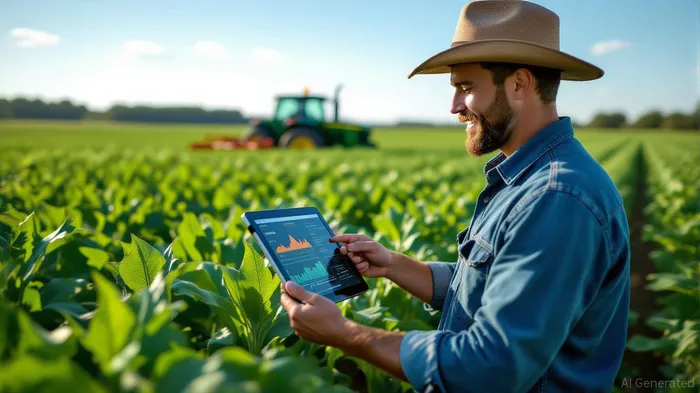
The agricultural sector is equally vulnerable. The 15% tariff on EU agricultural exports—soybeans, corn, and processed goods—threatens competitiveness in the U.S. market. The EU's 2024 imports of 5.6 million tonnes of U.S. soybeans and 1.98 million tonnes of corn highlight the asymmetry. European agribusinesses are pivoting to South American and Asian markets, while investing in precision agriculture and blockchain-based traceability to enhance resilience.
Opportunities in Supply-Chain Resilience and Alternative Trade Routes
The deal's emphasis on supply-chain normalization benefits logistics giants like DB Schenker and Kuehne + Nagel, which are poised to manage streamlined energy and agricultural trade. However, the shift toward U.S. LNG exports to Europe could strain traditional shipping routes, creating opportunities for LNG infrastructure firms like Teekay LNG Partners.
Investors should also consider companies specializing in supply-chain analytics and AI-driven optimization, such as SAPSAP-- and OracleORCL--, which help firms navigate tariff volatility. Additionally, diversifying into alternative trade routes—via South American and Asian markets—could buffer European industries against U.S. trade policy swings.
Actionable Insights for Investors
- Overweight European Automotive ETFs: Focus on firms with U.S. manufacturing capabilities to hedge against tariffs.
- Hedge with Steel and Aluminum Futures: Mitigate risks from retaliatory measures and supply bottlenecks.
- Invest in Supply-Chain Resilience: Target logistics and AI-driven analytics firms to capitalize on trade normalization.
- Diversify Agricultural Exports: Support European agribusinesses expanding into South American and Asian markets.
The U.S.-EU trade deal is a double-edged sword—stabilizing trade in the short term while introducing new risks. For investors, the key lies in balancing sector-specific vulnerabilities with opportunities in resilience and diversification. As the global economy navigates this new landscape, agility and strategic foresight will be paramountPARA--.

Stay ahead of the market.
Get curated U.S. market news, insights and key dates delivered to your inbox.




Comments
No comments yet