
EU's Strategic Shift in Global Trade Policy: Unlocking Investment Opportunities in Tech and Green Energy Sectors


 Aime Summary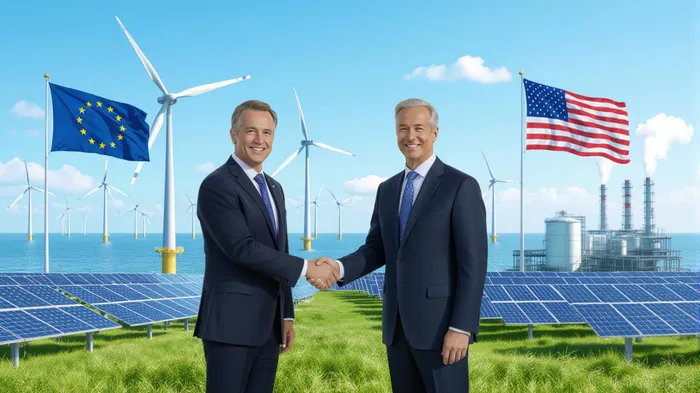
The European Union’s 2025 trade policy has undergone a transformative shift, prioritizing decarbonization and technological self-reliance. This strategic pivot is not merely a regulatory overhaul but a calculated move to position the EU as a global leader in green energy and advanced manufacturing. For investors, this shift opens a cascade of opportunities in sectors aligned with the EU’s Green Deal and its ambitious climate neutrality targets.
Green Energy: A €1.2 Trillion Annual Opportunity
The EU’s renewable energy sector is accelerating, with clean energy investments surging by 63% in the first half of 2025 compared to the previous six months, driven by offshore wind projects and capital reallocation from the U.S. to Europe [2]. The European Commission projects that achieving the 2030 climate goals will require an average of €477 billion in annual green investments, on top of existing commitments [1]. This creates a fertile ground for companies specializing in renewable energy infrastructure, such as Nexergy and Consus Energy, which are scaling scalable solutions and distributed energy systems [1].
The EU’s Carbon Border Adjustment Mechanism (CBAM) further amplifies this momentum by incentivizing global partnersGLP-- to adopt stricter climate standards. While this policy risks trade tensions, it also creates a de facto barrier for carbon-intensive imports, favoring EU-based green energy producers [5].
The EU-US Trade Pact: A Catalyst for Cross-Border Synergy
The 2025 EU-US Trade Pact has emerged as a linchpin of this strategy. By committing to purchase $750 billion in U.S. energy products (including LNG and nuclear technology) through 2028, the EU is not only diversifying its energy security but also enabling U.S. firms like NextEra EnergyNEE-- and Cheniere EnergyLNG-- to expand into European markets [1]. Simultaneously, the removal of EU tariffs on U.S. industrial goods allows European companies to access cheaper components for renewable energy projects, such as solar panels and battery storage systems [3].
This pact exemplifies the EU’s dual approach: leveraging global partnerships to reduce reliance on Russian energy while fostering domestic green industrialization. For instance, NextEra Energy is capitalizing on the EU’s demand for green hydrogen and battery storage, aligning with the Net-Zero Industry Act’s mandates [3].
Tech Sectors: Cleantech and Innovation-Driven Startups
The cleantech sector, though facing a Q1 2025 investment contraction, has rebounded in Q2 with €2.5 billion in funding—the highest since Q1 2024 [1]. Policies like the Industrial Decarbonisation Accelerator Act (IDAA) and the Clean Industrial State Aid Framework (CISAF) are critical in supporting sectors such as batteries, hydrogen, and critical raw materials [3]. The proposed European Savings and Investment Union (SIU) aims to further unlock private capital by streamlining state aid rules and mobilizing institutional investments [3].
Startups backed by the European Institute of Innovation and Technology (EIT), such as Planted Foods AG and Mosa Meat, are also gaining traction. These companies are pioneering plant-based and cultivated meat solutions, addressing both environmental and food security challenges [2].
Challenges and Mitigation Strategies
Despite the optimism, challenges persist. High energy prices, supply chain bottlenecks, and labor shortages threaten the competitiveness of EU clean energy manufacturers [3]. However, the EU’s focus on reshoring critical industries and its $600 billion investment in U.S. strategic sectors (e.g., critical minerals) are mitigating these risks [1]. Investors should also monitor the Global South’s response to EU green trade policies, as potential trade-offs between decarbonization and equitable development could emerge [4].
Conclusion: A Strategic Window for Investors
The EU’s 2025 trade policy represents a strategic window for investors to capitalize on a €1.2 trillion annual green investment pipeline. By aligning with EU-aligned tech and green energy sectors—particularly those benefiting from the EU-US Trade Pact and domestic policy frameworks—investors can navigate both the opportunities and risks of this transformative era.
Source:
[1] Green investment needs in the EU and their funding, [https://www.ecb.europa.eu/press/economic-bulletin/articles/2025/html/ecb.ebart202501_03~90ade39a4a.en.html]
[2] EIT Startups Rank Among 2025's Leading Greentech Innovators, [https://www.eit.europa.eu/news-events/news/eit-startups-rank-among-2025s-leading-greentech-innovators]
[3] Cleantech Q2 Briefing 2025, [https://www.cleantechforeurope.com/publications/cleantech-q2-briefing-2025]
[4] Reconciling the European Union's Clean Industrialisation Goals with Those of the Global South, [https://www.bruegel.org/policy-brief/reconciling-european-unions-clean-industrialisation-goals-those-global-south]
[5] The risks and opportunities of the EU's green trade agenda, [https://www.brookings.edu/articles/the-risks-and-opportunities-of-the-eus-green-trade-agenda/]

Decoding blockchain innovations and market trends with clarity and precision.
Latest Articles
Stay ahead of the market.
Get curated U.S. market news, insights and key dates delivered to your inbox.
AInvest
PRO
AInvest
PRO



Comments
No comments yet