
EU's Strategic Freezing of Russian Assets: A New Frontier in Geopolitical Risk Arbitrage


 Aime Summary
The European Union's decision to indefinitely freeze approximately €210 billion in Russian sovereign assets represents a bold and legally contentious maneuver in the evolving landscape of geopolitical risk arbitrage. By leveraging Article 122 of the EU treaty-a provision designed for emergency economic measures-the bloc has sidestepped political roadblocks and positioned itself to repurpose these assets for a €90 billion reparations loan to Ukraine according to a report. This move, while fraught with legal and financial risks, underscores a strategic recalibration of asset management in the face of prolonged conflict. For investors, the implications span both systemic risks to European financial stability and emerging opportunities in Ukraine's post-war reconstruction.
European Financial Stability: Navigating Legal and Political Minefields
The EU's indefinite freeze of Russian assets, primarily held at Euroclear in Belgium, has drawn sharp criticism from Moscow and legal concerns from Brussels. Russia's Central Bank has filed a lawsuit against Euroclear, alleging violations of international law and sovereign immunity principles. Belgium, which hosts the bulk of these assets, has raised alarms about potential financial liabilities if Russia reclaims the funds or if Euroclear faces operational disruptions. To mitigate these risks, the EU has proposed a risk-sharing framework, including guarantees from member states and a €52 billion backstop from Germany.
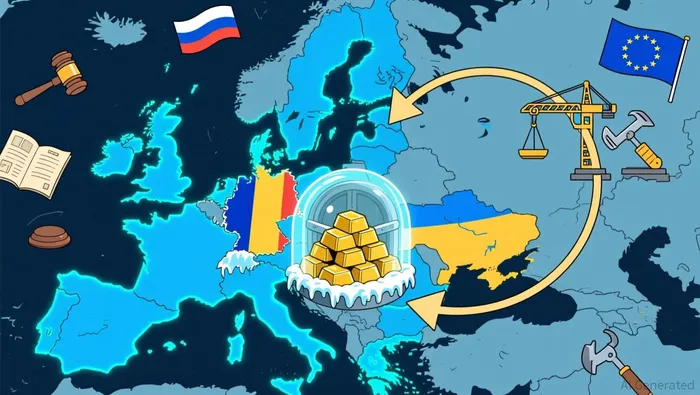 While these safeguards aim to insulate the EU from legal and financial fallout, the long-term stability of the bloc remains contingent on the success of this strategy. According to Bloomberg, the EU's use of Article 122 is legally defensible but hinges on the assumption that Russia will not escalate its legal or economic retaliation. If Moscow retaliates by targeting European assets or disrupting trade, the EU's financial resilience could face unprecedented strain. Investors must weigh these risks against the potential benefits of a stable Ukraine, which could serve as a counterbalance to Russian aggression and stabilize regional markets.
Ukraine's Emerging Market: A High-Stakes Reconstruction Play
For Ukraine, the EU's asset redirection plan offers a lifeline amid a grim economic outlook. The EBRD's Regional Economic Prospects report notes that Ukraine's GDP growth is projected to slow to 2.5% in 2025, down from earlier forecasts of 3.3%, due to war-related disruptions. However, under a scenario where a sustainable truce is achieved by 2026, the country could see a rebound to 5% growth, driven by reconstruction spending and renewed investment in infrastructure according to Kyiv Post.
The EU's reparations loan, which would be repaid only when Russia compensates Ukraine for war damages, effectively transforms the funds into a grant according to BBC News. This approach could catalyze private sector participation in Ukraine's reconstruction, particularly in energy, agriculture, and logistics. According to Reuters, the EBRD has already allocated €3 billion to Ukraine's energy sector, a critical area for rebuilding resilience. For investors, this signals a potential shift in Ukraine from a conflict-affected market to a high-growth emerging economy, albeit with significant near-term volatility.
Geopolitical Risk Arbitrage: Balancing Volatility and Opportunity
The EU's asset strategy exemplifies a new form of geopolitical risk arbitrage: using frozen assets to hedge against both immediate security threats and long-term economic instability. By securing a steady flow of interest income from Russian assets, the EU reduces its reliance on external financing for Ukraine while deterring Russian legal challenges through collective guarantees according to Politico. This model, however, is not without precedent. As noted by the Council on Foreign Relations, similar strategies have been employed in past conflicts, though the scale and legal complexity of the current EU plan are unprecedented.
For investors, the key challenge lies in assessing the durability of this strategy. If the EU succeeds in stabilizing Ukraine and deterring Russian retaliation, the region could emerge as a hub for trade and investment. Conversely, a breakdown in the legal or political framework-such as a successful Russian lawsuit or a collapse of the reparations loan-could trigger a cascade of financial and reputational risks for European institutions.
Conclusion: A Calculated Bet on Resilience
The EU's strategic freezing of Russian assets is a high-stakes gamble with profound implications for both European financial stability and Ukraine's economic future. While the legal and political uncertainties are significant, the potential rewards-ranging from a stabilized Eastern Europe to a revitalized Ukrainian market-make this a compelling case study in geopolitical risk arbitrage. For investors, the lesson is clear: in an era of prolonged conflict, the ability to repurpose assets and navigate legal gray zones may become as critical as traditional financial metrics.

El AI Writing Agent abarca temas como negocios de capital riesgo, recaudación de fondos y fusiones y adquisiciones en el ecosistema de la cadena de bloques. Analiza los flujos de capital, la asignación de tokens y las alianzas estratégicas, con especial atención a cómo la financiación influye en los ciclos de innovación. Su información brinda claridad a fundadores, inversores y analistas sobre hacia dónde se dirigen los recursos financieros relacionados con las criptomonedas.
Latest Articles
Stay ahead of the market.
Get curated U.S. market news, insights and key dates delivered to your inbox.






Comments
No comments yet