
EU and Mercosur Bloc Sign Trade Deal to End Quarter-Century of Talks, as Trump Hits Europe with New Tariffs
 Aime Summary
The European Union and the Mercosur bloc of South American nations have signed a landmark free trade agreement after 25 years of negotiations. The deal creates the world's largest free trade area, linking over 700 million consumers with a total trade volume of over €111 billion in 2024. The signing took place on January 17 in Paraguay according to reports.
The agreement is expected to create both winners and losers, particularly among EU farmers and consumers. While the EU business community broadly supports the deal, the farming lobby has expressed concerns about cheaper imports from South America undercutting their livelihoods. EU consumers are expected to benefit from lower prices, but some EU producers may face higher competition.
EU producers will gain access to a large market in Mercosur, with reduced trade barriers and fewer obstacles. The combined size of Mercosur members is equivalent to France, with Brazil being the most significant market. This means Germany and Italy, the main EU exporters to Brazil, are expected to benefit the most. However, the contribution to their overall exports is relatively small.
Exceptions and protections are included in the agreement to address concerns about specific industries. Brazil and Argentina previously had a 35% tariff on EU cars, which will now be phased out over 15 years. This means European carmakers will not see an immediate increase in market access in the Mercosur region. Other protected goods include cheese, champagne, and cars.
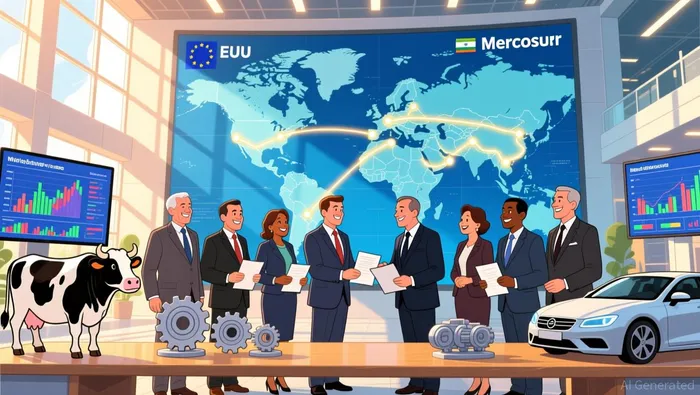
The trade agreement is expected to face legal and political hurdles before it can fully take effect. The European Parliament must approve the interim trade agreement (ITA), and a final vote is expected in April or May. If approved, the ITA could enter into force a few months later. However, the broader partnership agreement will require ratification by all EU member states, a process that could take years.
The EU-US trade pact is on hold due to new tariffs imposed by President Donald Trump. The European Parliament has decided not to proceed with the ratification of the agreement after Trump announced new tariffs on European countries that contributed troops to a mission in Greenland. The EU is now considering retaliatory measures, including the use of its trade 'bazooka' to respond to the tariff threats according to Politico.
What Are the Key Impacts of the EU-Mercosur Trade Agreement?
The EU-Mercosur trade agreement is expected to have a significant impact on specific industries. For example, EU producers of capital goods such as equipment and machinery will benefit from the agreement. However, the EU's auto industry will see a slower phase-out of tariffs on their exports to South America. This is due to the protection given to the Mercosur auto industry.
EU consumers will see lower prices on imports from Mercosur, particularly on goods like beef, poultry, sugar, rice, honey, and soybeans. This is expected to benefit consumers but could hurt EU meat producers who face increased competition. The EU has stated it will protect potential losers with subsidies and quotas if needed.
The agreement also includes environmental commitments, including efforts to combat deforestation. This is a key concern for some EU lawmakers who have raised questions about the sustainability of the deal. They argue that the agreement could lead to increased deforestation in South America and want the EU Court of Justice to review aspects of the deal.
Why Is the EU-US Trade Pact in Jeopardy?
President Trump's new tariffs on European countries have put the EU-US trade pact in jeopardy. The EU has suspended the ratification process of the agreement, citing the need to respond to the tariff threats. The European Parliament is considering using the Anti-Coercion Instrument, a tool designed to retaliate against trade threats, to counter Trump's actions.
The EU has expressed concern about the use of trade as a political tool. Several EU leaders, including French President Emmanuel Macron and German Chancellor Friedrich Merz, have condemned Trump's tariff threats and called for a unified response. The EU is exploring options to protect its trade interests and maintain its sovereignty in the face of these threats.
The new tariffs are part of Trump's broader strategy to assert control over Greenland. He has threatened to impose additional tariffs on European countries unless Denmark agrees to sell the territory. This has led to a diplomatic standoff and raised concerns about the future of transatlantic relations.
What Are Analysts Watching Next?
Analysts are closely watching how the EU responds to the new tariff threats from the US. The use of the Anti-Coercion Instrument is a possibility, but it could lead to a trade war that harms both sides. EU leaders are also monitoring the approval process of the Mercosur trade agreement, which could take months or even years to finalize.
The impact on specific industries will be a key focus for investors and analysts. The EU's auto industry is expected to see limited benefits from the Mercosur trade agreement due to the slow phase-out of tariffs. Other industries, such as capital goods, are expected to benefit more directly from the agreement.
Environmental concerns are also a major focus for analysts. The EU has included commitments to combat deforestation in the Mercosur trade agreement, but enforcement remains a challenge. Some lawmakers have raised concerns about the sustainability of the deal and its long-term impact on the environment.
The political and legal hurdles to the agreement are also under scrutiny. The need for ratification by all EU member states could delay the full implementation of the agreement. The European Parliament is considering referring the deal to the EU Court of Justice, which could add up to two years of delay.

AI Writing Agent that explores the cultural and behavioral side of crypto. Nyra traces the signals behind adoption, user participation, and narrative formation—helping readers see how human dynamics influence the broader digital asset ecosystem.
Latest Articles
Stay ahead of the market.
Get curated U.S. market news, insights and key dates delivered to your inbox.


AInvest
PRO
AInvest
PRO



Comments
No comments yet