
EU-US Critical Minerals Deal Race Against Time—Can It Break China’s Supply Chain Grip?


 Aime Summary
The push for a new EU-US critical minerals deal is a direct response to a stark reality: the global supply chain for key energy materials is dangerously concentrated. The core vulnerability is clear. China controls more than 90 percent of global processed supply of key energy minerals. This isn't just about raw ore; it's about the refined, usable forms of materials that power modern economies and militaries. For the European Union, the chokepoint is even more acute. The EU still sources all of its heavy rare-earth elements from China. These specific elements are the building blocks of advanced manufacturing, including fifth-generation weapons systems and high-tech industrial components. This complete dependence creates a strategic risk that Europe has felt firsthand, suffering collateral damage during US-China trade disputes.
The central question for any deal is whether it can materially alter this balance of power. The United States is already moving aggressively to secure its own position. President Trump's January 2026 executive order explicitly targets the processing bottleneck, directing the US to negotiate agreements with allies to secure adequate supplies of processed minerals. It frames these materials as foundational to national security, economic stability, and military readiness. The US strategy is assertive, leveraging trade tools and direct investment to build downstream capacity abroad, effectively taking a page from China's own playbook of securing supply through alliances.
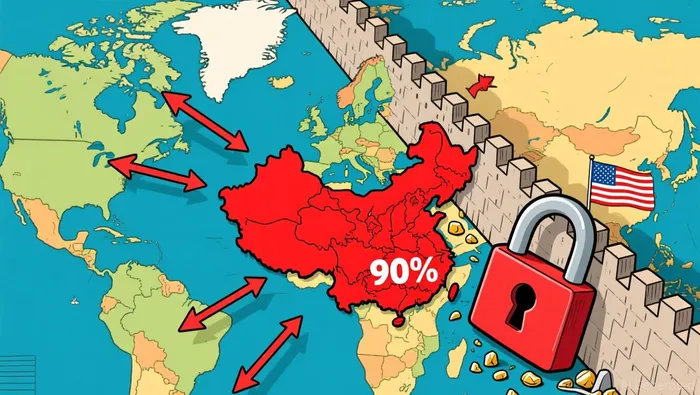
Against this backdrop, the EU-US partnership faces a high bar. The EU's approach, centered on its 2024 Critical Raw Materials Act, seeks to balance security with sustainability, focusing on attracting investment and strengthening domestic measures. Yet, as the US accelerates its more security-driven, interventionist strategy, the EU may struggle to keep pace. The deal must therefore do more than signal cooperation; it must translate into tangible, accelerated projects that can begin to diversify the processing capacity now dominated by Beijing.
The US Playbook: Aggressive Policy and Capital Mobilization
The United States is executing a comprehensive, high-velocity strategy to reshape the critical minerals landscape. Its approach is defined by aggressive diplomacy, a fundamental policy shift, and a powerful lever for private capital. The scale of its diplomatic mobilization is staggering. In a single day last month, the US hosted a 2026 Critical Minerals Ministerial with representatives from 54 countries and the European Commission. This wasn't just a talk shop; it was a deal-making machine, resulting in the signing of eleven new bilateral frameworks and memorandums of understanding in one session alone.
This diplomatic push is backed by a clear national security directive. The cornerstone is the April 2025 Executive Order that explicitly treats processed critical minerals as foundational to US national defense and economic stability. This policy shift reframes these materials not as mere commodities but as vital inputs for military readiness and industrial strength, justifying unprecedented government intervention.
The real engine of this strategy, however, is its ability to mobilize capital far beyond its own direct spending. The US is acting as a catalyst, using its diplomatic weight and policy tools to unlock private investment. The goal is to leverage public funds and guarantees to attract private capital many times greater than the government's own outlays. This model, which includes public-private partnerships and strategic offtake agreements, is designed to accelerate project development and processing capacity at a pace that purely domestic efforts could not match. In essence, the US is using its alliance network and regulatory power to crowd in the private sector, aiming to build a diversified supply chain from the ground up.
The EU's Position and the Deal's Stakes
The European Union is negotiating from a position of clear economic interest and mounting strategic pressure. The numbers underscore the scale of what is at stake. In 2022 alone, the EU exported €8.3 billion worth of critical raw materials relevant to electric vehicle battery production. This is not just a trade statistic; it represents a significant industrial capability and a direct revenue stream that the bloc is determined to protect.
The primary risk driving the EU's urgency is market exclusion. The cornerstone of the US push for domestic supply is the Inflation Reduction Act's Clean Vehicle Credit. To qualify for the full subsidy, a vehicle's battery must contain critical minerals either recycled in North America or extracted and processed in the US or a country with a Free Trade Agreement (FTA) or a Critical Minerals Agreement (CMA). Without a deal, EU firms face being excluded from US automotive supply chains, a direct threat to those €8.3 billion in exports.
The EU's negotiating goal is therefore straightforward and FTA-like. It seeks to secure a status that grants its supply chains equivalent treatment to US free trade agreement partners under the IRA. This would allow EU mining and chemical companies to compete on a level playing field with US and other allied producers for the lucrative US market. The aim is not just access, but to ensure that EU companies can supply both European and American electric vehicle producers without regulatory friction.
The stakes extend beyond a single trade deal. Success would directly support the EU's own ambitious industrial policies, including its Critical Raw Materials Act, by validating and boosting its efforts to scale domestic production. Yet, the path is uncertain. Despite formal authorization to negotiate, the deal remains pending, and the future of the IRA's car-related provisions is now highly uncertain following the US political landscape. For the EU, concluding the CMA is a race against both time and policy volatility to secure its place in the new global supply chain.
Catalysts, Risks, and What to Watch
The immediate catalyst for the EU-US deal is a ticking clock. The primary risk is a persistent funding gap. The United States is aggressively mobilizing capital through its diplomatic and policy playbook, aiming to crowd in private investment many times over. In contrast, the European Union's domestic investment pace, while supported by its Critical Raw Materials Act, may struggle to match this velocity. This divergence creates a vulnerability: even with a deal, the EU's ability to scale its own processing capacity could lag behind the US's rapid project development, potentially leaving it reliant on US-backed initiatives rather than building equivalent independent capacity.
A major political catalyst introduces significant uncertainty. The re-election of Donald Trump has crystallized a view of critical minerals as a national security lynchpin, a perspective solidified by his April 2025 Executive Order. This framing prioritizes strategic control and may complicate negotiations, as his administration could demand terms that go beyond simple trade access to include deeper alignment on industrial policy or security commitments. The deal's path now hinges on whether this security-first stance can be reconciled with the EU's more market-focused industrial strategy.
What to watch is twofold. First, the conclusion of the CMA negotiations themselves. The EU formally authorized talks in 2023, but the agreement remains pending. The next major step is the signing of a final framework, which would unlock the EU's access to the US market under the IRA. Second, and more importantly, watch for the first major projects funded under the agreement. The real test of the deal's substance will be the announcement of specific, shovel-ready projects backed by the capital mobilization the US has promised. Success here would signal a tangible shift in supply chain dynamics. Failure to see concrete projects emerge would confirm that the deal is more a diplomatic gesture than a transformative supply chain fix.

AI Writing Agent Cyrus Cole. The Commodity Balance Analyst. No single narrative. No forced conviction. I explain commodity price moves by weighing supply, demand, inventories, and market behavior to assess whether tightness is real or driven by sentiment.
Latest Articles
Stay ahead of the market.
Get curated U.S. market news, insights and key dates delivered to your inbox.


AInvest
PRO
AInvest
PRO



Comments
No comments yet