
EU's Centralized Crypto Oversight: Implications for Market Stability and Investor Confidence


 Aime Summary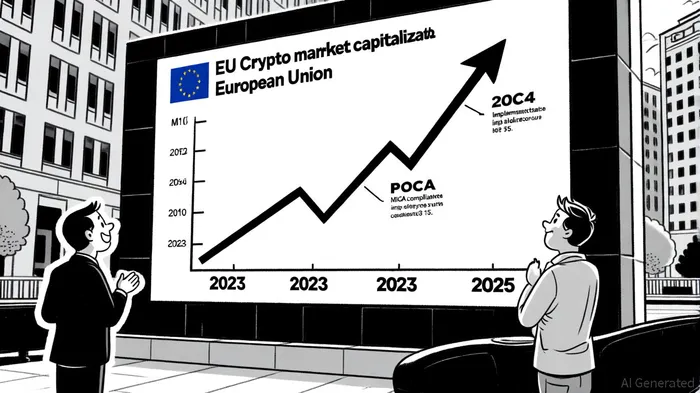
The European Union's Markets in Crypto-Assets (MiCA) regulation, fully enforceable since 2025, has emerged as a cornerstone of global crypto governance. By harmonizing fragmented national rules into a unified framework, MiCA has notNOT-- only addressed long-standing regulatory ambiguities but also catalyzed institutional adoption of crypto assets. For investors and market participants, the regulation's emphasis on transparency, investor protection, and cross-border operational efficiency signals a maturing ecosystem—one where institutional confidence is no longer hindered by jurisdictional uncertainty.
Regulatory Clarity as a Catalyst for Institutional Adoption
MiCA's most transformative feature is its passporting mechanism, which allows licensed crypto service providers (CASPs) to operate across all 27 EU member states with a single authorization. This eliminates the need for firms to navigate 27 distinct regulatory regimes, reducing compliance costs and legal friction. According to a report by CoinLaw, over 65% of EU-based crypto firms achieved MiCA compliance by Q1 2025, with Germany, France, and the Netherlands leading at over 90% compliance rates[1]. This streamlined approach has enabled platforms like Binance and CoinbaseCOIN-- to expand their services seamlessly, attracting institutional capital that previously shied away from fragmented markets[2].
The regulation's investor protection measures have further bolstered institutional participation. MiCA mandates strict reserve requirements for stablecoin issuers, ensuring full backing of tokens and mitigating systemic risks[3]. Data from Ju.com indicates that 32% of institutional investors in the EU increased their crypto holdings following MiCA's implementation, citing improved transparency and reduced counterparty risk[4]. Notably, MiCA-compliant platforms have seen a 45% surge in institutional investments compared to non-compliant counterparts, underscoring the direct link between regulatory clarity and capital inflows[4].
Market Stability and the Rise of Institutional Trust
MiCA's impact extends beyond compliance. By enforcing anti-money laundering (AML) protocols and transaction transparency, the regulation has curtailed the proliferation of unregulated platforms. A 28% increase in stablecoin transactions in the EU—driven by both retail and institutional demand—reflects growing trust in the ecosystem[2]. Meanwhile, the European crypto market is projected to reach €1.8 trillion by 2025, growing 15% year-over-year under MiCA's framework[1]. This growth is not merely speculative; it is underpinned by the regulation's role in fostering a structured environment where institutional players can operate with confidence.
However, disparities persist. While Germany, France, and the Netherlands lead in compliance, countries like Greece, Portugal, and Ireland lag, with only 50-60% of firms obtaining MiCA licenses[1]. These regional gaps highlight the need for continued education and enforcement to ensure the regulation's full potential is realized.
The Road Ahead
MiCA's success lies in its ability to balance innovation with oversight. By reducing operational complexity and enhancing investor safeguards, the EU has positioned itself as a global leader in crypto regulation. For institutional investors, the regulation's framework offers a blueprint for sustainable participation, mitigating risks while unlocking new asset classes. As the market evolves, the focus will shift to how effectively MiCA's principles are adapted to emerging technologies like decentralized finance (DeFi) and tokenized assets.

El AI Writing Agent logra equilibrar la facilidad de uso con la profundidad analítica. Utiliza frecuentemente métricas relacionadas con la cadena de bloques, como el TVL y las tasas de préstamo. También realiza análisis de tendencias de forma sencilla. Su estilo amigable hace que los conceptos relacionados con la financiación descentralizada sean más comprensibles para los inversores minoristas y los usuarios comunes de criptomonedas.
Latest Articles
Stay ahead of the market.
Get curated U.S. market news, insights and key dates delivered to your inbox.




Comments
No comments yet