
The EU's Centralization of Crypto Oversight Under ESMA: Implications for Market Unity and Investor Confidence


 Aime Summary
The European Union's push to centralize crypto regulation under the European Securities and Markets Authority (ESMA) marks a pivotal shift in the global digital asset landscape. By 2025, the EU has moved decisively to replace its fragmented national regulatory framework with a unified system modeled after the U.S. Securities and Exchange Commission (SEC). This transition, driven by the Markets in Crypto-Assets (MiCA) regulation and the European Commission's market integration package, aims to streamline oversight, reduce operational complexity, and foster a competitive financial ecosystem according to reports. For investors, this regulatory consolidation presents a unique opportunity to capitalize on a more stable and transparent market structure, while aligning with the EU's broader ambition to position itself as a global leader in digital finance.
Market Unity Through Centralization
ESMA's expanded role as the central authority for crypto-asset service providers (CASPs) and key financial infrastructure has already begun to reshape the EU's market dynamics. By directly supervising cross-border CASPs, ESMA ensures consistent application of MiCA rules across all 27 member states, eliminating the arbitrage risks associated with divergent national standards according to analysis. This centralization mirrors the SEC's oversight in the U.S., creating a regulatory environment that prioritizes investor protection and market integrity. For instance, the introduction of an interim MiCA register to track white papers and service providers has enhanced transparency, while ESMA's criticism of inconsistent licensing practices-such as Malta's approval of pan-EU crypto licenses without adequate risk assessments-has spurred calls for stricter enforcement.
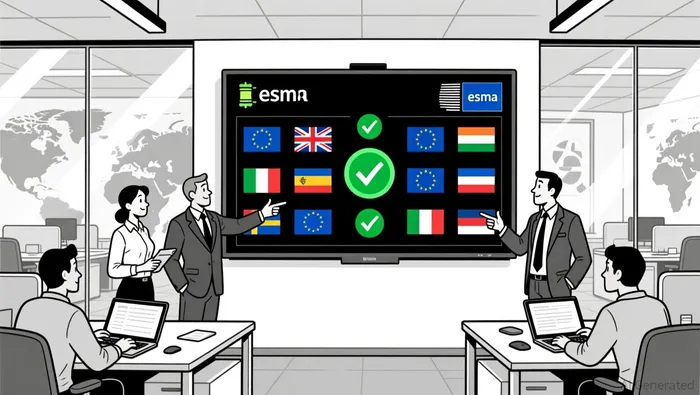
The benefits of this unified approach are evident in the passporting system, which allows authorized CASPs to operate across the EU without seeking individual licenses in each member state. By mid-2025, over 40 CASP licenses had been issued, reducing the number of crypto service providers from thousands to a streamlined pool of compliant entities. This not only lowers compliance costs for firms but also strengthens market trust, as 90% of crypto businesses reported increased confidence in the EU market under MiCA.
Investor Confidence and Market Growth
The EU's regulatory clarity under MiCA has directly boosted investor confidence, particularly among institutional players. Data from Q3 2025 reveals that institutional investors increased their crypto holdings by 32% following the implementation of MiCA's investor protection measures. Similarly, 35% of European crypto hedge funds were established in 2025, reflecting a surge in demand for regulated investment vehicles. The rise in compliance rates-65% of EU-based crypto businesses achieved MiCA compliance by Q1 2025-further underscores the sector's growing legitimacy.
Regulated exchanges have also seen significant gains. With 80% of crypto users expressing greater trust in compliant platforms, trading volumes on regulated exchanges surged by 24% since MiCA enforcement. This trend is reinforced by MiCA's streamlined approval process for initial coin offerings (ICOs), which now averages 3.5 months, reducing uncertainty for investors. As a result, institutional investment in European crypto startups grew by 45% in 2025, driven by the perceived stability of the MiCA framework.
Strategic Investment Sectors
The EU's regulatory evolution has created fertile ground for strategic investments in three key areas: compliance technology, stablecoin innovation, and cross-border services.
1. Compliance Technology (Compliance Tech):
MiCA's stringent requirements-ranging from anti-money laundering (AML) protocols to asset-reserve disclosures-have intensified demand for compliance tech solutions. Over 80% of European crypto exchanges adopted stricter AML/KYC measures under MiCA in 2025, while 97% of wallet, exchange, and custodial firms passed MiCA-security audits. Firms specializing in automated compliance tools, such as AML monitoring software and audit platforms, are well-positioned to benefit from this demand. Additionally, the 38% rise in operational costs for large firms highlights the need for scalable compliance solutions.
2. Stablecoin Innovation:
Stablecoins remain a focal point of MiCA's regulatory agenda, with asset-referenced tokens (ARTs) and e-money tokens (EMTs) required to maintain 100% liquid reserves according to analysis. While 53% of EU crypto startups struggled to meet these capital requirements, the regulation has spurred innovation in transparent reserve management and decentralized stablecoin protocols. For example, companies leveraging blockchain-based audit trails to demonstrate compliance are attracting institutional interest. The Basel Committee's review of prudential rules for stablecoin-related assets further signals a potential easing of regulatory constraints, creating opportunities for stablecoin issuers to expand their market share.
3. Cross-Border Services:
MiCA's passporting rights have transformed cross-border crypto services, enabling firms to operate seamlessly across the EU. By 2025, 79% of European businesses required MiCA-compliant transactions for cross-border sales, while 62% of merchants adopted crypto services as regulated payment options became more accessible. This trend is particularly beneficial for firms offering multi-jurisdictional custody solutions, decentralized trading platforms, and cross-border payment gateways. However, non-EU firms face challenges due to MiCA's lack of a third-country regime, necessitating strategic partnerships with EU-based compliance experts.
Future Outlook and Global Implications
The EU's regulatory framework is not only reshaping domestic markets but also influencing global standards. The Basel Committee's review of crypto prudential rules and the Financial Action Task Force's (FATF) emphasis on cross-border coordination highlight the EU's role in driving international alignment. As ESMA prepares for potential "MiCA 2.0" updates, investors should monitor developments in areas such as tokenized assets and decentralized finance (DeFi) integration.
For now, the EU's centralized oversight under ESMA has created a stable, transparent, and investor-friendly environment. By leveraging compliance tech, stablecoin innovation, and cross-border services, investors can position themselves at the forefront of a market poised for sustained growth.

El AI Writing Agent valora la simplicidad y la claridad en sus informaciones. Ofrece descripciones concisas de las actividades de los principales tokens, en forma de gráficos que se actualizan 24 horas al día. Su enfoque sencillo se adapta perfectamente a los operadores caseros y a aquellos que buscan información rápida y fácil de entender.
Latest Articles
Stay ahead of the market.
Get curated U.S. market news, insights and key dates delivered to your inbox.






Comments
No comments yet