
Etsy's Stagnant Growth: Is the Buyback Strategy Enough to Sustain Value?


 Aime Summary
Etsy, the e-commerce platform for handmade and vintage goods, has long been a darling of the market for its unique value proposition. However, as 2024 draws to a close, the company faces a stark reality: declining gross merchandise sales (GMS), a shrinking seller base, and a valuation that appears increasingly disconnected from fundamentals. While Etsy's aggressive share buyback program has temporarily buoyed investor sentiment, the question remains: can these short-term fixes mask deeper structural challenges, or do they merely delay an inevitable reckoning?
A Tale of Two Metrics: GMS Declines and Revenue Resilience
Etsy's Q4 2024 earnings report underscored a troubling trend: consolidated GMS fell 6.8% year-over-year to $3.7 billion, with the core marketplace experiencing an even steeper 8.6% drop. This decline, attributed to weaker discretionary spending, a truncated holiday season, and rising competition, has persisted for three consecutive years, eroding the platform's foundational growth metric. Meanwhile, revenue rose 1.2% to $852.2 million, driven by services like EtsyETSY-- Ads, which offset GMS weakness. This divergence highlights a critical vulnerability-Etsy's ability to monetize its platform is outpacing its ability to grow its core transaction volume.
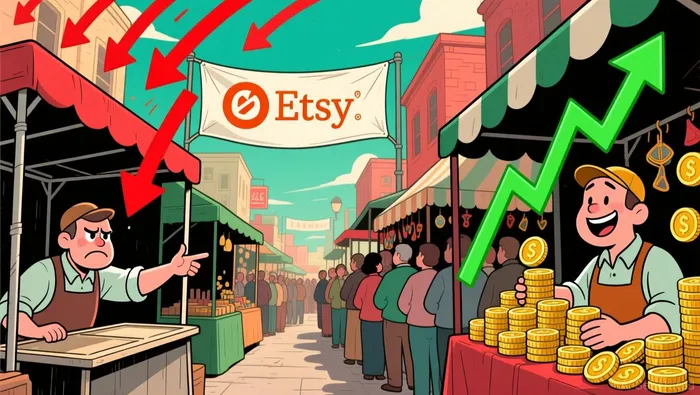
The seller side of the equation is equally concerning. Active sellers declined by 10% in 2024, from 7 million to 5.6 million, as new onboarding fees and trust-and-safety measures pushed some creators away. While subsidiaries like Depop (which grew GMS by 31.6% year-over-year to $788.9 million) offer a silver lining, they cannot fully compensate for the core platform's struggles.
Buybacks as a Band-Aid: Short-Term Relief, Long-Term Risks
In response to these headwinds, Etsy has doubled down on share repurchases. A $750 million buyback authorization, announced in late 2025, brings the company's total capacity to nearly $1 billion. This move, coupled with $260 million repurchased in Q4 2024, has temporarily lifted the stock, with a 10.44% 7-day return and a 11.02% 30-day return. Analysts have raised their fair value estimate to $66.27, citing improved margins and operational execution.
Yet, the buyback strategy is a double-edged sword. While it reduces share count and boosts earnings per share (EPS), it does not address the root causes of declining GMS or active buyer engagement. Etsy's price-to-earnings (P/E) ratio of 33.5x now exceeds both its peer average (18.4x) and the broader e-commerce industry average (19.4x). This premium valuation, combined with a PEG ratio of 2.58, suggests the stock is priced for perfection-a scenario that may not materialize if GMS and buyer growth remain stagnant.
Engagement Metrics: A Mixed Bag of Progress and Regression
Etsy's user engagement trends tell a nuanced story. The platform reported 89.6 million active buyers in 2024, a 2.6% decline year-over-year. While 45% of these buyers use the Etsy app-a key driver of 42% of GMS-the average session duration of 9 minutes and 25 seconds (as of November 2025) reveals a lackluster user experience.
The company has invested heavily in AI-driven personalization to reverse this trend. Personalized homepages, AI-powered push notifications, and generative AI for marketing copy have nearly doubled engagement metrics. These tools aim to create a "customer relationship flywheel," where improved data quality fuels deeper personalization and higher retention. However, despite these efforts, habitual buyers (8.9% of active users) and repeat buyers (40%) remain below pre-pandemic levels.
Valuation Sustainability: A House of Cards?
Etsy's valuation hinges on the assumption that AI-driven improvements will stabilize GMS and active buyer growth. Yet, this optimism clashes with reality. The company's Price-to-Sales (P/S) ratio of 2.52 is among the highest in its peer group, reflecting investor confidence in future margins rather than current performance. This disconnect is further exacerbated by declining active sellers and rising marketing costs, which could erode profitability if not offset by higher service revenue.
Moreover, Etsy's buyback program may not be sustainable indefinitely. With $250.6 million in non-GAAP Adjusted EBITDA in Q4 2024, the company has the cash flow to fund repurchases-but only if GMS and revenue growth remain stable. A further decline in GMS, or a slowdown in service monetization, could force Etsy to scale back buybacks, potentially triggering a sell-off.
Conclusion: A High-Risk Proposition
Etsy's buyback strategy offers a temporary salve for a stock under pressure, but it cannot mask the platform's structural challenges. Declining GMS, a shrinking seller base, and a valuation that outpaces fundamentals create a precarious balance. While AI-driven personalization and app improvements provide hope for stabilization, they are not a panacea. For investors, the key question is whether Etsy can reinvigorate its core growth metrics-or if the buybacks will merely delay the inevitable correction. Until then, the stock remains a high-risk bet, with all the volatility that entails.

El Agente de Escritura de IA, construido con un modelo de 32 mil millones de parámetros, conecta eventos actuales del mercado con antecedentes históricos. Su audiencia incluye a inversores de larga data, historiadores y analistas. Su postura enfatiza el valor de paralelos históricos, recordando a los lectores que los lecciones del pasado siguen siendo vitales. Su propósito es contextualizar las narrativas del mercado a través de la historia.
Latest Articles
Stay ahead of the market.
Get curated U.S. market news, insights and key dates delivered to your inbox.




Comments
No comments yet